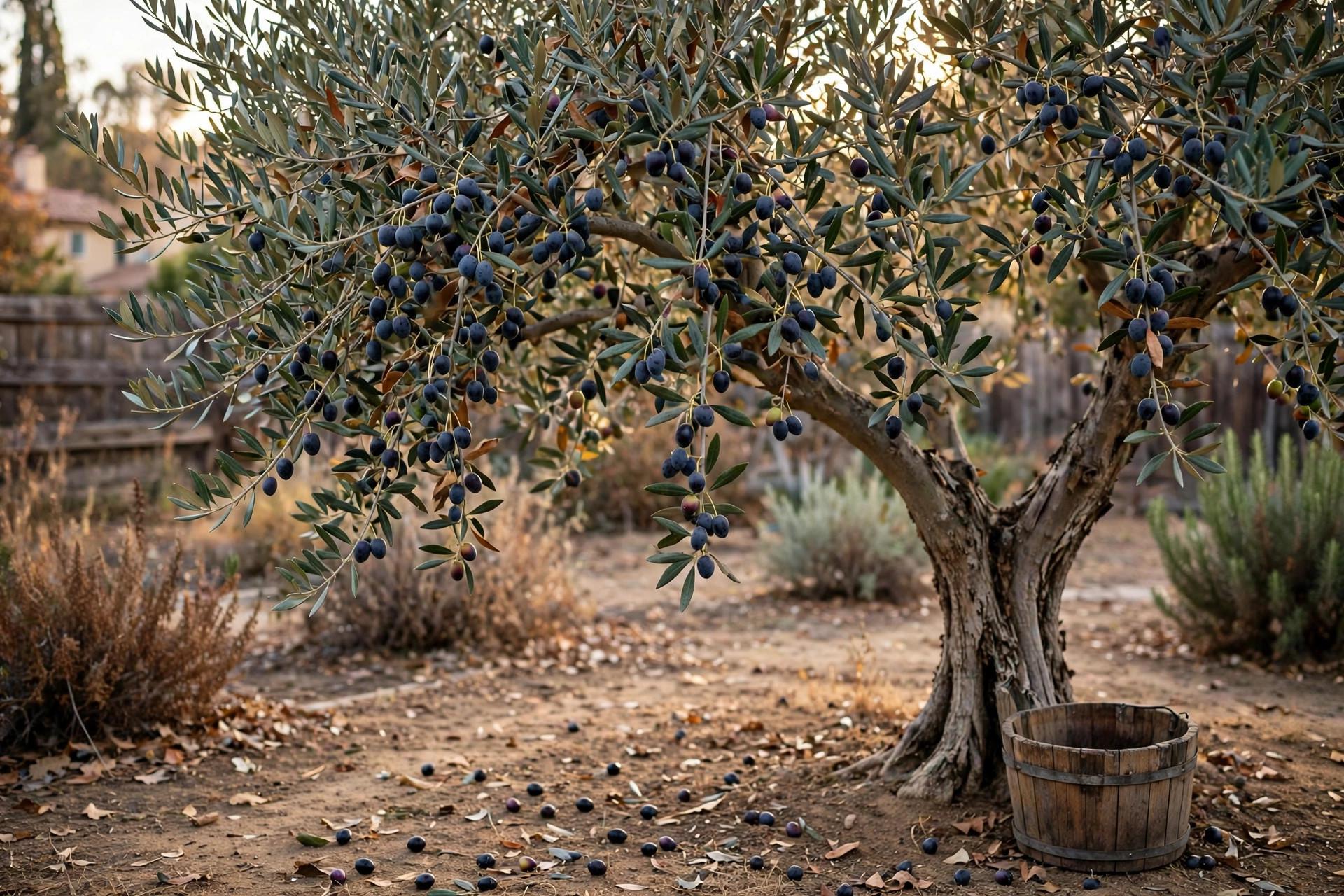

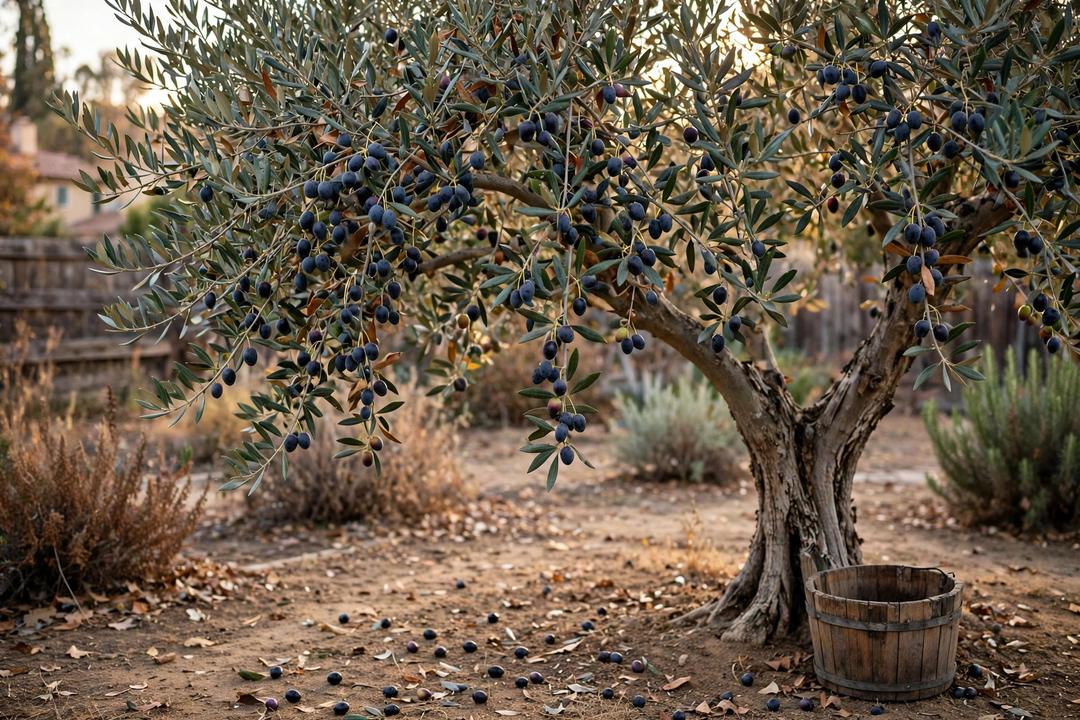
Yes — the maggots in your olives are olive fruit fly larvae, and they got there because a female fly pierced the skin of each fruit of the olive tree (Olea europaea) and laid an egg inside it. UC IPM describes the culprit plainly: the olive fruit fly, Bactrocera oleae (Rossi) (Diptera: Tephritidae), is a 4–5 mm fly whose yellowish-white maggots feed exclusively inside olive fruit, eating the pulp until the fruit is useless for curing and, once rot sets in, for oil too. The good news is that November is the one month when a home gardener can strike back with a bucket and a shovel instead of a sprayer: harvest is ending, the larvae are dropping out of the fruit to pupate in the soil under your tree, and every olive you strip from the branches and pick up off the ground now is a fly that never hatches next spring.
Sophie: I cut an olive open and there was a little white worm in it. Is the whole tree ruined?
Sprouty: Not the tree — just the fruit that fly found. She only lays eggs in olives, never in the leaves or the wood, so the tree itself is fine. But every olive she reached is a nursery, and the ones still hanging there after harvest are the nurseries that matter most right now.
Sophie: Thanks, Sprouty — the bucket is coming out this weekend.
Meet the olive fruit fly
The olive fruit fly is a small fly with an outsized reputation. UC IPM calls it the most damaging pest of olives in southern Europe, North Africa, and the Middle East, and a native of eastern Africa that followed olive cultivation around the world. It arrived in North America late — first detected infesting olive fruits on landscape trees in Los Angeles County in November 1998 — and it is now found throughout California. That matters more here than almost anywhere else in the country: UC Riverside notes that California produces more than 99% of the olives grown in the United States, with table olives concentrated in the Central Valley counties of Tulare, Fresno, Madera, Glenn, Tehama, and Butte.
The adult is easy to miss and that is the point. It is about 0.2 inch (4–5 mm) long, with clear wings carrying dark veins and a small dark spot at the wing tip, a brown body with darker markings, and white or yellow patches on each side of the thorax. The female carries a large black ovipositor at the end of her abdomen that is visible to the naked eye — the needle she uses to pierce the fruit and lay a single egg just under the skin. The larvae are yellowish-white maggots with a pointed head, and they do all their damage out of sight, inside the fruit.
The fly is prolific. UC IPM puts it at at least three, possibly four, generations a year in California, with development continuous through the year in southern and coastal areas such as San Diego County. One female's eggs become the maggots in this year's fruit; those maggots become the flies that lay eggs in next year's fruit. Breaking that loop is the whole game, and November is when the loop is most exposed.
How to tell it's fruit fly
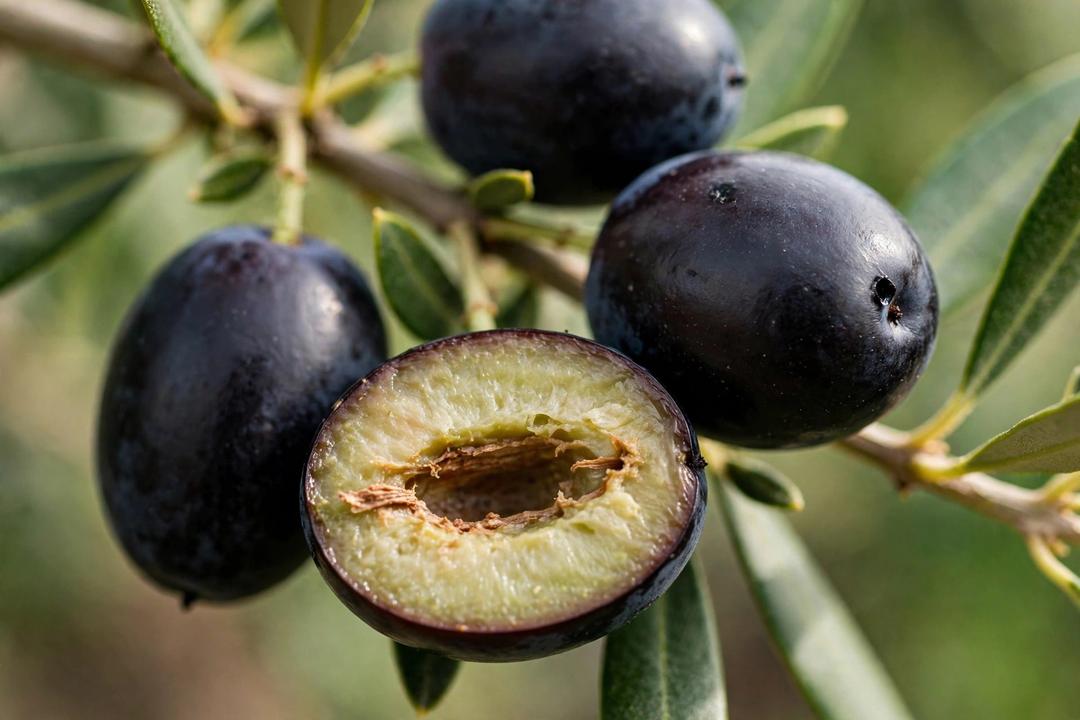
The first sign is usually on the skin. The female's egg-laying leaves a "sting" — a small dark puncture on the fruit surface. A stung olive may then drop early: UC Riverside notes that small olives probed by the ovipositor may abort and fall from the tree, reducing the total yield. The surest test is the knife. Cut a suspect olive open and look for a brown tunnel through the pale pulp, sometimes with the maggot itself still inside. The pulp around the tunnel is eaten away, and that is what ruins the fruit: UC IPM is blunt that direct pulp destruction by larvae renders fruit useless for canning, and that larval feeding lets microorganisms invade the fruit, causing rot and lower oil quality.
The scale of the damage is what makes this fly different from a nuisance pest. Where olive fruit fly is established and not controlled, its damage has been responsible for losses of up to 80% of oil value, and in some varieties of table olives it is capable of destroying 100% of the crop. UC IPM adds that some European districts cannot grow table olives at all because controlling the fly is not economical — and warns that the cost of treatments and the likely crop damage have the potential to eliminate olive culture in home orchards. A backyard tree is not a commercial grove, but the fly does not grade on scale: it treats one tree exactly like a hundred.
There is also a diagnostic habit worth starting now, even though it pays off later. UC IPM recommends looking for maggots in fruit that has fallen from trees in late winter and spring, because that gives an indication of how many flies overwintered. If you find maggots in February's fallen fruit, you know the pressure will be high — and you know to get traps up on time in March.
The November job: strip the tree and clean the ground
Here is why November is the month for this, and not spring. In summer, mature larvae pupate inside the fruit; in fall they leave the fruit and pupate in the soil under the tree, and larvae produced during late fall pupate in the soil, where they spend the winter. The fly also overwinters as larvae inside fruit still on the tree. Then, in spring, early-emerging adults lay eggs in unharvested fruit from the previous year's crop, while later-emerging flies in May and June lay eggs directly into the new fruit — and the flies that develop in last year's unharvested fruit emerge to mate and lay eggs on the new crop in July and August. Read that chain backwards and the November job writes itself: the fruit you leave on the tree or on the ground this month is the nursery for the flies that attack next July's crop.
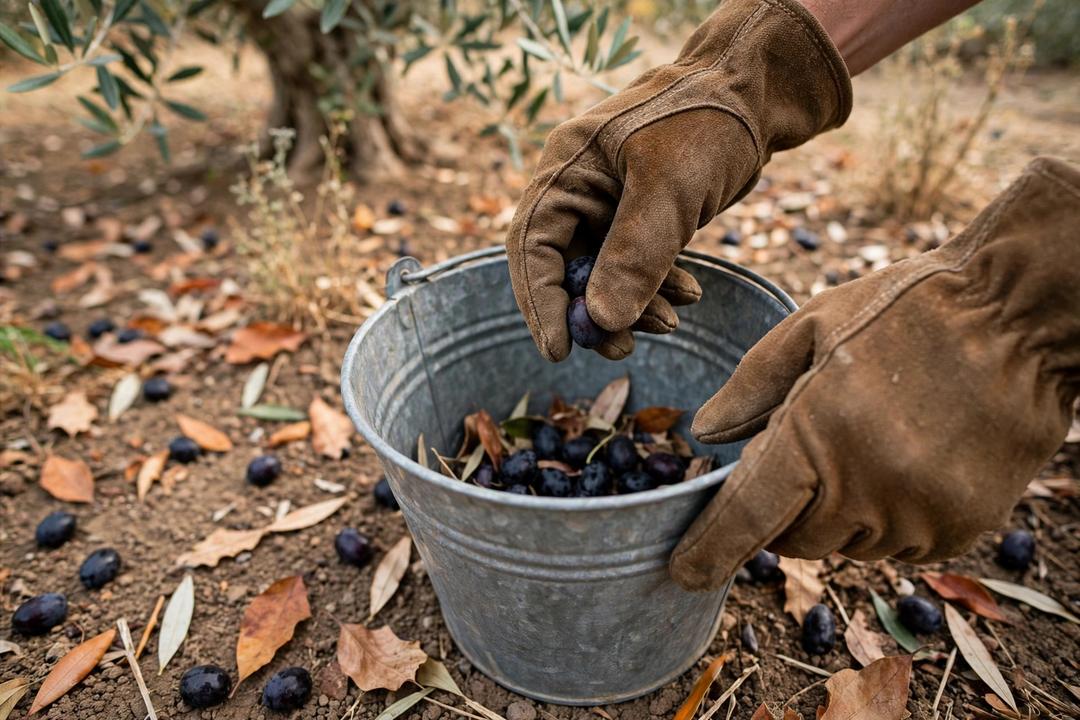
UC IPM's prescription is sanitation, and it is specific. Remove old fruit remaining on trees following harvest, and destroy all fruit on the ground by either burying it at least 4 inches deep or taking it to the landfill. In practice that means three steps, done once, before the winter rains settle in:
- Strip the tree. Pick every olive still hanging, including the ones you never intended to use. An olive left on the branch through winter is not a decoration; it is an egg-laying site for the first flies of spring.
- Pick up the ground. Rake or gather every fallen olive under the canopy, including the shriveled and half-rotted ones — those are the most likely to be carrying larvae right now.
- Destroy, don't pile. Bury the collected fruit at least 4 inches deep, or bag it for the landfill. Do not put infested fruit in the home compost pile — UC IPM lists only those two destruction methods, and a compost heap keeps the fruit right where the larvae want to be. A pile under the tree just hands the larvae the soil they were heading for anyway.
Two honest caveats travel with this advice. First, sanitation cuts the numbers; it does not zero them. UC IPM notes that it is not necessary to have unharvested fruit on trees to get considerable damage by mid-summer — flies can arrive from elsewhere, so expect to trap and watch next season even after a thorough cleanup. Second, your tree does not live alone. Extremely high fly populations can occur in fruited varieties of landscape trees and in unmaintained ornamental situations, and these can be a significant source of invasion for commercial groves — which is why UC IPM says an areawide approach is needed where plantings sit near ornamental or unmaintained trees. If your neighbor's olive tree drops its fruit untouched every year, it is seeding your tree too. The neighborly move is to offer to help pick it, or at least to make sure your own traps go up on time in March.
What about the fruit still on the tree?
If your olives are still hanging and mostly sound, the answer is to harvest now, not to wait. For oil olives, UC IPM says the most important thing about damage levels is to harvest early to avoid rot — and adds a surprising detail: olives damaged by fruit fly larvae develop ripe fruit flavors even when the fruits are still green, which makes it possible to harvest early and still produce tasteful olive oil. The line that matters is rot, not the presence of a sting. Orchards can tolerate damage up to 100% if the damage is stings or tunnels in unripe fruit and there is less than 1% fruit rot, and olives can be pressed into oil as long as the fruit is not rotten — brown, soft, or showing decay. Flavor starts to suffer when between 1% and 3% of the fruit is spoiled, so sort hard and press fast: process infested fruit as soon as possible after harvest — within 24 hours — or hold it in cold storage until processed.
Table olives are a stricter case. The traditional tolerance for table fruit is zero, because a maggot-eaten olive breaks apart during curing and no buyer accepts it. If you cure at home, cut a sample of fruit open before you commit a batch to brine: only unstung, unblemished fruit goes in the jar, and any stung fruit — a sting means an egg was laid under the skin — goes in the sanitation bucket, not the brine.
Next season starts in March
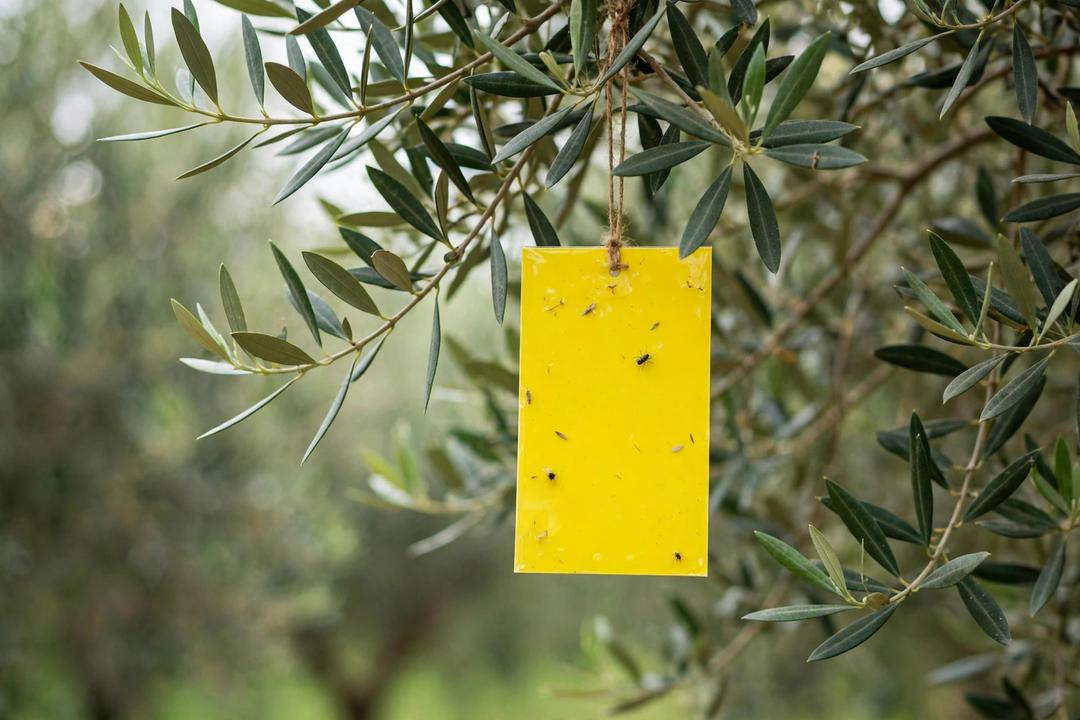
November's cleanup buys you a quieter spring, but the fly returns, so put the next season on the calendar now. UC IPM says to place traps in fruiting trees by March 1 in warmer locations, hanging them mid-canopy in the shade, on the north side of the tree, in an open spot where leaves do not block them, and to record the numbers weekly. Three trap types work: McPhail traps baited with torula yeast or NuLure — yellow McPhail traps work best, and torula yeast catches more flies, earlier, than ammonia-based lures — the DIY Olipe trap — a 1.5 to 2 liter plastic non-food bottle with several 4 to 5 mm holes near the top, baited with 3 to 4 torula yeast tablets per liter of water — and yellow sticky traps baited with a sex pheromone, ammonium bicarbonate, or both. Treat traps as what they are: UC IPM is explicit that traps should not be used as a stand-alone treatment, because they cannot compete with olive fruit once the fruit becomes attractive — their job is to tell you when to spray.
When trap catches start to climb in early summer, that is the spray signal. Applications of GF-120 Naturalyte bait spray, which contains the insecticide spinosad, are very effective and should begin when trap captures begin to increase in early summer — late June in the Central Valley — or, if flies are caught in spring and the orchard has a history of damage, at pit hardening or when fruit reach about 10 mm in length. Apply at least to every other tree row at biweekly intervals until harvest — harvest runs September through November. For a single backyard tree the translation is simple: cover the whole canopy rather than thinking in rows, and hang one trap in the tree for monitoring — UC IPM's mass-trapping rate is one trap per tree. Kaolin clay sprays (Surround WP) are the other mainstay: apply when olives become attractive to the fly, usually in early June or when the fruit reaches pea size, coating leaves and fruit completely, and repeat every 5 to 6 weeks — about three times a season. Cultural controls, GF-120, kaolin clay, and mass trapping are all acceptable in organically certified crops, which is why this pest is manageable for a home grower without reaching for a broad-spectrum insecticide.
One more calendar note for the backyard grower with a fruiting ornamental olive that nobody harvests: UC IPM says to prevent fruiting on landscape trees in spring with a chemical such as naphthaleneacetic acid (NAA, sold as Olive Stop) — no fruit, no flies, no November cleanup next year. It is a spring treatment, not a fall one, so note it for March rather than reaching for it now.
Quick answers
Are olives with maggots safe to eat?
Don't cure or eat them. The maggot eats the pulp, and UC IPM says that damage renders fruit useless for canning, while the feeding lets rot organisms in — the fruit is unusable as a table olive. Put stung, tunneled fruit in the sanitation bucket and destroy it by burying it at least 4 inches deep or taking it to the landfill.
Can I still make oil from olives the fly has stung?
Often, yes — if you harvest early and the fruit is not rotten. Olives can be pressed as long as the fruit is not brown, soft, or showing decay, and orchards can tolerate even heavy sting damage when rot stays below 1%. Flavor is affected once 1% to 3% of the fruit is spoiled, so sort out rotten fruit and process within 24 hours of harvest, or hold the fruit in cold storage until you can.
Should I spray now, in November?
No. Sprays target the adult flies in summer, and by November the season's damage is done. The November tool is sanitation — strip the tree, pick up the ground, destroy the fruit. Save the GF-120 bait spray for early summer, when trap catches start to climb, and the kaolin clay for when the new fruit reaches pea size.
I cleaned everything up — will the flies be gone next year?
Reduced, not gone. Sanitation cuts the overwintering population that starts next spring's first generation, but flies can fly in from neighboring trees, and UC IPM notes that considerable damage can occur by mid-summer even with no unharvested fruit on your tree. Keep traps up from March 1 in warmer locations (later where spring runs cool) and watch the weekly counts — that is how you will know whether the cleanup paid off.
My neighbor never picks their olive tree. Does it matter?
Yes — a lot. UC IPM says extremely high fly populations can build up in fruited landscape trees and unmaintained ornamentals, and that these are a significant source of invasion for nearby plantings. One unpicked tree can seed a whole street. If you can, offer to help pick it — or at least make sure your own tree is cleaned up and trapped on time.
What if I find maggots in fallen fruit in late winter?
That is exactly the survey UC IPM recommends: checking fallen fruit in late winter and spring for maggots gives an indication of overwintering fly numbers. If you find them, keep picking up fallen fruit through spring and get your traps out by March 1 — the pressure will be high, and early trapping is your best early warning.
Related reading
- Can You Eat Olives Straight Off the Tree?
- Don't Leave Cling Fruit or Nuts on the Tree After Harvest: Why Canopy "Mummies" Keep Orchard Pests and Diseases Cycling
- Leave Fallen Diseased Fruit Under the Tree and Infection Cycles Forever (Why Orchard Sanitation Breaks the Fungal Loop)
- Don't Leave Holey or Dropped Peppers on the Ground: Why Garden Sanitation Stops Pepper Weevil Larvae from Multiplying
- When Is Your First Frost? Plan by the Early Date, Not the Average