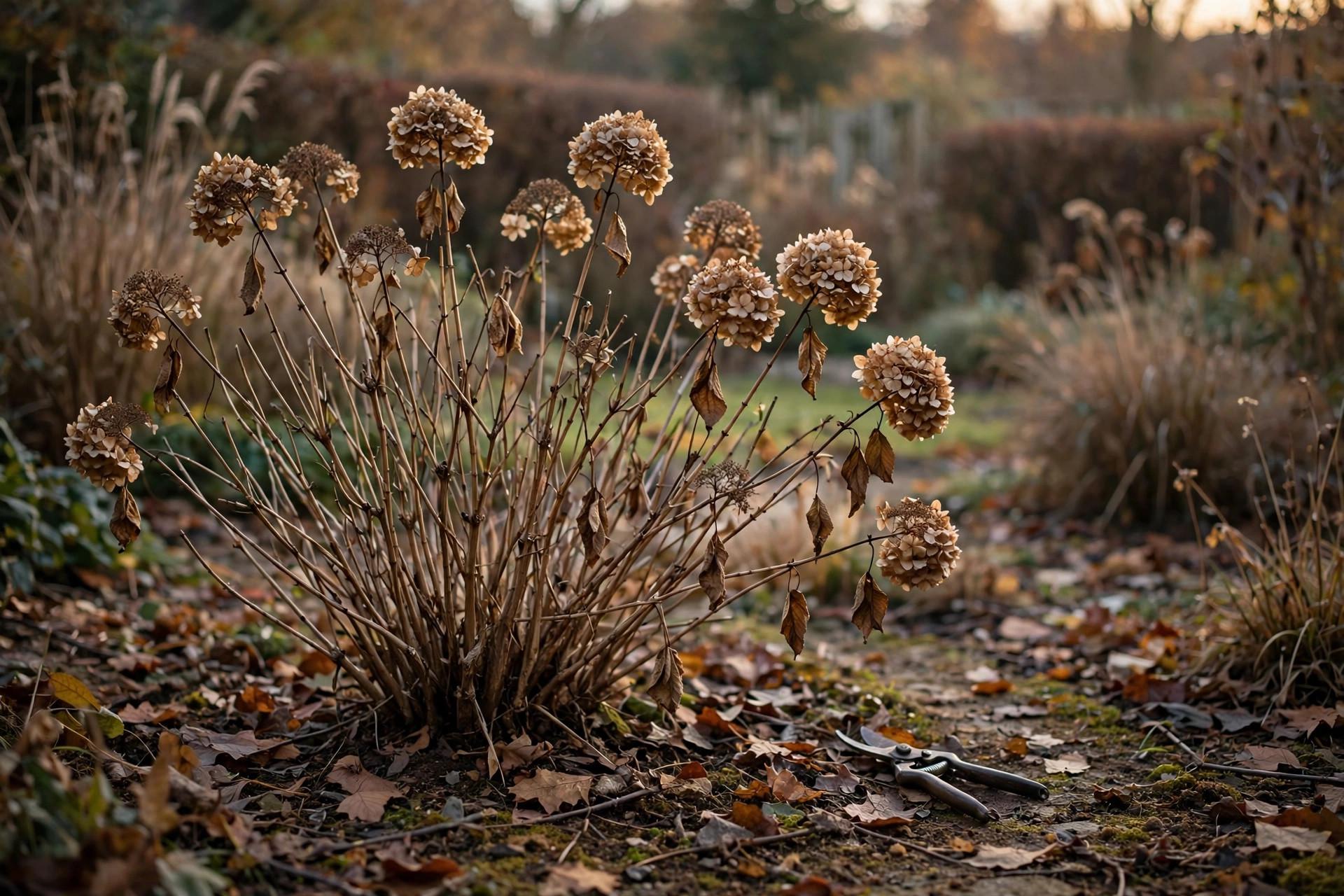

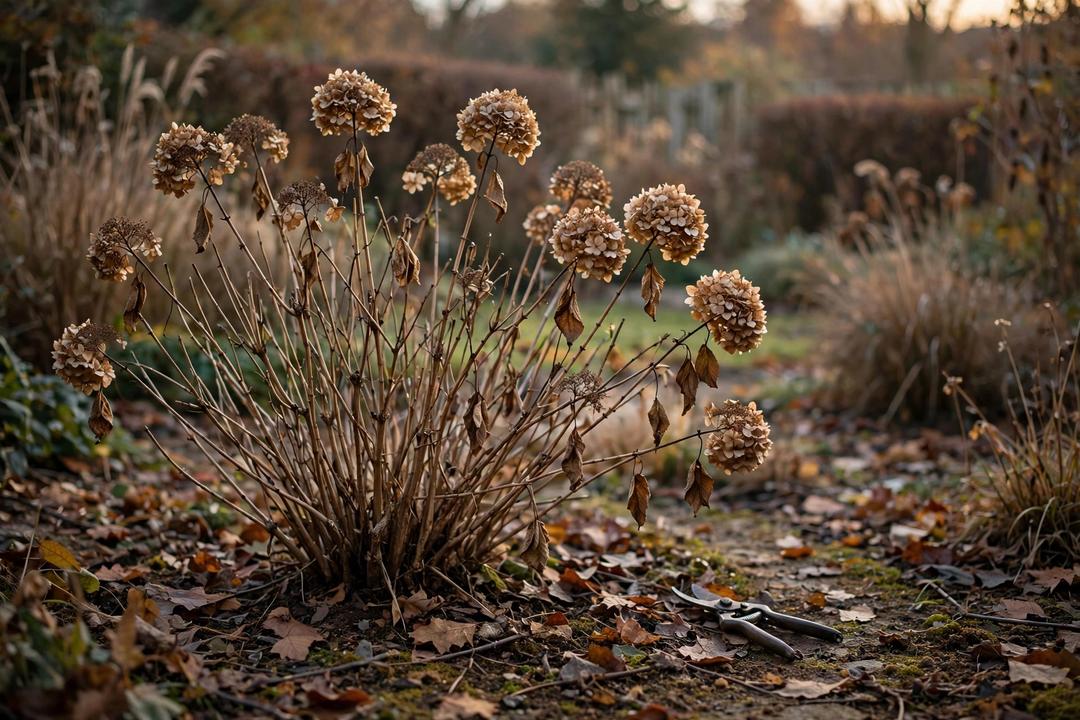
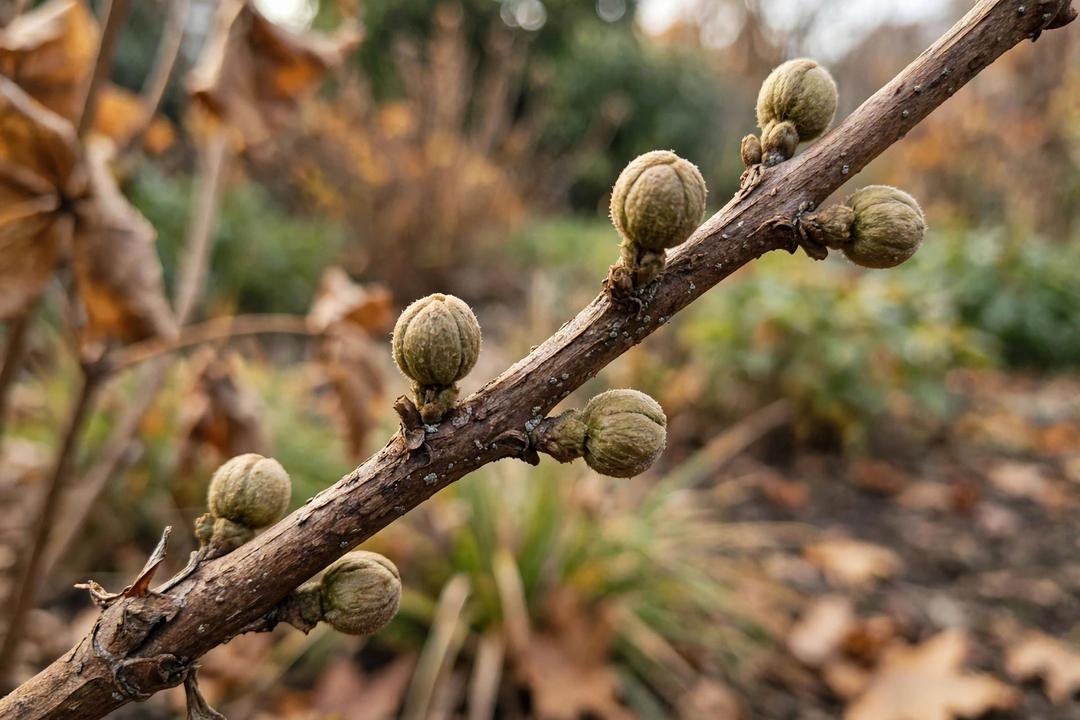
Usually, no. Most hydrangeas already carry next summer's flower buds on their bare stems in November, and cutting them back now deletes next summer's flowers — those buds can't be replaced. The University of Maryland Extension puts it bluntly: "Many hydrangeas cannot replace flower buds that were accidentally removed." Bigleaf, mountain, oakleaf, and climbing hydrangeas bloom on old wood — growth at least a year old — and they form their flower buds during the summer and autumn before those flowers open. The buds lie dormant on the stems all winter. Cut the stems in fall, and you have cut off next year's bloom. The exception is the two types that bloom on new wood — smooth and panicle hydrangeas — and even those are pruned in late winter or early spring, not in fall.
Sophie: My hydrangea looks dead — bare sticks and brown flower heads. Surely I should cut it back before winter?
Sprouty: Those bare sticks are holding next summer. The buds are already on them, asleep. Cut now and you get a lovely green bush next year — with no flowers on it at all, if it's a bigleaf.
The 30-second check: old wood or new wood?
Everything about hydrangea pruning comes down to one question: does your shrub bloom on old wood or new wood? Old wood is branch growth at least one year old — all the branches present before the shrub breaks dormancy in spring. Hydrangeas (family Hydrangeaceae) that bloom on old wood develop their flower buds during the summer and autumn the year before those flowers open, and the buds lie dormant on the stems through winter, according to the University of Maryland Extension. New wood is growth produced in the current season; hydrangeas that bloom on new wood form their flower buds just before opening them, in spring or summer, so their overwintering stems carry no dormant flower buds at all.
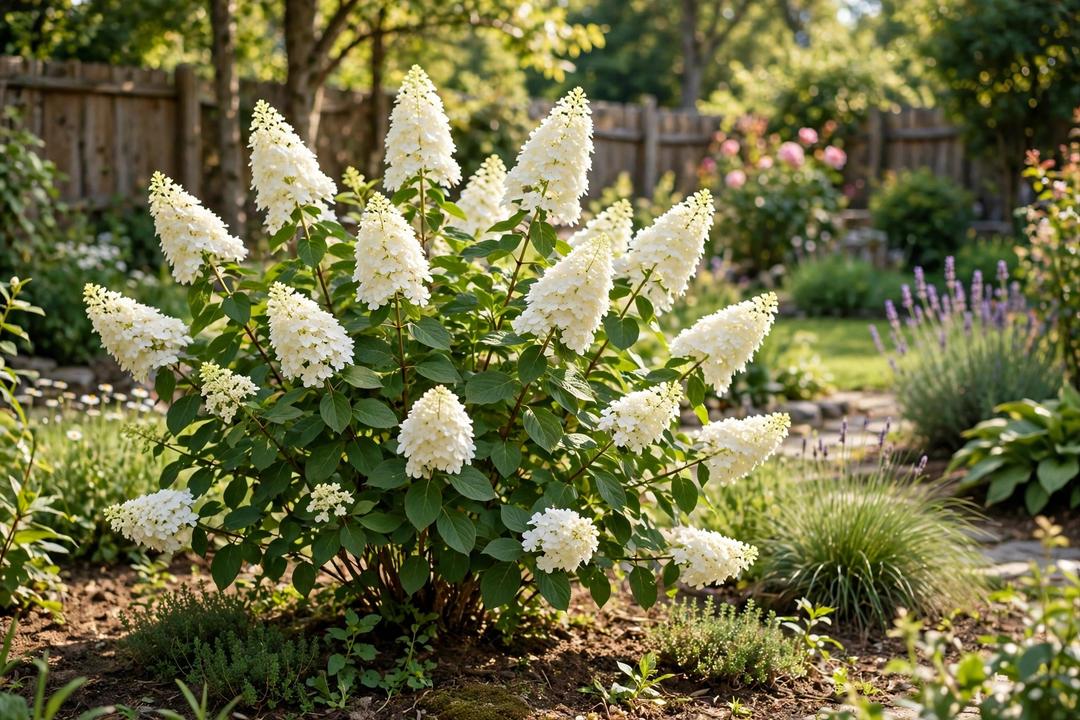
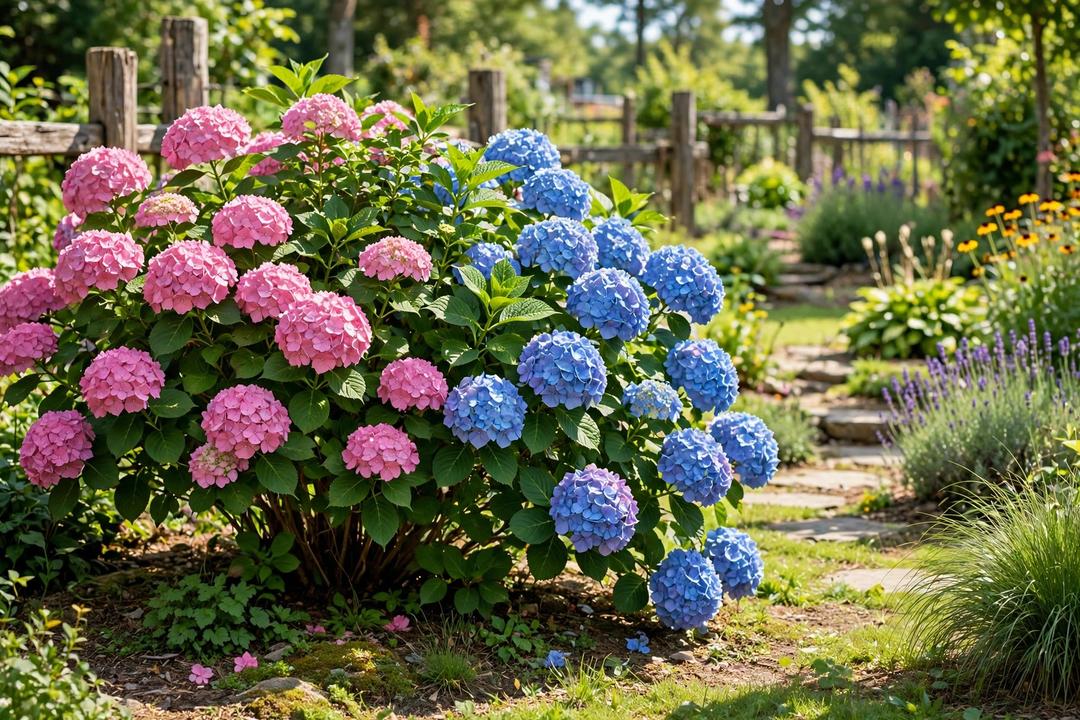
If you do not know which kind you have, the flowers tell you. For the month-by-month version by USDA zone, see our hydrangea pruning calendar. The only commonly grown hydrangeas that can produce blue or purple flowers are bigleaf (Hydrangea macrophylla) and mountain hydrangea (Hydrangea serrata), per Maryland Extension — if yours bloomed blue or purple, it is an old-wood type and the pruners stay in the shed. Oakleaf hydrangea (Hydrangea quercifolia) has unmistakable oak-shaped leaves. Panicle hydrangea (Hydrangea paniculata) carries cone-shaped flower clusters and is the last species to flower. Smooth hydrangea (Hydrangea arborescens, including the popular 'Annabelle') has round white flower heads in flat to roundish clusters.
| Hydrangea type | Blooms on | When to prune | Cut back in fall? |
|---|---|---|---|
| Bigleaf (H. macrophylla) — mophead & lacecap | Old wood | Just after flowers fade, in summer | No |
| Mountain (H. serrata) | Old wood | Just after flowers fade, in summer | No |
| Oakleaf (H. quercifolia) | Old wood | After flowering, in summer | No |
| Climbing (H. anomala subsp. petiolaris) | Old wood | Rarely pruned at all | No |
| Smooth (H. arborescens) — 'Annabelle' | New wood | Late winter or early spring | Wait — not fall |
| Panicle (H. paniculata) — 'Limelight', PeeGee | New wood | Late winter or early spring | Wait — not fall |
| Reblooming bigleaf (Endless Summer®, Blushing Bride®) | Both woods | Early spring, or after the first flush fades | Not needed |
Timing data: University of Maryland Extension and Iowa State University Extension.
Do not cut these in fall: bigleaf, mountain, oakleaf, climbing
Bigleaf and mountain hydrangeas should be pruned just after the flowers fade — in summer, not fall. Maryland Extension notes they can be trimmed to about 12 inches off the ground at that time, but the window is summer: by November the buds for next year are already set, and a fall cut removes them. Oakleaf hydrangea is pruned after flowering in summer and can be left taller, especially large-maturing varieties; Iowa State University Extension adds that oakleaf "performs best with minimal pruning" and that winter-damaged stems can be pruned out in spring after the new leaves emerge. Climbing hydrangeas are not routinely pruned at all, though they fall in the old-wood group.
There is a second reason to wait beyond the buds: Maryland Extension advises that pruning "still should be avoided close to winter dormancy" even when flowers are not a concern, because fresh cuts made as the plant shuts down are more vulnerable to winter damage. A hard fall cut on an old-wood hydrangea costs you twice — the flowers and the stem tips.
These can be cut — but in late winter, not fall
Smooth and panicle hydrangeas bloom on new wood, so a fall cut would not remove next year's buds — they do not exist yet. But the standard advice is still to wait. Maryland Extension says to prune smooth hydrangea in late winter or early spring, trimming to about 12 inches off the ground, and panicle hydrangea to the same height or taller. Iowa State University Extension notes smooth hydrangeas can be cut back to the ground in late winter or early spring, and panicle hydrangeas are reduced by selectively removing a few branches in March or early April, with rejuvenation pruning of large old shrubs — removing several of the largest stems near ground level — also done in late winter or early spring.
Why wait, if the buds are not at stake? Because pruning in late winter lets you see what actually survived. Winter cold and spring frosts kill some stems and buds; cutting in fall means guessing, and cutting in late winter means cutting with information. If a smooth or panicle hydrangea is genuinely in the way right now — blocking a path, for example — removing a stem or two in fall will not cost you flowers, but the real pruning still belongs in late winter — and keep it to a stem or two, only if truly necessary: UMD still advises avoiding cuts close to winter dormancy, since fresh cuts are more vulnerable to winter damage.
The exception: reblooming varieties
Some newer bigleaf cultivars — Endless Summer®, 'Blushing Bride', BloomStruck® — are remontant, meaning they produce flower buds on both old and new wood. The old-wood buds open first, since they were already fully formed at the start of the season, followed by new-wood flowers that keep forming into summer, according to Maryland Extension. That trait is a safety net: after a cold winter, these cultivars may die back to ground level but still bloom in late summer on the current year's growth, as Iowa State University Extension notes.
For rebloomers, Maryland Extension says to prune either in early spring or after the first flush of flowers has faded, removing as little wood as possible — early-season pruning delays the start of flowering, and mid-season pruning can shorten the reblooming window. A fall haircut on a rebloomer costs you the early-summer flush but not the whole season. That is the only hydrangea where a fall cut is a partial loss instead of a total one, and it is still not recommended.
What you CAN do in November
Putting the pruners down does not mean doing nothing. Four jobs are safe — and useful — right now:
- Dead-head the spent flowers. Snipping off only the faded flower at the branch tip — no further down the branch — can be done any time after flowers fade, for any hydrangea type, per Maryland Extension. It is cosmetic, not necessary for plant health, but if brown flower heads bother you, this is the safe way to remove them. Do not cut into the stem below the flower: that is where the buds live.
- Remove only stems that are unmistakably dead. A stem that is brittle, snaps cleanly, and shows no green under the bark in the standard scratch test is dead — as is anything broken or diseased — and can come off now. If you are unsure whether a stem is dead or just dormant, leave it: dormant old-wood stems look dead in November, and Iowa State advises waiting until the shrub begins to leaf out in spring, when dead stems are obvious, before pruning out dead wood.
- Thin only dead or damaged stems in fall. Thinning removes entire stems, so on bigleaf, mountain, and oakleaf hydrangeas every stem you remove in November takes its flowers with it. Do real thinning just after flowering in summer, when Maryland Extension says bigleaf and mountain types benefit most from the improved air circulation that lowers leaf-spot risk; in fall, limit thinning to stems that are clearly dead or diseased.
- Leave the spring cleanup for spring. In cold-winter areas, the smartest move is to wait until the shrub begins to leaf out, then prune out all dead wood — that is Iowa State's advice for bigleaf hydrangeas verbatim: "For maximum bloom, wait until the shrubs begin to leaf out before pruning." Once green growth appears, the dead stems are obvious and the live ones are not.
In frost-free climates hydrangeas may not go fully dormant — the old-wood/new-wood rule still holds, but winter dieback is less of a factor.
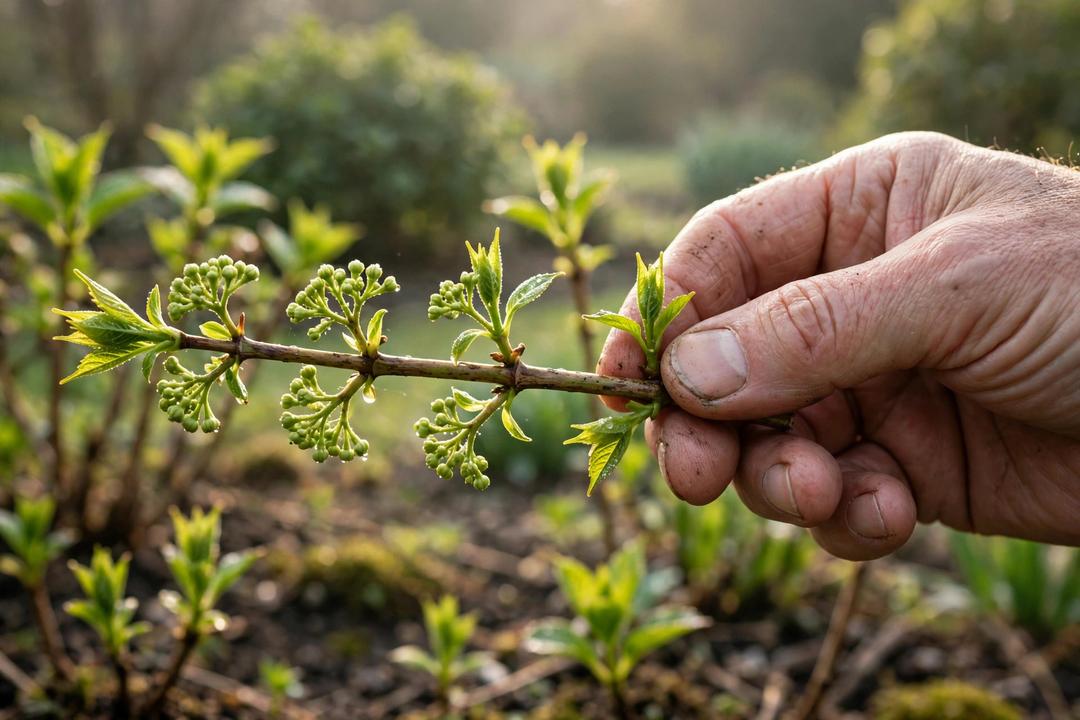
If you already cut it back
First, do not panic — and do not try to fix it with more cutting. The shrub will almost certainly leaf out and grow next year — Maryland Extension notes that renewal pruning costs flowers for a year or longer while the plant recovers, which implies regrowth, not death. What you have lost is one season of flowers on the stems you removed, not the plant. A renewal pruning — removing most of the old wood — can leave a shrub flowering poorly or not at all for a year or longer while it recovers, per Maryland Extension, so the cost is real but temporary.
What to do now: leave it alone. Next spring, let it leaf out fully before touching it again, and remove only the stems that never leafed out. If the shrub is a reblooming variety, you may still get late-summer flowers on new wood. And if the shrub is simply too big for its spot, remember Maryland Extension's alternative: rather than regularly pruning an overgrown hydrangea, transplant it or replace it with a variety that naturally stays more compact. Breeding has produced dwarf and compact varieties in every major species group, so a smaller shrub is often a better answer than an annual fight with the pruners.
Quick answers
Should I cut back hydrangeas in fall?
No, for most types. Bigleaf, mountain, oakleaf, and climbing hydrangeas bloom on old wood and already carry next year's flower buds in fall — cutting them now removes next summer's flowers. Smooth and panicle hydrangeas bloom on new wood, but they are pruned in late winter or early spring, not fall.
How do I tell what kind of hydrangea I have?
By the flowers. Blue or purple flowers mean bigleaf or mountain hydrangea (the only two species that produce them, per Maryland Extension) — both old-wood types. Oak-shaped leaves mean oakleaf. Cone-shaped white flower clusters mean panicle. Round white heads mean smooth ('Annabelle').
Can I at least remove the dead brown flower heads?
Yes. Dead-heading — snipping only the spent flower at the branch tip — is safe any time after flowers fade, for any hydrangea type, according to Maryland Extension. Just do not cut down into the stem below the flower, where the buds sit.
When should I prune a panicle hydrangea like 'Limelight'?
Late winter or early spring, before the leaves come out. Iowa State Extension says to selectively remove a few branches in March or early April; Maryland Extension says panicles can be pruned to about 12 inches or left taller.
My hydrangea didn't bloom this year. Was it the pruning?
Very possibly. Common causes of a leafy, flowerless hydrangea are pruning an old-wood type at the wrong time (fall or spring, removing the buds), winter cold killing the buds, or too much shade — UMD notes pruning may stimulate better flowering if the shrub is receiving enough light. If you pruned last fall and got leaves but no flowers this year, the pruning is the prime suspect — and the fix is to not prune again until just after flowering next summer.
What if I have a reblooming hydrangea like Endless Summer?
Rebloomers flower on both old and new wood, so a mistimed cut costs the early flush but not the whole season. Prune in early spring or after the first flush of flowers fades, and remove as little wood as possible, per Maryland Extension.