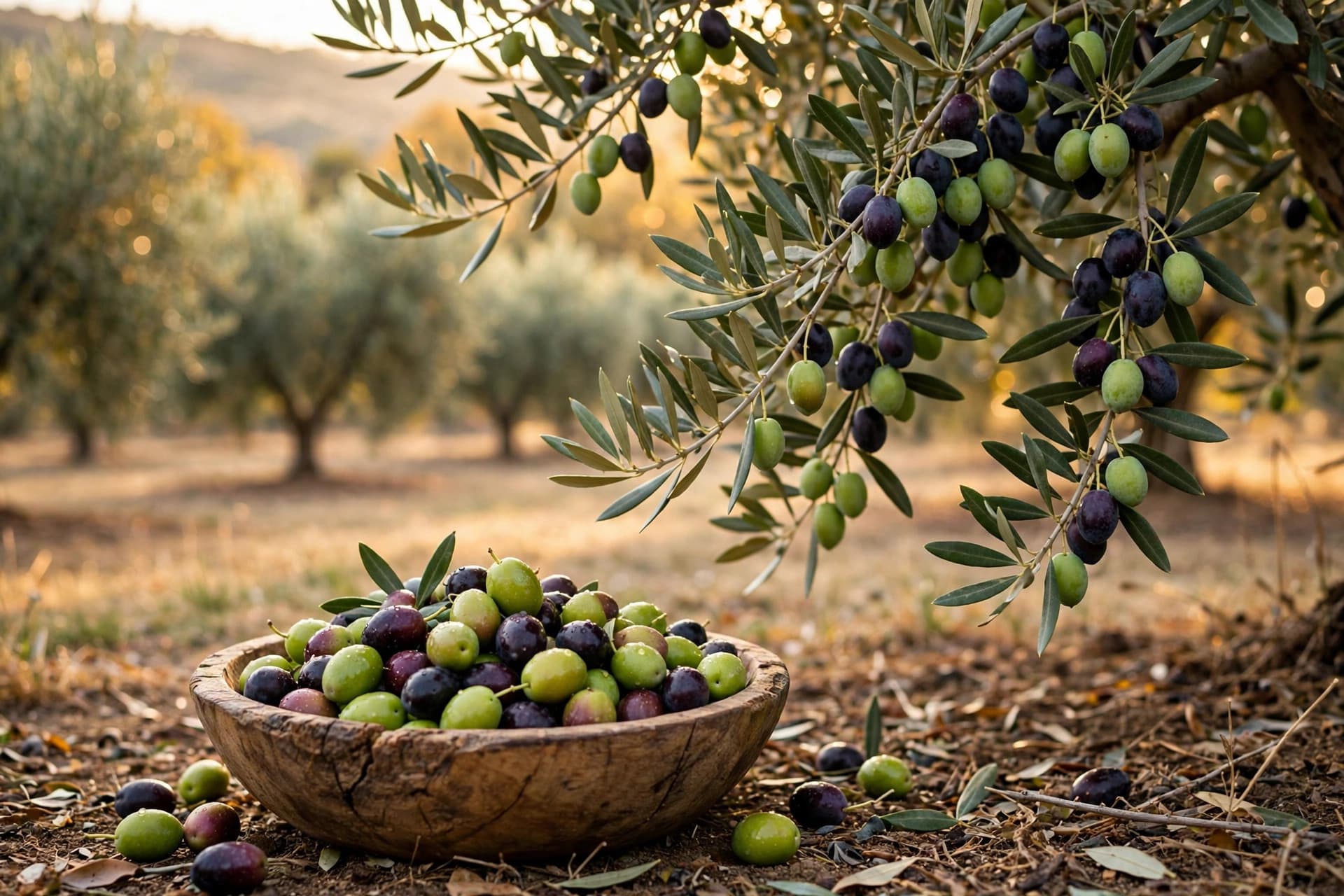

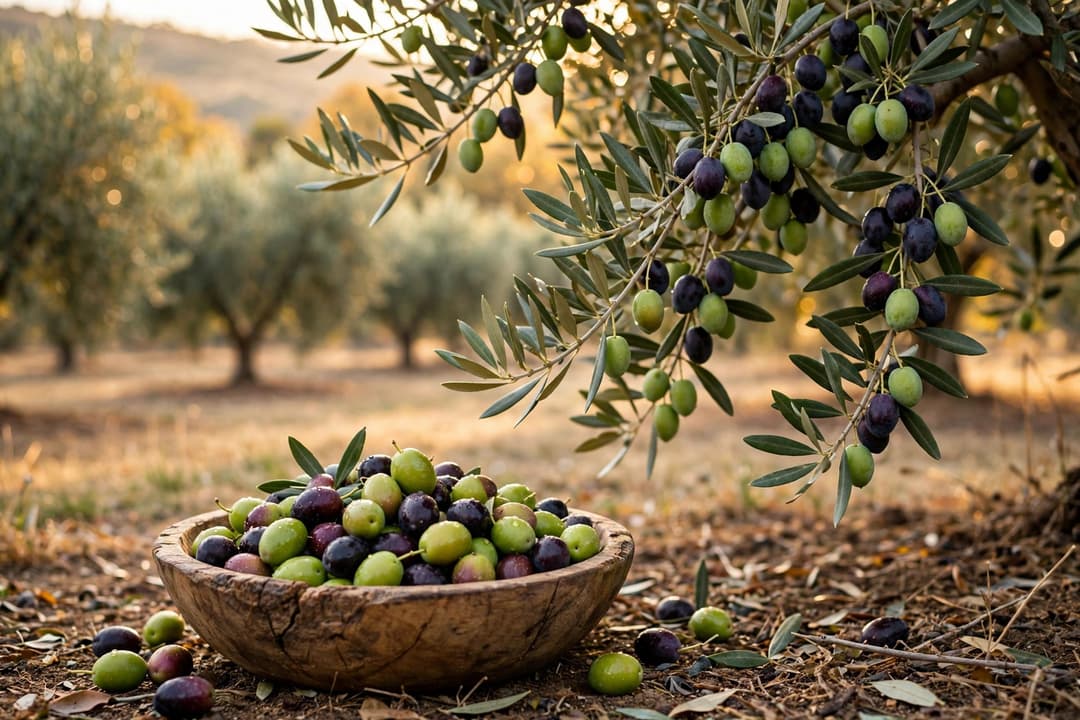
No — do not eat olives straight off the tree. A raw olive is inedibly bitter, and the bitterness is the whole story: the fruit contains oleuropein, a phenolic compound whose related forms — oleuropein aglycon and ligstroside aglycon — were among the most potent bitter tastants in olive oil in laboratory receptor tests (National Library of Medicine, 2021). One bite is usually enough to convince anyone: the taste is sharp, drying, and lingering. The fruit is not made to be eaten raw — it is made to be cured, and curing is the entire craft that turns it into the olive you know.
Sophie: (Reaching for a glossy black olive on the branch) "Sprouty, this one looks ripe — surely this one is ready to eat?"
Sprouty: "Ripe is not the same as ready, Sophie. Pick by colour, cure before eating, and follow a tested recipe — that is the whole job."
🫒 Takeaway: Do not eat olives raw. Pick them at the right colour, cure them before eating, and follow a tested UC recipe start to finish.
Why the tree makes them bitter
Think of oleuropein as a deterrent, not a flavour: it is a bitter phenolic compound that makes the fruit unpalatable to anything that might eat it, and human bitter-taste receptors respond to its related compounds more potently than to nearly any other compound in the fruit (National Library of Medicine, 2021). That is why "just try one" is a dare every orchard visitor regrets — and why a University of California Master Food Preserver, writing after her own first attempt, confirms olives are "terribly bitter straight from the tree and cannot be eaten that way" (UCCE Master Food Preservers of El Dorado County, 2017).
Importantly, ripeness does not fix it. Green and black olives are the same fruit at different points on the ripening arc — the University of California's Master Gardener guidance notes that black olives are fully ripe while green olives are picked earlier, and that either way the fruit must be cured or pressed soon after picking because raw olives do not store well (UC Agriculture and Natural Resources). A fully black olive is softer and less astringent-tasting than a hard green one, but it still requires curing. The one famous exception proves the rule: a few rare varieties, like Turkey's Hurma olives, naturally lose most of their oleuropein while still on the tree — researchers measured Hurma fruit below 2,000 mg/kg of oleuropein against 35,000 mg/kg in the same cultivar's bitter fruit (Grasas y Aceites, CSIC). Your backyard tree is almost certainly not one of them.
California's harvest runs mid-September through December
Olives are harvested at different stages of ripeness, and UC Agriculture and Natural Resources Publication 8267, Olives: Safe Methods for Home Pickling (June 2007), gives the calendar: the first mature green-ripe olives are ready in California starting in mid-September, and naturally black-ripe olives are harvested starting in mid-November and continuing through December, depending on variety, yield, region, and weather. Late October, then, is turning-colour season — fruit moving from yellow-green through rose to red-brown — not a single deadline week. Pick by colour and by use: green-ripe for firm table olives, fully black for mellow ones, anywhere along the arc for oil.
Is it ready? The squeeze test
Colour alone is not quite enough, and Publication 8267 gives two hands-on checks. A mature green-ripe olive, picked when evenly coloured from yellow-green to straw, releases a characteristic creamy-white juice when you squeeze it. A naturally black-ripe olive, dark red to purple or black, releases a reddish-black liquid when squeezed, and its flesh is nearly completely pigmented. Sort by ripeness before you start — different stages suit different cures — and select only freshly harvested, unbruised olives, handling them gently: bruised fruit will not survive curing well. Process within a few days of picking; if you must wait, hold the fruit cool rather than leaving it sitting warm, since UC postharvest guidance puts the optimum storage range at 41–45.5°F (UC Kearney Agricultural Research and Extension Center).
Before you cure, sort ruthlessly. The olive fruit fly — the most serious threat to fruit quality in California, per UC's Master Gardener guidance — lays eggs under the skin, and its larvae tunnel through the pulp (UC Integrated Pest Management). For olives processed into oil, UC IPM says fruit can still be used as long as it is not rotten, brown, or soft, and that infested fruit should be processed within 24 hours of harvest or held in cold storage (UC Integrated Pest Management). For table curing, apply the stricter version: discard any stung, brown, soft, or decaying fruit and follow a tested curing recipe — do not carry an oil-olive tolerance rule into a jar you plan to eat from.
Four ways to make them edible
Every curing method does the same job — leach out or break down the oleuropein — and UC ANR Publication 8267 covers all four: water, brine, dry salt, and lye. The method descriptions below follow that publication's approach; the exact steps, salt weights, and times for your batch must come from the tested recipe itself, not from this summary. Publication 8267 itself warns that food-preservation research is ongoing and recommendations may change, so check for current tested guidance before preserving.
Water curing (fastest, mildest). Crack or slit the olives to expose the flesh, then soak in fresh water changed daily over a week or more before a finishing soak in salted brine. The result is gentle and delicate, but it keeps the shortest time and needs refrigeration.
Brine curing (the classic). Submerge the olives in salt water and let slow fermentation do the work over weeks to months — a UC Master Food Preserver's own batch, started in heavy brine and finished in lighter brine, took several months before the olives were ready to eat (UCCE Master Food Preservers of El Dorado County, 2017). Follow the recipe's handling steps exactly, including keeping the fruit submerged as directed.
Dry salt curing (for ripe black olives). Pack fully ripe black olives in coarse salt, which draws out moisture and bitterness together over several weeks. The olives shrivel, wrinkle, and concentrate in flavour. This style is for fully ripe, non-green fruit only.
Lye curing (fastest, highest caution). A dilute food-grade lye (sodium hydroxide) solution breaks oleuropein down quickly — the method behind most canned black olives. The same UC Master Food Preserver batch spent about 12 hours in a lye-water solution, then was rinsed with fresh water several times a day for about a week, then stored in a light brine for about two weeks before eating (UCCE Master Food Preservers of El Dorado County, 2017). UC's Master Food Preserver safety rules are non-negotiable: use only 100% pure granulated food-grade lye — never drain cleaner or any product containing metal pellets — keep lye where children cannot touch it, never let it contact skin, and keep a solution of one cup vinegar to one cup water at hand to rinse skin on contact (UC Master Food Preservers). Beginners should start with water or brine.
When to throw a batch away
No curing guide is complete without a stop signal. If olives become moldy, soft, or bad-smelling at any stage, do not eat or taste them — discard the batch. That rule comes from Publication 8267's spoilage guidance, and it is the one rule with no exceptions: a questionable jar is never worth a taste test. Finished olives keep by the method you preserved them with — refrigerated in brine, or preserved by freezing, drying, or pressure canning according to Publication 8267's preservation table. For canning specifically, do not apply a bare time-and-pressure figure as universal: UC's Master Food Preserver guidance cites 60 minutes at 240°F (10 pounds pressure at sea level) for olives, but the tested recipe's jar size and altitude adjustments govern your batch (UC Master Food Preservers). If you are unsure about canning, cure a small batch and keep it refrigerated in brine instead.
What if your tree never fruits?
Some California gardeners have the opposite problem: an olive tree that drops nothing to cure. That is often by design. UC notes that fruitless varieties such as 'Swan Hill,' 'Majestic Beauty,' and 'Wilsoni' produce little or no fruit (UC Agriculture and Natural Resources) — they are planted as ornamentals and shade trees precisely so there is little fruit to deal with, and so they offer olive fruit fly almost nothing to infest. If your tree is one of these, there is nothing to cure and nothing wrong with the tree. If your fruiting tree drops fruit that nobody harvests, clear it up rather than leaving it to rot under the canopy: fallen fruit feeds the next generation of olive fruit flies.
Quick answers
Can you eat olives straight off the tree?
No. Raw olives are inedibly bitter because of oleuropein, and they are never sold or served as a raw snack. They must be cured — in water, brine, dry salt, or lye — before they are edible (National Library of Medicine, 2021; UCCE Master Food Preservers, 2017).
Are green and black olives different trees?
No — they are the same fruit at different ripeness. Green olives are picked earlier, black olives when fully ripe (UC Agriculture and Natural Resources). Both need curing.
When should I pick olives in California?
From mid-September (green-ripe) through December (naturally black-ripe), picking by colour and by use — not by a single deadline week. Green-ripe fruit releases creamy-white juice when squeezed; black-ripe fruit releases reddish-black liquid and is nearly fully pigmented inside.
How do I know when curing is finished?
By taste, per your tested recipe — not by a fixed day count. Brine fermentation takes weeks to months; a lye batch takes roughly a week of rinsing plus about two weeks in light brine in UC's documented home example (UCCE Master Food Preservers, 2017). Taste a single olive when the recipe says to check; if bitterness remains, keep curing.
How do I store finished olives?
By the preservation method: refrigerated in brine for short keeping, or frozen, dried, or pressure-canned for longer storage, following Publication 8267's preservation table. Canning times depend on jar size and altitude — use the tested recipe, never a bare time-and-pressure figure.
Can I cure olives with fly damage?
Only sound fruit. UC IPM's tolerance rule was written for olives processed into oil; for table curing, discard any stung, brown, soft, or decaying fruit and follow a tested recipe (UC Integrated Pest Management). If a batch turns moldy, soft, or bad-smelling, discard it without tasting.