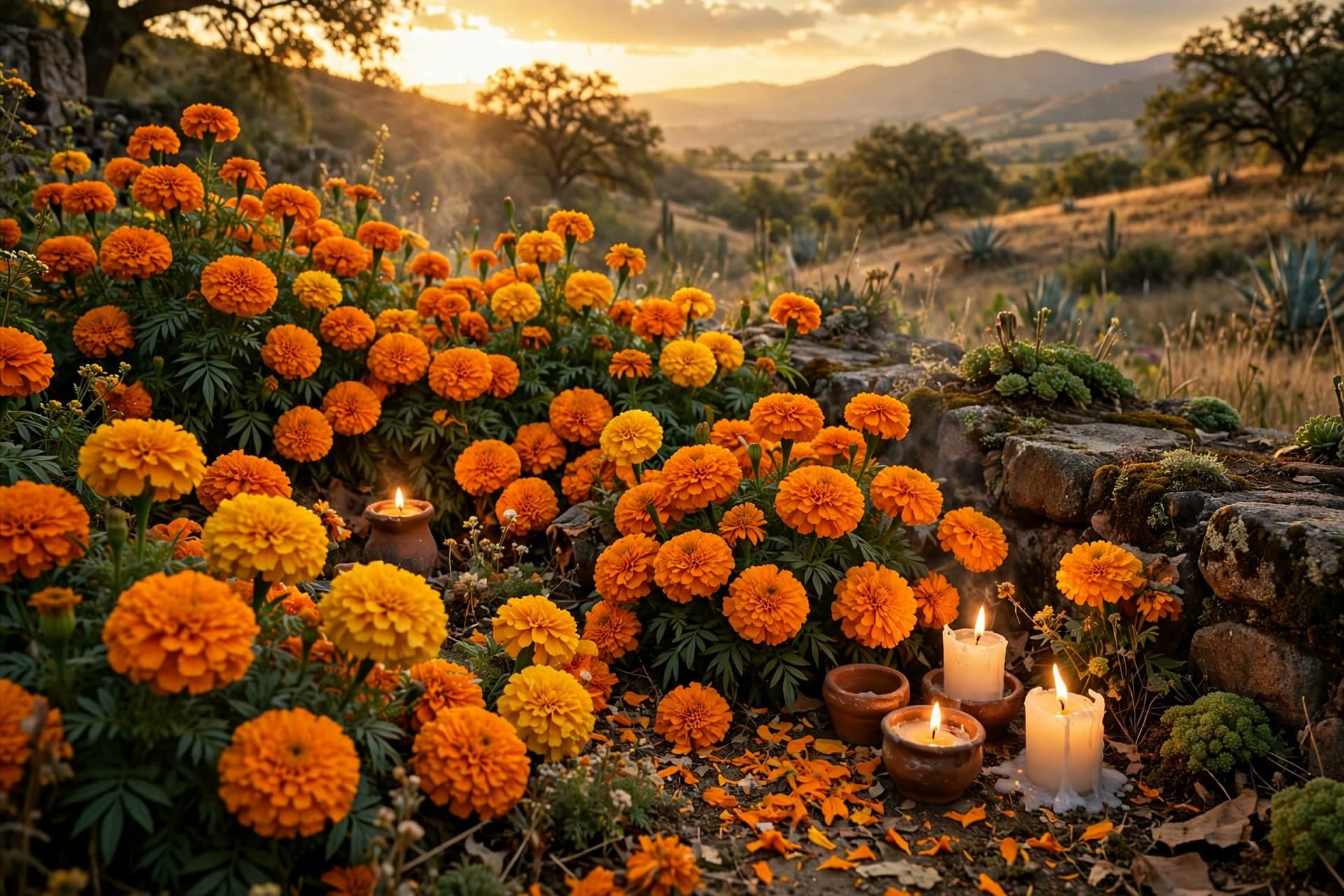

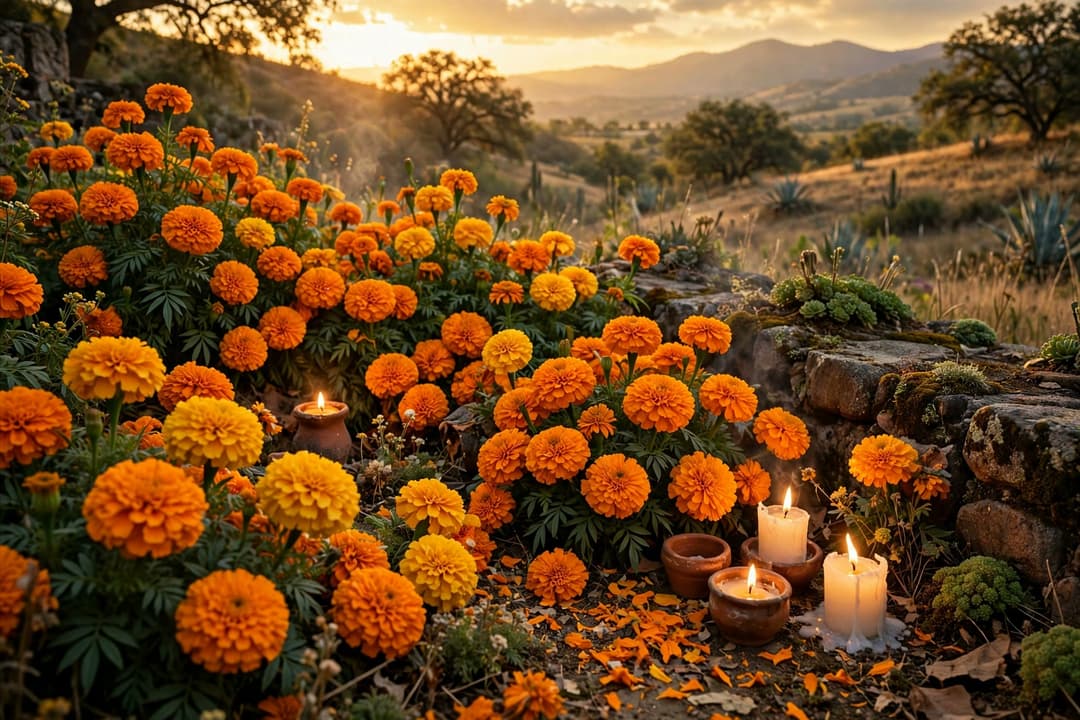
Marigolds are the flower of Día de los Muertos because, per tradition, their blazing orange-gold color and strong, musky scent guide the souls of the dead back to their families. The color is compared to the sun, the fragrance acts as a beacon, and families scatter the petals in paths from the front door or cemetery straight to the ofrenda so the returning spirits can follow them home (Thursd's October 2026 guide). That's why, with the holiday nine days out — November 1 for the children, November 2 for the adults (Thursd, October 2026) — the flowers are everywhere right now (Florists' Review's 2026 prep guide).
Important honesty note: this article covers documented tradition, not botany. The scent-and-color guiding the dead home is a belief held by the families who keep the holiday — not a scientific claim — and there is no law naming any flower the official one. In practice, as Thursd puts it, "no other flower is as closely tied to the holiday" as the cempasúchil (Thursd, October 2026).
Sophie: (Staring at the mountain of orange flowers at the market) "Sprouty, why marigolds? Of all the flowers, why did the dead pick the loudest one?"
Sprouty: (Holding up a bloom) "Because loud is the point, Sophie. The color is compared to the sun, and that strong musky scent is the beacon — the dead are expected back, and this is how they find the way. Families scatter the petals in a path from the door to the ofrenda. It's not decoration. It's directions."
🌼 Takeaway: Marigolds are Día de los Muertos' flower because, per tradition, their blazing color and strong scent guide returning souls home along a path of petals. Buy fresh cempasúchil now — and sow your own next spring for next year's ofrenda.
The spirit-guide story: color, scent, and a path of petals
The scent does the heavy lifting: Florists' Review notes that the flower's strong, musky scent is believed to guide the spirits of the dead back to their family's home, and that its brilliant color is believed to help spirits see in the dark (Florists' Review, October 2026). Case Western Reserve University describes marigolds as "believed to serve as the pathway to the mortal world," their vibrant appearance and strong fragrance guiding lost souls to their destinations (Case Western Reserve University). The color plays backup: the Mexica compared its bright orange and yellow color with the sun, which is why it ended up on their altars and in their burials (Thursd, October 2026). Both channels — sight and smell — converge on the ofrenda.
The petal path is the most physical expression of that belief. Families scatter marigold petals in a path from the cemetery or the front door to the ofrenda, so the spirits can follow it to their altar and back (Thursd, October 2026). UNESCO's own description of the celebration — inscribed on the Representative List of the Intangible Cultural Heritage of Humanity in 2008 — says families "facilitate the return of the souls to Earth by laying flower petals, candles and offerings along the path leading from the cemetery to their homes" (UNESCO Intangible Cultural Heritage). A California State Parks history piece adds that Mayan descendants in the Guatemalan mountains left trails of marigold petals from the graveyard to their houses (California State Parks, by Amy Lew). The dead are expected back, and the bright, fragrant trail is how they find the way home.
The name is a Nahuatl history lesson
The Spanish name cempasúchil comes from the Nahuatl cempohualxōchitl, literally "twenty flowers" — cempoa, "twenty," plus xōchitl, "flower" (California State Parks). The reference isn't a petal count to check on your bouquet: it's the profusion of ray florets packed into each bloom, and twenty was a number of completion in the Aztec counting system (Mexicolore). The Aztecs gathered the wild plant and cultivated it for medicinal, ceremonial, and decorative purposes — this wasn't a flower that entered the tradition recently (California State Parks). And note the botanical misnomer in the common name: the Aztec or "African" marigold is Tagetes erecta in the daisy family (Asteraceae), native to Mexico and Guatemala — not Africa (NC State Extension Plant Toolbox).
Buy the right marigold — and plant for next year
If you're shopping for an ofrenda, read the Latin on the tag. Texas gardening writer Greg Grant notes that Tagetes erecta — the Mexican or Aztec marigold — is the species most often used in the celebrations; Tagetes patula, the French marigold, is smaller (Florists' Review, October 2026). Both are native to Mexico and Guatemala, and both sit in the daisy family (NC State Extension, T. patula), but for the traditional petal-path look you want the big-flowered erecta types.
And here's the gardener's honest calendar: with November 1 nine days away, there is no time to grow flowers for this year's altar — buy fresh cempasúchil from growers, nurseries, and markets now, while they're in season. But any California gardener can grow next year's supply. NC State's extension guide says the plant grows best from seed started indoors six to eight weeks before the last frost date and set out after it; it does well in full sun, prefers evenly moist well-drained soil, and — the key for an October payoff — "spent flowers should be promptly deadheaded," because that keeps the long bloom season rolling through summer and fall (NC State Extension Plant Toolbox). Sow in spring, deadhead all summer, and the blooms peak exactly when the dead are expected home.
Quick answers
Why are marigolds the flower of Day of the Dead?
Per tradition, their blazing orange-gold color and strong, musky scent are believed to guide the souls of the dead back to their families. Families scatter the petals in paths from the door or cemetery to the ofrenda so the returning spirits can follow them home (Thursd, October 2026; Florists' Review, October 2026).
Is there an official flower of Día de los Muertos?
No law names one — but in practice it's the cempasúchil, the Mexican or Aztec marigold (Tagetes erecta), also called flor de muerto. No other flower is as closely tied to the holiday (Thursd, October 2026).
What does "cempasúchil" mean?
It comes from the Nahuatl cempohualxōchitl, "twenty flowers" — a reference to the profusion of petals in each bloom, with twenty as a number of completion. It is not a literal count (California State Parks; Mexicolore).
Can I grow cempasúchil in California?
Yes — it's an easy warm-season annual here. Start seed indoors six to eight weeks before the last frost, set plants out after it, give full sun and well-drained soil, and deadhead spent flowers to keep blooms coming through fall (NC State Extension). For this year's altar, buy fresh flowers; for next year's, sow in spring.
What's the difference between Aztec and French marigolds?
The Aztec or Mexican marigold (Tagetes erecta) is the tall, big-flowered species most often used in Day of the Dead celebrations; the French marigold (Tagetes patula) is a smaller, compact plant. Both are native to Mexico and Guatemala (Florists' Review; NC State Extension).