
The short answer: Tuberose releases fragrance in a daily rhythm, with scent emission peaking at night. Its flowers evolved to attract night-flying moths, so evening fragrance is part of its pollination story — a pattern confirmed by published research on scent emission in Polianthes tuberosa L. (PubMed 29036488). For gardeners, that means dusk is the best time to enjoy the blooms — from whatever distance feels comfortable.
Watch: Why Tuberose Smells Stronger After Dark
Sprouty and Sophie show what dusk does to tuberose fragrance — in under 15 seconds.
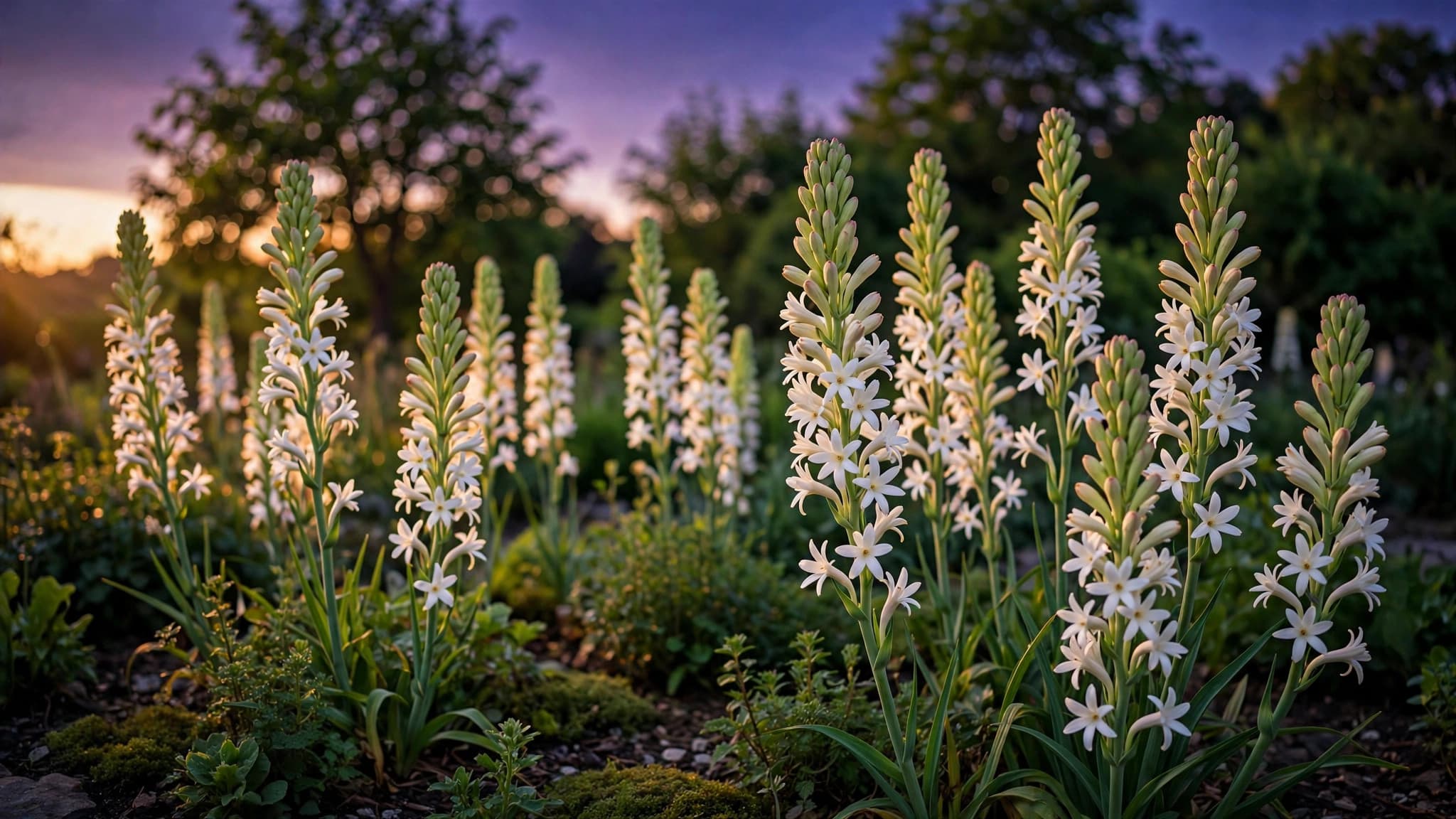
Few flowers carry as much drama in their scent as tuberose. By day, the tall spikes of waxy white blooms are politely fragrant. But as the sun drops, tuberose turns up the volume — releasing wave after wave of its famously heady perfume into the evening air. That nighttime surge is no accident: it is the flower's ancient strategy for calling in its pollinators.
The scene below is from our video companion above — a story, not a documented garden incident. That exact dusk-time power move played out for Sophie: she leaned into a tuberose spike for one delighted sniff — and the fragrance hit her like a velvet wall. Before she could swoon, Sprouty stepped in with some timely advice:
Sophie: "Ooh, tuberose—gorgeous!"
Sprouty: "Easy, Sophie! Stronger at dusk. Enjoy it from farther back."
Sophie: "Lovely—from over here!"
🌙 On-Screen Lesson: Tuberose fragrance grows stronger toward night. If it feels intense up close, step back and enjoy it from a little farther away.
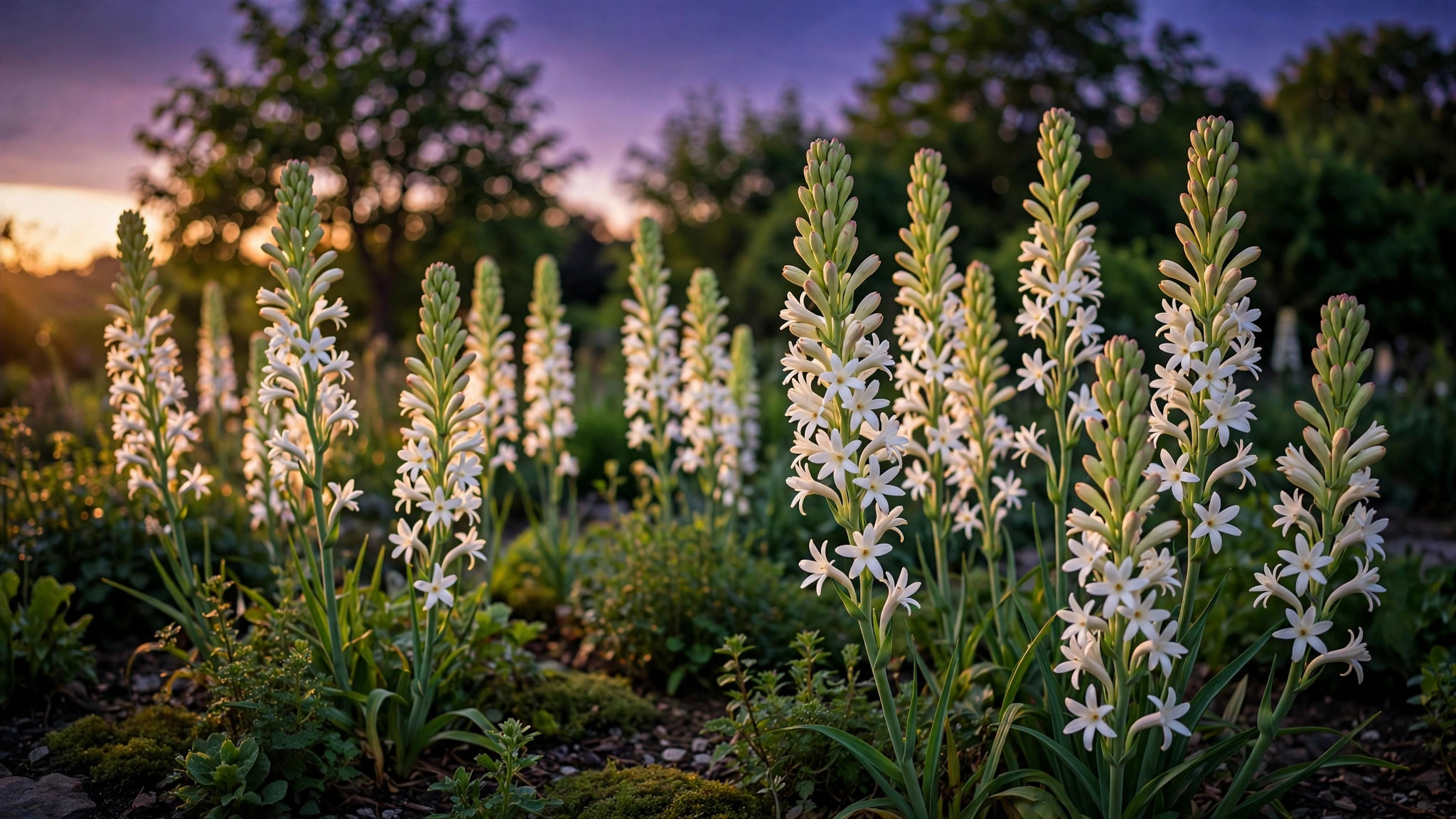
The Science: Why the Scent Peaks After Dark
Tuberose is native to Mexico and belongs to the asparagus family, Asparagaceae (botanists now place it as Agave amica, formerly Polianthes tuberosa). In its native habitat, its pollinators are night-flying moths — insects that navigate largely by scent in the dark. That evolutionary partnership explains the evening surge: the flowers emit scent volatiles on a daily rhythm that crests at night, precisely when their moth pollinators are active.
This isn't just gardener lore. A published study on the morphological and physiological changes behind tuberose's scent emission confirmed the spatio-temporal pattern: fragrance release follows a daily cycle peaking in the evening (Morphological, Physiological and Ultrastructural Changes in Flowers Explain the Spatio-Temporal Emission of Scent Volatiles in Polianthes tuberosa L., PubMed 29036488). By day the blooms hold back; after dusk they broadcast.
So when Sophie leaned in at dusk in our video and got walloped by perfume, she was experiencing the flower exactly as evolution designed it: a moth beacon firing at full strength.
Growing Tips: Enjoying Tuberose at Dusk
Want tuberose's evening magic in your own garden? It is a warm-season plant grown from rhizomes, and it asks for a few simple things. The NC State Extension Gardener Plant Toolbox entry for Agave amica is an excellent reference for the botanical and care details below.
Planting: Sun, Drainage, and Timing
Give tuberose full sun and well-drained soil — soggy ground rots the rhizomes. Plant rhizomes in spring only after all frost danger has passed and the soil has warmed. In cooler climates, gardeners often start them in pots indoors and move them out once nights stay warm, or lift and store the rhizomes over winter like dahlias.
Placement: Put the Evening Garden Where You'll Be
Since the fragrance peaks after dark, plant tuberose where you spend summer evenings — near a patio, along a path to the front door, or beside an outdoor seating area. One caution from experience: the scent is genuinely powerful, and sensitive sleepers have reported headaches from a vase of tuberose on the nightstand. Admire it; don't marinate in it.
Foliage: Let It Die Back Naturally
Leave green foliage until it naturally dies back. Like other rhizomatous plants, tuberose recharges its underground storage from its leaves after blooming — cutting them early weakens next season's show.
Cut Stems: Gorgeous Indoors, With Ventilation
Tuberose makes a spectacular cut flower with a long vase life. Bring stems indoors to enjoy the perfume — but keep the room ventilated and skip the bedside table. If the scent ever feels overwhelming, do what Sophie did: enjoy it from a little farther back.
The Cultural Story: "Dangerous Pleasures"
In the Victorian language of flowers — the elaborate code by which bouquets carried secret messages — tuberose meant "dangerous pleasures." You can read the original text yourself: Kate Greenaway's Language of Flowers lists the association explicitly (Project Gutenberg edition).
Flower lore holds that the Victorians considered its scent so powerfully intoxicating that young women were discouraged from breathing it in — though the flower dictionary alone doesn't establish that broader claim, and it should be read as traditional lore rather than documented history. Similar traditional warnings about inhaling its powerful evening fragrance exist in India, where perfume accounts describe young girls being cautioned against the scent after dark, when it is at its most potent.
It is easy to laugh at Victorian prudishness from the distance of the 21st century. But the Victorians were responding to something real: tuberose genuinely is one of the most powerful natural fragrances in the plant kingdom, and its potency is not constant — it builds through the day and crests at night.
Rajanigandha: India's Fragrance of the Night
From its Mexican origins, tuberose traveled the world and found perhaps its most devoted audience in India, where it is known as Rajanigandha — "fragrance of the night." The name captures exactly what makes the flower special: it perfumes the darkness. In India, tuberose is woven deep into celebration and ritual — weddings, garlands, hair ornaments, and religious poojas. A flower the Victorians treated as a dangerous pleasure became, in Indian hands, a flower of joy and devotion. Same scent, two completely different cultural stories.
You may already know tuberose by another name: Rajanigandha in Hindi, Nela Sampangi or Nela Sampenga (నేల సంపంగి / నేల సంపెంగ) in Telugu, and Sambangi (சம்பங்கி) in Tamil. IISc's flora database records "Nela sampengi," and Tamil Nadu Agricultural University uses "Sambangi" for tuberose. A note on precision: "Sampangi" alone can also mean champak (Magnolia champaca), a different plant — which is why the fuller Telugu name, Nela Sampangi, is preferred. Regional names and spellings vary; here, we mean the white-flowered tuberose, Agave amica, formerly Polianthes tuberosa.
The night-fragrance theme repeats around the world. In Chinese, tuberose is 夜来香 (yè lái xiāng) — "fragrance comes at night." In Indonesia it is bunga sedap malam, literally "flower that smells good in the night." In Hindi it is also called Nishigandha. In Spanish it is nardo — and in Nahuatl, the language of the Aztecs who first cultivated it in its native Mexico, it is omixochitl, "bone flower," for its white blooms. Different continents, same observation: this is a flower of the night.
🌙 Enjoying Tuberose at Dusk — 3 Tips to Save
- Time it right: Step out at dusk, when scent emission peaks — that's the flower's moth-pollinator hour.
- Give it space: If the perfume feels intense up close, enjoy it from a few feet back. Distance tames the indolic punch.
- Plant it where evenings happen: Near the patio or seating area, not the bedroom window — you'll thank yourself at midnight.
Frequently Asked Questions About Tuberose Fragrance
Why does tuberose smell stronger at night?
Tuberose evolved to attract night-flying moth pollinators, which find flowers by scent in the dark. Its fragrance compounds are released on a daily rhythm that peaks after dusk — a pattern confirmed by published research on scent emission in Polianthes tuberosa (PubMed 29036488).
What did tuberose mean in the Victorian language of flowers?
Tuberose signified "dangerous pleasures," as recorded in Kate Greenaway's Language of Flowers (Project Gutenberg). Traditional flower lore adds that its scent was considered so intoxicating that young women were discouraged from smelling it — a claim best read as lore rather than documented history.
What is Rajanigandha?
Rajanigandha — "fragrance of the night" — is the Indian name for tuberose. It is widely used across India in weddings, garlands, hair ornaments, and religious offerings and poojas.
What is tuberose called in Telugu and Tamil?
In Telugu, tuberose is called Nela Sampangi or Nela Sampenga (నేల సంపంగి / నేల సంపెంగ); in Tamil, it is Sambangi or Sampangi (சம்பங்கி). Use the fuller "Nela Sampangi" in Telugu to avoid confusion with champak (Magnolia champaca), which is also called Sampangi. All of these names refer to the white-flowered tuberose, Agave amica, formerly Polianthes tuberosa.
What family does tuberose belong to?
Tuberose belongs to the asparagus family, Asparagaceae. Botanists now place it as Agave amica, formerly Polianthes tuberosa. See the NC State Extension entry for details.
Can tuberose fragrance cause headaches?
Some sensitive people report headaches from prolonged exposure to tuberose's very potent scent, especially in enclosed spaces. If you love the fragrance but find it intense, enjoy it outdoors or in a ventilated room — or simply admire it from a little farther back, as Sprouty advises.
When should I plant tuberose rhizomes?
Plant tuberose rhizomes in spring after all danger of frost has passed and the soil has warmed, in full sun and well-drained soil. In colder climates, start them in pots indoors or lift and store the rhizomes over winter. Leave green foliage until it naturally dies back so the rhizomes recharge for next season.
Share the Discovery
Know someone who'd love this? Here's your conversation starter:
- 🔬 The science hook: "Why does the same tuberose smell stronger after sunset?"
- 📖 The history hook: "Victorian flower dictionaries gave tuberose a surprisingly dramatic meaning."
- 💬 Ask a friend: "Do you know this flower as tuberose or Rajanigandha?"
More Fragrant Flowers & Evening Garden Ideas
Fragrance is one of gardening's greatest pleasures — and the strongest flowers deserve the most thoughtful placement. Keep exploring: learn why Arabian jasmine won't bloom (and 7 mistakes to fix), plan next season with 5 flowering plants to plant in September, and see why you should never leave fallen camellia flowers on the ground.