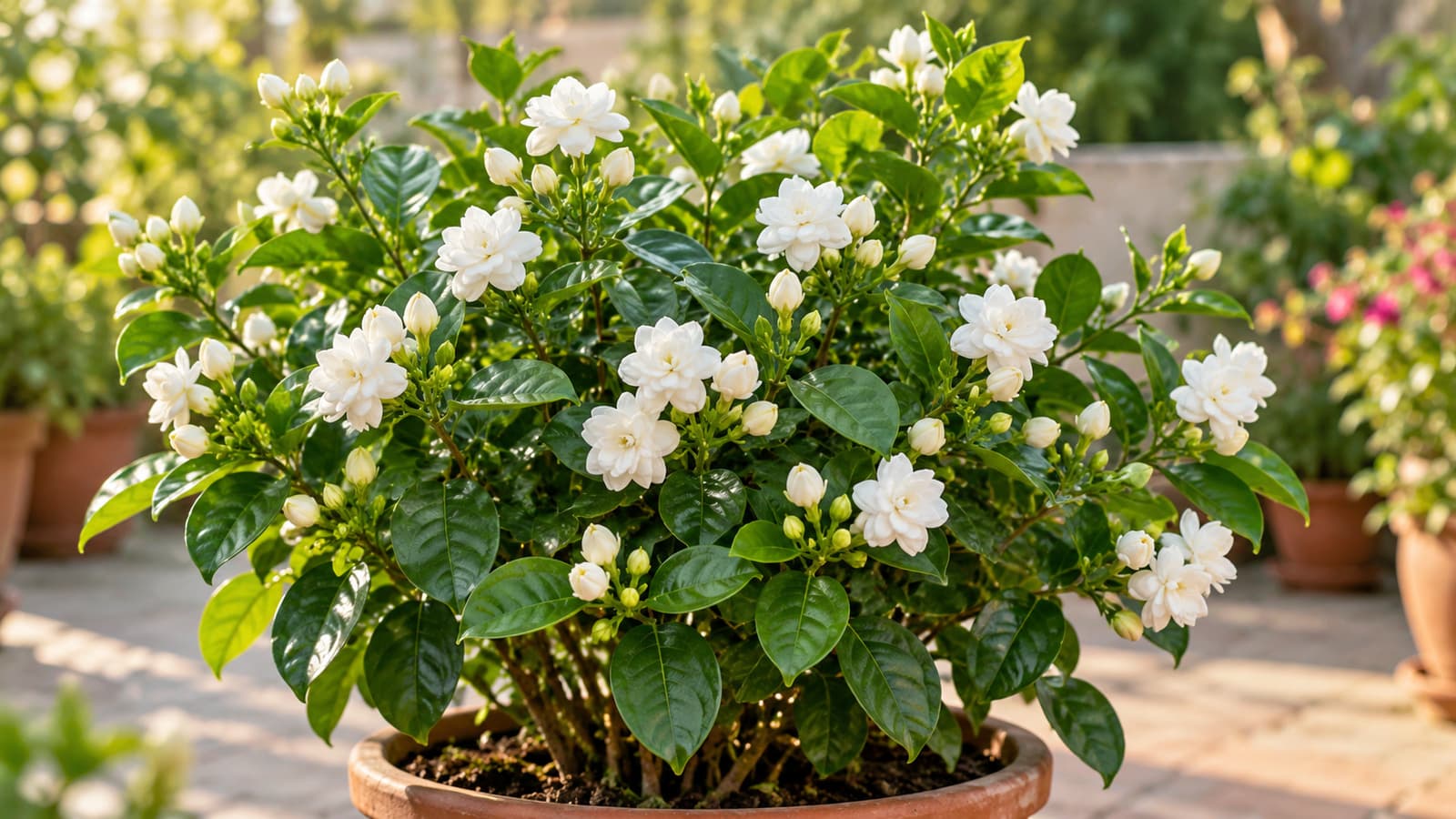

If your Arabian jasmine has healthy leaves but no flowers, start with the basics: light, recent pruning, growing conditions, and root health. If buds form but then drop or arrive damaged, inspect those buds separately before changing anything else. One note up front — this guide is about Arabian jasmine, Jasminum sambac. It’s a warm-climate plant, and advice written for other jasmine species doesn’t automatically apply.
That’s the whole diagnosis in one paragraph. Everything below just helps you work out which of those checks is failing on your plant.
Quick diagnosis: which one is yours?
| What you see | Check first |
|---|---|
| Healthy foliage, no visible buds | Light, recent pruning, plant maturity, feeding history |
| Buds form but drop or arrive damaged | Moisture swings, sudden moves, physical damage, pests |
| Yellow leaves and no flowers | Root condition and watering — before any bloom treatment |
| Slow growth in a cool or dim season | Seasonal conditions and indoor light — this may be normal, not a problem |
These are starting checks, not diagnoses. The same symptom can have different causes in different homes, so work through them in order instead of jumping to the fix that sounds easiest.
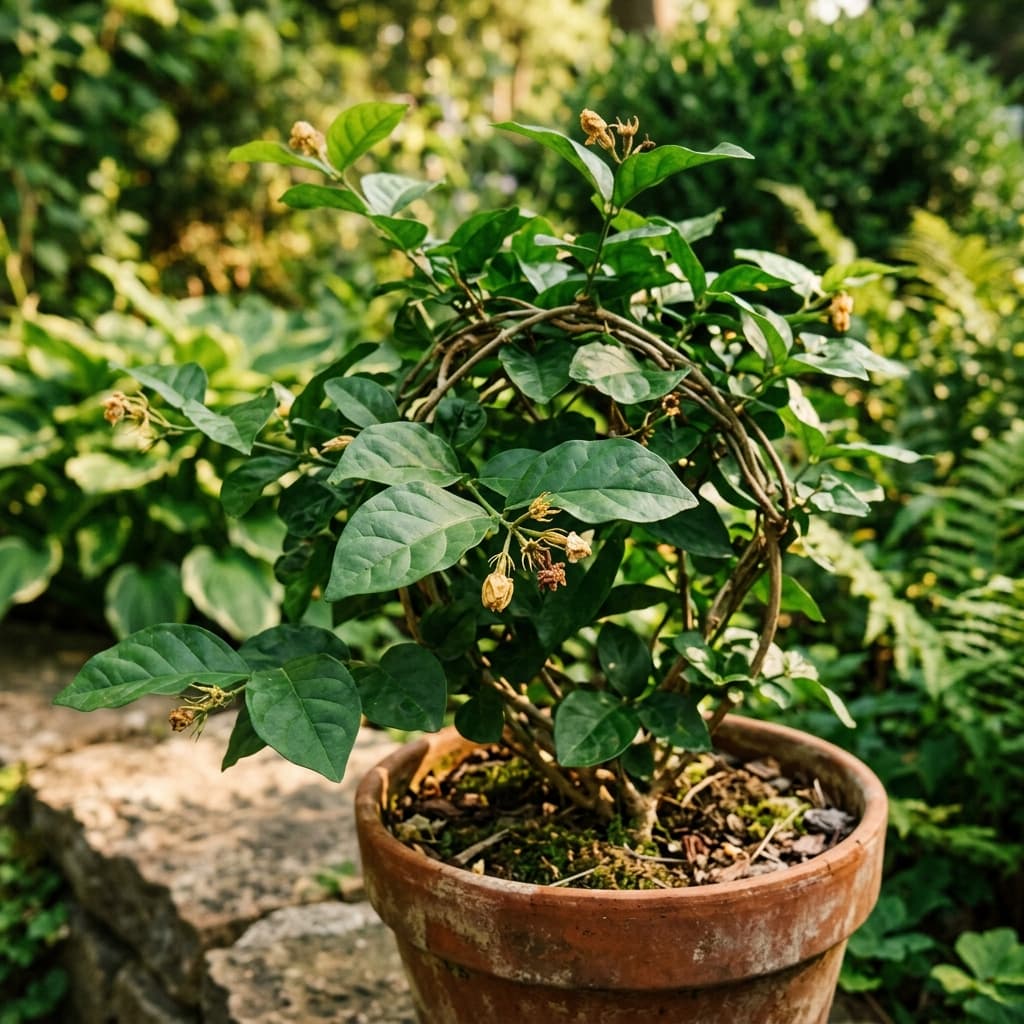
First, confirm it’s actually Jasminum sambac
“Jasmine” is a crowded name. Arabian jasmine — Jasminum sambac — is the intensely fragrant one with small white blooms and rounded evergreen leaves, known across India as Mogra. It also answers to more names than most gardeners realize: the IISc flora database records Gundu malle, Boddu malle, and Malli in Telugu, and Tamil Nadu Agricultural University uses Malligai / Gundumalli in Tamil. Names vary by region and cultivar, so keep Jasminum sambac beside whichever name you use — “jasmine” or “malli” alone can point to entirely different species.
This matters because jasmine advice is not interchangeable. Winter jasmine (J. nudiflorum), common jasmine (J. officinale), and pink jasmine (J. polyanthum) bloom on different wood, in different seasons, with different triggers. If your plant was sold simply as “jasmine,” check its flowers and foliage against Arabian jasmine’s profile before applying anything in this guide.
Two different problems need two different fixes
Healthy leaves, no buds at all. The plant isn’t even trying to flower. Work through light, recent pruning, the plant’s age and maturity, and its feeding history — in roughly that order.
Buds form, then drop, yellow, or open damaged. The plant is trying. Something is interrupting it: moisture swings, a sudden move, cold drafts, physical damage, or pests. Inspect the buds themselves first — don’t start by repotting or changing fertilizer.
Light: the most common missing ingredient
Arabian jasmine is a sun-loving flowering plant, and most indoor light advice undersells what it needs. Bright indirect light keeps it alive and green. Direct sun is what tells it to flower. During the growing season it wants several hours of direct sun a day — the Florida Museum’s plant profile lists it for full sun to partial shade.
☀️ Light reality check
- South or west-facing window with direct sun: good for blooming
- East-facing with a few hours of morning sun: marginal — may bloom weakly or not at all
- Bright north-facing spot or deep shade: healthy plant, likely no flowers
- Balcony or patio in the warm months: excellent — this is where mogra thrives
Acclimate gradually. Moving a shade-grown plant straight into blazing afternoon sun — an easy mistake in hot inland California — scorches leaves and stresses buds. That’s a separate problem from simply “more light.” Shift it outdoors over 7–10 days: bright shade first, then morning sun, then full exposure. A few weeks of real summer sun can kick-start budding that continues for months.
Water and roots: check the pot before blaming the plant
What matters isn’t a schedule — it’s the moisture in the root zone. That depends on your potting mix, drainage, pot size and material, temperature, and how actively the plant is growing. Any watering interval is only an example, not a prescription: a small terracotta pot on a hot patio can dry out in a day or two, while a large glazed pot indoors in winter can stay moist for a week or more.
Check before you water. The top inch or two of mix should be dry, and lifting the pot to feel its weight is the most reliable test there is. Drainage holes are non-negotiable, and saucers should be emptied — jasmine hates soggy feet.
Pot size has a direct and underappreciated effect on flowering, and both extremes cause trouble:
| Pot situation | Effect on flowering | What to do |
|---|---|---|
| Pot much larger than the root ball | Energy goes to roots and leaves, not flowers | Downsize to a snugger fit, or wait for roots to fill the pot before upsizing |
| Slightly snug — roots just reaching the edges | Often the sweet spot for flowering | Leave it alone; don’t repot yet |
| Severely root-bound — roots escaping, mix depleted, water runs straight through | Stressed plant; unlikely to bloom well | Repot one size up with fresh mix; give it several weeks to settle |
When you do repot, go up only one size. A terracotta pot — which breathes and steadies soil moisture better than plastic — suits jasmine well.
Pruning: what you cut matters more than the calendar
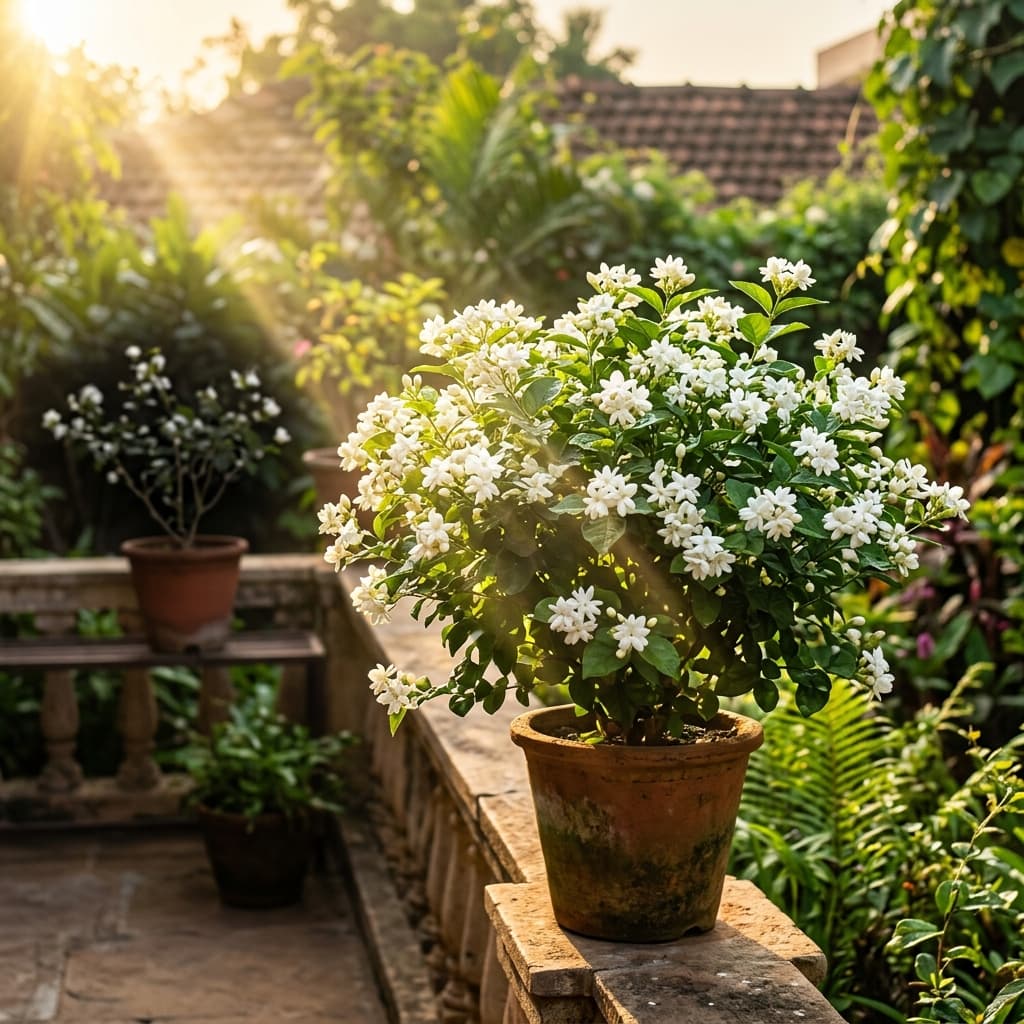
There is no universal pruning month for Arabian jasmine, because readers grow it in wildly different climates and systems — tropical field rows, Mediterranean patios, indoor pots under grow lights. What matters is what you’re cutting:
- Light shaping and deadheading — removing spent flowers, tipping back a leggy stem a little — is maintenance. Do it during the growing and flowering season without worry.
- Cutting stems that carry live buds directly removes flowers. If buds are forming, put the shears down.
- Hard pruning — cutting well back into older wood — should happen when the plant has a long, warm stretch ahead to regrow. In a mild-winter climate that window is wide; where winters are cold and the plant comes indoors, heavy cuts are riskier, because regrowth stalls and you’ve removed wood that would have flowered.
To see why calendar rules don’t travel: Tamil Nadu Agricultural University’s commercial Malligai guide describes November pruning of Jasminum sambac — but that’s field production in a tropical climate, not a potted plant on a California patio. Take the principle (prune when regrowth conditions are good in your climate), not the month.
Feeding: read the label, not the myth
A quick correction that matters: 20-20-20 is not a nitrogen-heavy fertilizer. It’s a balanced formula — equal parts nitrogen, phosphorus, and potassium. What pushes leafy growth at the expense of flowers is too much nitrogen relative to what the plant needs, and that comes from dose and frequency, not just the numbers on the bag. A balanced feed applied too often or mixed too strong grows leaves just as enthusiastically as a high-nitrogen one.
Keep three things separate: the ratio (what’s in it), the concentration (how strong you mix it), and the dose (how often and how much). Problems can come from any of the three — which is why “just switch the ratio” is rarely the whole fix.
And before reaching for a bloom booster: phosphorus-rich feeds and banana-peel tea are not guaranteed bloom triggers. If light is low or the roots are struggling, no fertilizer fixes that — you’ll just be feeding a plant that can’t use it. Diagnose light and root condition first. Then feed according to the product label, at the rate it prescribes, while the plant is actively growing, and ease off when growth slows in the cool season.
Inspect your buds and leaves before blaming the climate
This is the step most troubleshooting guides skip. If buds are yellowing, browning at the tip, failing to open, or showing chew marks — look closely before you change the watering, the feeding, or the plant’s address. Check the undersides of leaves and inside bud clusters for tiny insects, webbing, or sticky residue. TNAU’s malligai guide documents bud-damaging pests on this exact crop, so you wouldn’t be the first.
Physical damage counts too: buds knocked loose while moving the plant, wind-battered stems, a curious pet. If you find damage, remove the affected buds and foliage, dispose of them (don’t compost), check neighboring plants, and repeat the inspection over the next couple of weeks. Only once the buds check out clean should you go back to climate and nutrition theories.
Seasonal expectations: a quiet winter is normal, not a failure
Arabian jasmine does not require a mandatory cool, dry winter rest, and there’s no reason to deliberately drought-stress it. In warm regions J. sambac can flower across much of the year — the IISc species record notes flowering and fruiting through the year in its regional context. That doesn’t promise year-round blooms on a windowsill, but it does retire the idea that the plant needs a prescribed rest to flower.
What’s actually happening indoors through a cool, dim winter: growth slows, and few or no flowers is the plant responding honestly to its conditions. Warmth and strong light drive blooming. If your winters are cool and dark, expect a quiet season and a rebound when light and warmth return — that’s not a problem to fix, it’s a season to ride out.
💾 Save this checklist
No buds at all → more direct sun (acclimate gradually) · check for recent hard pruning · is the plant mature enough · review feeding dose, not just ratio
Buds dropping or damaged → inspect buds and leaf undersides for pests · check for moisture swings and sudden moves · keep conditions stable once buds set
Yellow leaves, no flowers → check roots and drainage first · rule out watering issues with Sprouty’s yellow-leaf guide before touching bloom strategy
FAQs
Are Mogra, Gundumalli, and Arabian jasmine the same plant?
Yes — all three are names for Jasminum sambac. Mogra is the widely used name across India, while Gundumalli (and Malligai) are Tamil names used by Tamil Nadu Agricultural University. The IISc flora database additionally records Gundu malle, Boddu malle, and Malli in Telugu. Names vary by region and cultivar, so keep the botanical name beside them — “jasmine” or “malli” alone can refer to other species.
What is Arabian jasmine called in Telugu and Tamil?
In Telugu: Gundu malle, Boddu malle, Malli (IISc flora records). In Tamil: Malligai / Gundumalli (TNAU usage). In Hindi and across much of India: Mogra.
Why do my jasmine buds fall off before opening?
Buds usually drop because of moisture swings, a sudden move or cold draft, physical damage, or pests — not because the plant “needs” a special fertilizer. Inspect the buds and leaf undersides first, then stabilize water and conditions. Keep the plant where it is once buds set; jasmine dislikes location changes mid-cycle.
Does Arabian jasmine need full sun to bloom?
It blooms best with several hours of direct sun a day during the growing season — full sun to partial shade, per the Florida Museum’s profile. Indoors, that means your brightest window; outdoors, acclimate it gradually over a week or more rather than moving it straight from shade into harsh afternoon sun.
Sources
- TNAU: Malligai (Jasminum sambac) — climate and pruning context, bud pests; commercial field guidance, not a home-garden prescription.
- IISc: Jasminum sambac species record — regional names and regional flowering record.
- Florida Museum: Arabian Jasmine — full sun to partial shade context.
You may also like
- Why Does Tuberose Smell Stronger at Night? — another night-fragrant classic, and what its scent is actually for.
- How to Design a Pollinator Garden — fragrant flowers like jasmine are pollinator magnets; here’s how to plan for them.
- Thrips Don’t Magically Disappear — if your bud inspection turned up pests, this is how to actually finish the job.
- Fungus Gnats Aren’t the Problem — Your Potting Routine Is — container moisture and potting habits, the root-zone side of the story.
Know someone whose mogra is all leaves and no flowers? Send them the checklist — the answer is usually light, roots, or buds, in that order.