
Editor’s note — updated October 1, 2026: This article previously claimed that watering orchids with ice cubes inevitably damages roots. We revised it after reviewing published research: bark-grown Phalaenopsis watered with ice showed comparable flower longevity and display life to plants given an equivalent amount of room-temperature water under the study’s conditions. The article now reflects that research and its limits, and recommends room-temperature watering as the practical default.
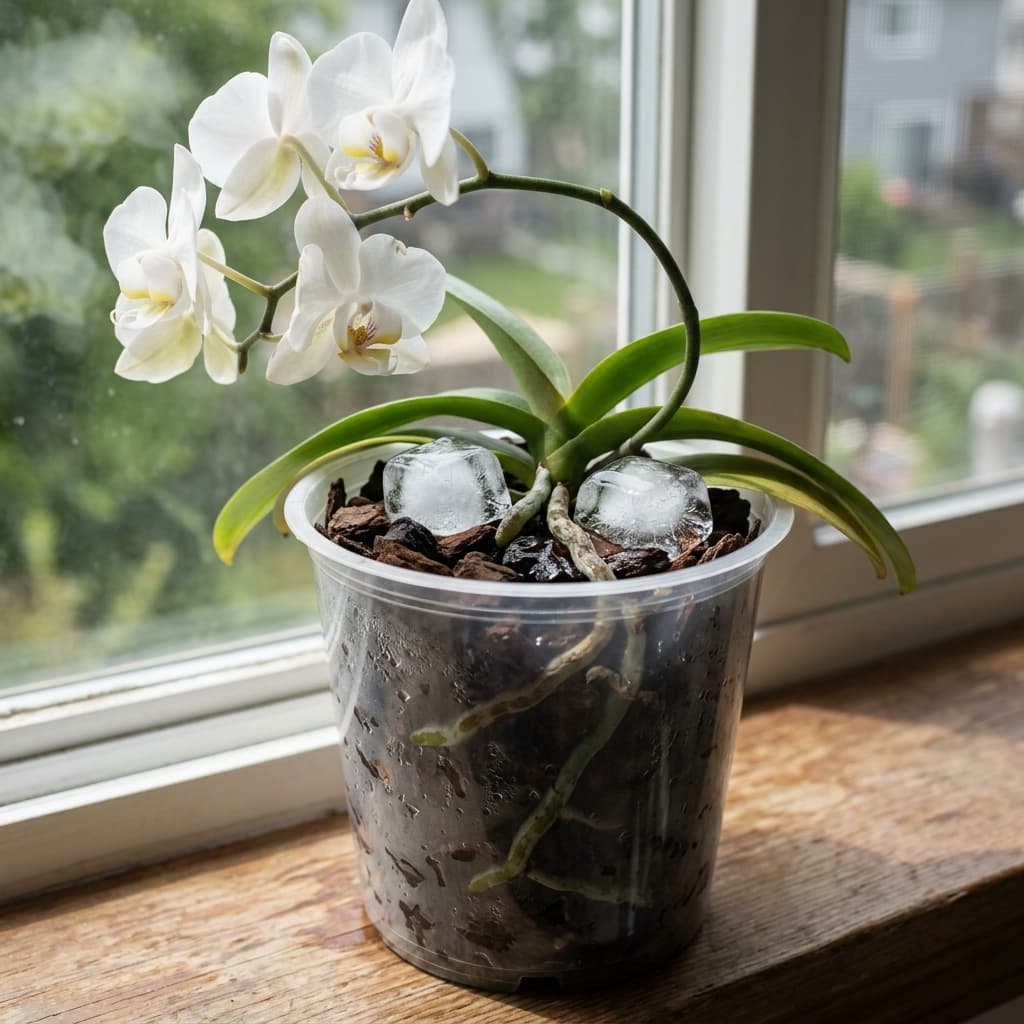
Ice cubes do not automatically kill a moth orchid. Research on Phalaenopsis grown in bark found no reduction in flower longevity or display life under the tested conditions. For everyday care, focus on the amount of water, the potting medium, and complete drainage rather than treating a cube count as a universal rule.
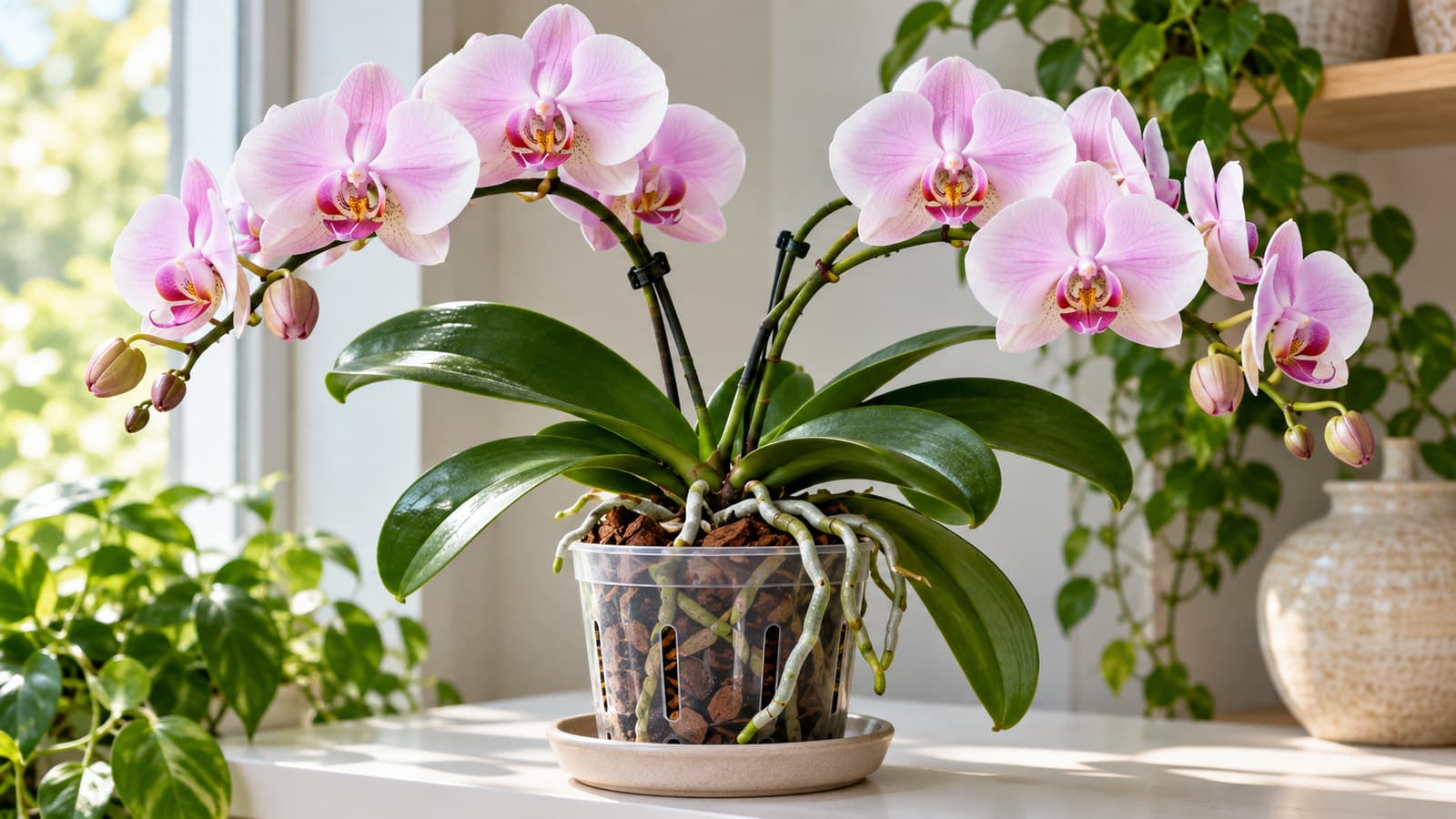
This article is about the common indoor moth orchid — the Phalaenopsis sold at grocery stores with the familiar “just add ice” tag. That matters, because “orchid” covers more than 25,000 species, and the research we’ll look at tested just one kind of orchid in one kind of potting mix. Sprouty is here to sort out what the study says, what it doesn’t, and how to water your plant well either way.
🧬 What the Research Actually Tested
The key evidence comes from work summarized by Ohio State’s greenhouse program and published in HortScience (2017, DOI 10.21273/HORTSCI12212-17): potted Phalaenopsis orchids growing in bark media were irrigated with ice cubes and compared with plants receiving an equivalent amount of room-temperature water.
The headline finding: ice cube irrigation did not decrease display life. Flower longevity was comparable between the two groups. That directly contradicts the old claim that ice inevitably shocks and ruins the roots — under the conditions tested, the plants performed just as well.
📋 The evidence card
Studied: Phalaenopsis in bark, ice cubes vs. an equivalent dose of room-temperature water — no decrease in flower longevity or display life.
Not established: a rule for every orchid species, every potting medium, or every home.
Two details in the study design matter. First, the comparison used an equivalent water dose — so the finding says ice-as-delivery-method didn’t harm the plants, not that any number of cubes is the right amount of water. Second, ice temperature is not root temperature: a melting cube at roughly 0–4°C warms as it melts and contacts the bark, so the root zone never experiences the same temperature as the ice itself.
⚠️ What the Study Does Not Establish
This is where the honest limits go:
- It tested one genus (Phalaenopsis) — not Vandas, Cattleyas, or the thousands of other orchids.
- It tested bark media only — not sphagnum moss, which holds water very differently.
- It was a controlled study, not a drafty apartment windowsill, a humid bathroom, or a hot summer kitchen.
- It measured flower display life — and also checked root and leaf health (chlorophyll, photosynthesis, shoot biomass) over the 4–6 month trial, finding no negative effects — but it was not a decades-long test of every growing situation.
So the research doesn’t make ice cubes the ideal method — and expert growers still recommend room-temperature watering as the default. The Missouri Botanical Garden advises watering moth orchids with tepid (room-temperature) water run through the pot until the medium is completely soaked, with no standing water left in the saucer. That’s the practical recommendation: not because every ice-watered plant is doomed, but because a proper soak is simpler, more controllable, and matches what the plant’s root system is built for.
| Method | Water temperature | What to know |
|---|---|---|
| Ice cubes weekly | Ice melts near 0–4°C, warming as it meets the bark — root-zone temperature is not the same as ice temperature | Studied on bark-grown Phalaenopsis: no decrease in display life under tested conditions. Hydration depends on cube size, medium, pot, and home conditions — a cube count is not a universal measure. |
| Room-temperature deep soak | Around room temperature — no precise number needed; if it feels comfortable to your hand, it works | The expert-recommended default: soak the medium thoroughly, drain completely, and water again when it’s nearly dry. |
💧 How to Water a Bark-Grown Phalaenopsis With Room-Temperature Water
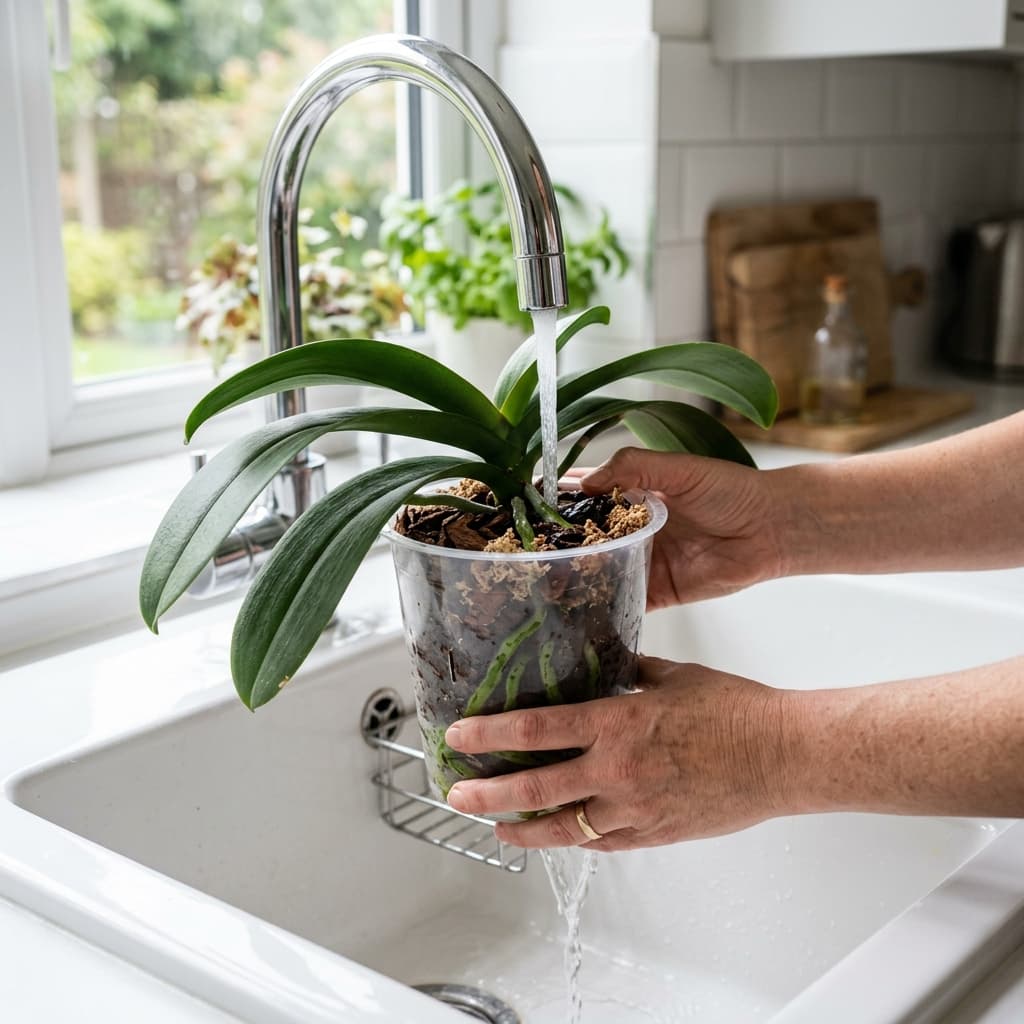
In the wild, moth orchids experience heavy tropical rainfall — a thorough soaking followed by fast drainage, then a period of near-dryness before the next rain. That cycle is what their root system is designed around. Here’s how to replicate it at home:
- Take the orchid to a sink.
- Run room-temperature water slowly and thoroughly over the bark mix until water flows freely from the drainage holes.
- Let it drain completely — tilt the pot, shake gently, and make sure no water is pooling at the bottom or sitting in the crown of the leaves.
- If the pot sits inside a decorative outer pot or saucer, empty any standing water after draining.
- Return it to its spot and leave it alone until the bark feels nearly dry and the roots inside the pot turn silvery-grey rather than green.
🔬 When is it time to water? Check these, not the calendar
Water when the bark feels nearly dry, the roots look silvery-grey rather than green, and the pot feels light when you lift it. A fixed 7–10 day schedule can’t account for your humidity, temperature, pot size, or airflow — the plant’s signals can. In many homes this works out to roughly once a week, but let the medium decide.
🌱 What Changes With Sphagnum, Pot Size, and Your Home
The study used bark, and your setup may differ:
- Sphagnum moss holds far more water than bark — it stays wet longer, so water less often and be extra careful about drainage. With moss, hold back on the heavy soak — water lightly and let it approach dryness between waterings, because constantly soggy moss is the fastest route to root rot.
- Smaller pots dry out faster than larger ones; a big bark-filled pot can stay damp in the center long after the surface looks dry.
- Your home shifts everything: dry heated winter air, humid bathrooms, bright warm windowsills, and air-conditioning drafts all change how fast the medium dries.
- Decorative outer pots without drainage are the classic trap — water collects at the bottom out of sight. Always lift the inner pot out and empty the outer one.
🪵 How to Check If Your Orchid’s Roots Are Healthy
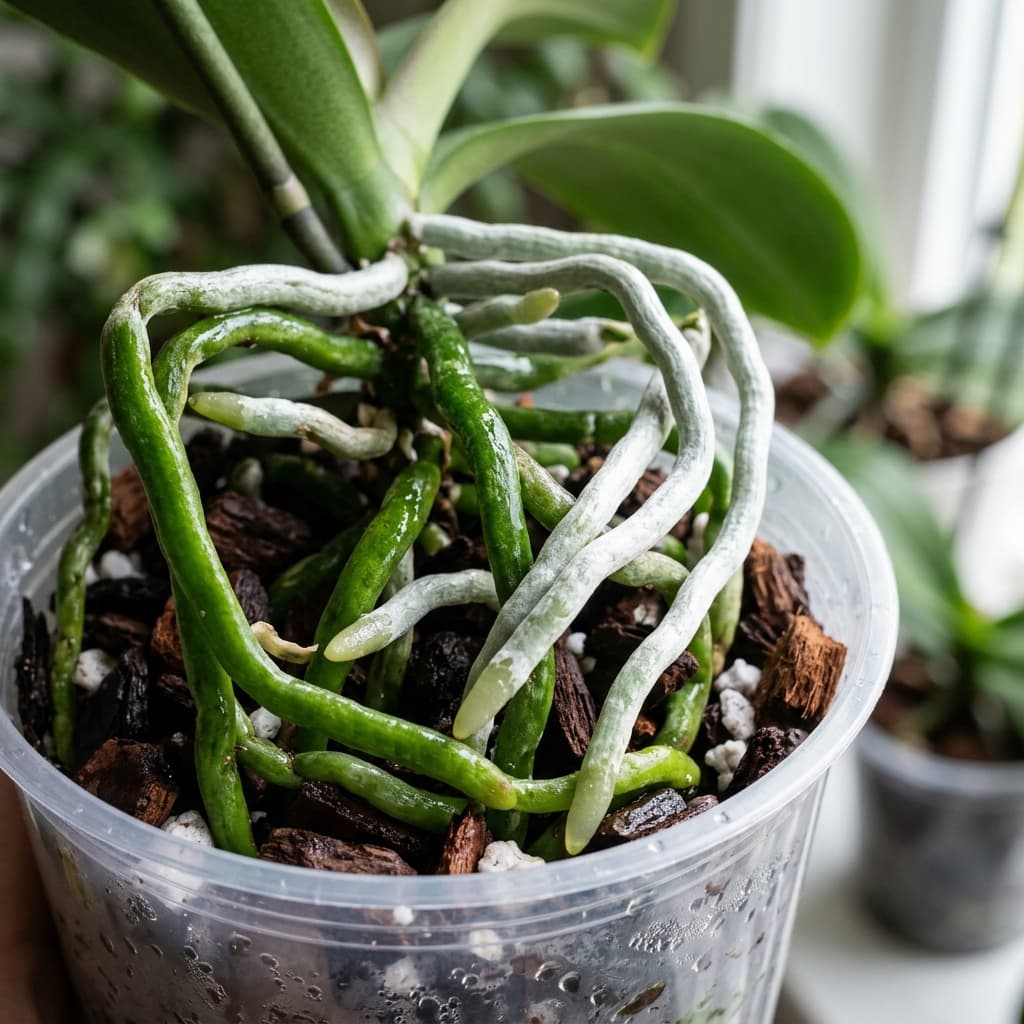
Root color is a useful clue, not a diagnosis on its own. Here’s how to read it:
Healthy roots are:
- ✅ Firm and plump
- ✅ Green when freshly watered (the velamen — the spongy outer layer — turns green as it hydrates)
- ✅ Silvery-grey or white when dry and ready for water
- ✅ Visible through the clear pot wall and looking full
Roots in trouble look like:
- ❌ Soft, mushy, and brown or black — most often rot from too much moisture, poor drainage, or decomposed medium. Several causes are possible, so treat the conditions, not a single culprit.
- ❌ Flat, shrivelled, and grey for an extended period — chronically underwatered, or roots that have already died back.
- ❌ Blackened tips — possible causes include rot, fertilizer burn, or mechanical damage; don’t assume cold water without other evidence.
If you find mushy, rotted roots: remove the orchid from its pot, trim only the dead tissue with sterilized scissors, and repot in fresh bark if the old medium has broken down into a soggy, soil-like mush. Trimming and repotting are warranted when rot is present or the medium is decomposed — not as routine maintenance. If the leaves are yellowing too, see our yellow-leaf diagnosis guide, since the problem may extend beyond the roots.
❓ Frequently Asked Questions
Does watering orchids with ice cubes kill them?
Not automatically. Research on bark-grown Phalaenopsis found no reduction in flower longevity or display life under the tested conditions. Expert growers still recommend room-temperature watering as the practical default, because a proper soak is easier to get right — but the old claim that ice inevitably destroys roots doesn’t hold up.
How much water does a moth orchid actually need?
It depends on the medium, pot, and your home — there’s no universal volume. The goal is to soak the medium thoroughly and let it drain completely, then wait until it’s nearly dry before watering again.
How do I know when to water my orchid?
In a clear pot: water when the roots turn silvery-grey and the bark feels nearly dry. Lift the pot — a light pot means dry medium. Don’t water on a fixed calendar schedule alone.
Can I use ice cubes on other types of orchids?
The research only tested Phalaenopsis in bark, so don’t assume the findings apply to Vandas, Cattleyas, or other orchids — and don’t assume the ice-cube routine is ideal for them either. When in doubt, room-temperature water and full drainage is the safer default across the board.
🌱 Sprouty Says
The ice cube tip spread because it felt precise and foolproof — and honestly, I used to claim it was an automatic plant-killer. The research says otherwise, and I’d rather be corrected than confident. Room-temperature water, a good soak, and full drainage is still the simplest way to keep your orchid happy.
Check the medium and drainage before your next watering.