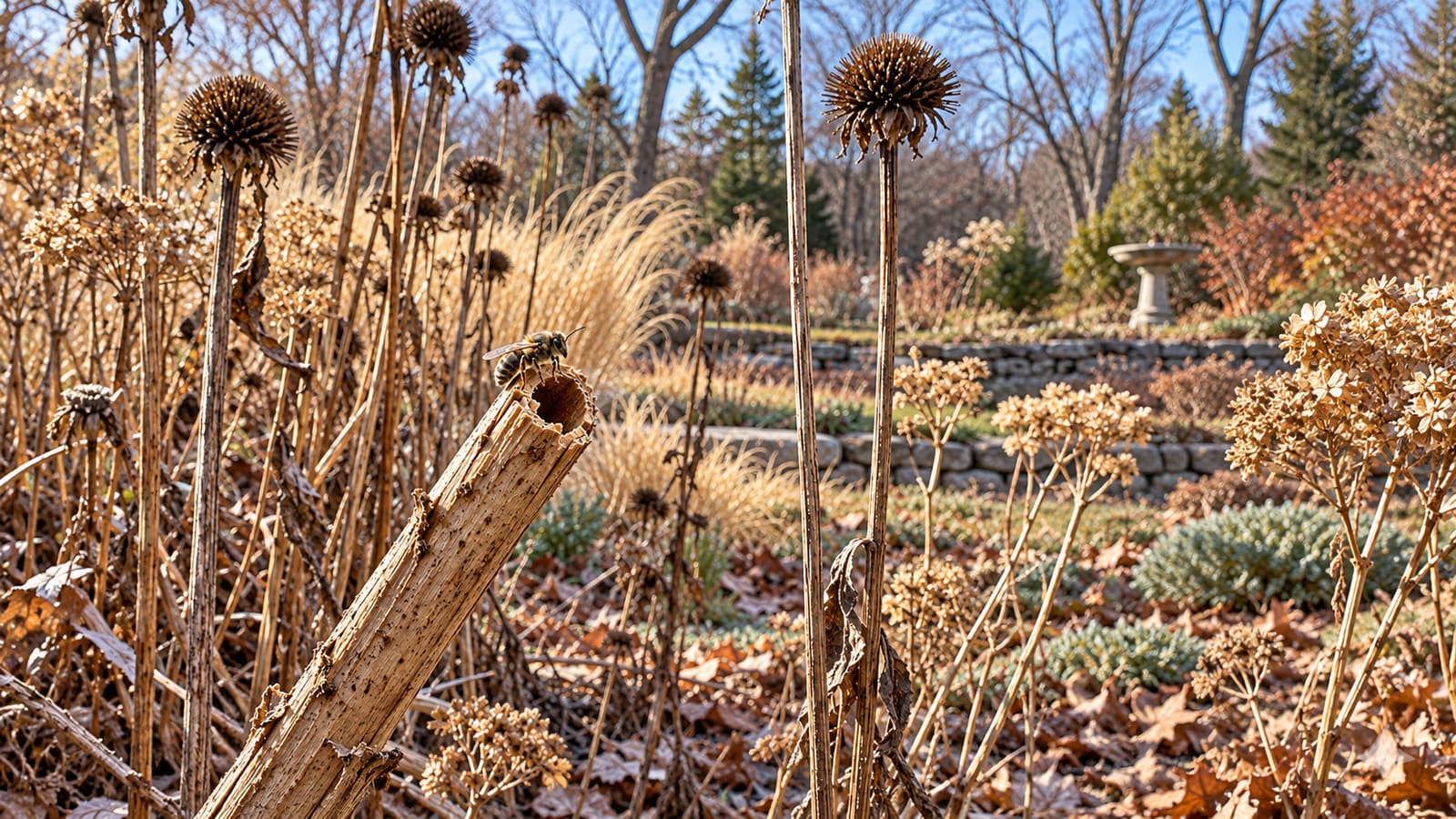

Some native bees use hollow or pithy plant stems as nests. Leave healthy old stems standing through winter, then consider cutting suitable stalks at varied heights in spring to expose nesting entrances. Keep the cut pieces in a sheltered place and leave the stubble through the next winter: bees may nest there during the coming growing season.
As summer blooms fade and cool autumn air settles across the garden, many gardeners feel an overwhelming urge to "tidy up." Sophie was standing over a border of spent coneflowers and bee balm, bypass pruners in hand: "These brown sticks look so messy and dead. Shouldn't I cut all these dried stems down before winter so the garden looks clean?"
Sprouty stopped her mid-snip: "Put those pruners down! Those hollow stalks aren't dead trash — some native bees raise their young inside them. Cut and bag them now and you're hauling away next year's pollinators."
✂️ The Short Version: Your Better Cleanup Plan
- Fall: leave healthy perennial stems standing. Don't cut, don't bag.
- Spring: cut suitable stalks at varied heights to open fresh nesting entrances.
- Keep every cutting on site in a loose, sheltered pile — never the curbside bin.
- Leave the stubble standing through the next winter — that second season is part of the habitat cycle.
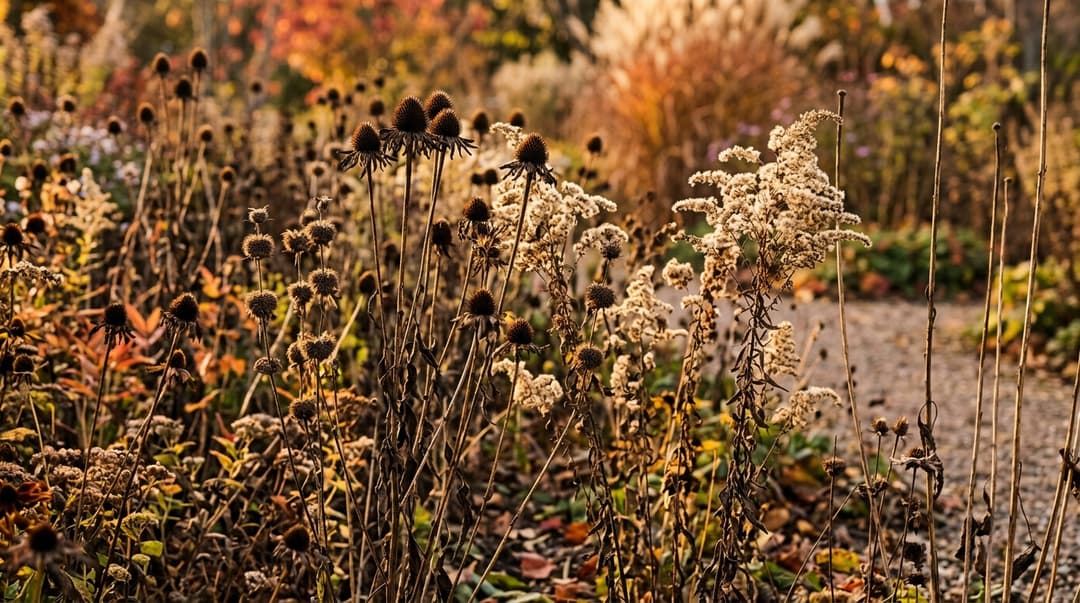
Watch Sprouty & Sophie Explain the Perennial Stem Rule
See why cutting dried stems in early fall evicts native bees in our latest quick tip video.
Which Bees Use Stems?
Unlike European honey bees that dwell in cooperative social hives, the vast majority of North America's roughly 4,000 native bee species are solitary. Each female scouts her own nest, gathers provisions, and lays her eggs individually.
The Xerces Society's nesting and overwintering habitat guide estimates that roughly 30% of native bee species are cavity nesters — a broad category that includes bees using hollow stems and beetle borings in dead wood, rock crevices, and other pre-existing tunnels. So the honest version of the claim is this: some native bees nest in hollow or pithy stems, and those stems are worth keeping. Common stem users include:
- Small carpenter bees (Ceratina spp.): tiny, dark metallic bees that excavate tunnels in the soft pith of dead stems, partitioning brood cells with chewed pith.
- Leafcutter bees (Megachile spp.): bees that line hollow stems and canes with neatly cut leaf pieces to protect their nursery chambers.
- Mason bees (Osmia spp.): spring pollinators that seal brood compartments inside existing hollow stems with mud.
- Masked bees (Hylaeus spp.): slender solitary bees that nest in hollow stems, lining galleries with a waterproof natural secretion.
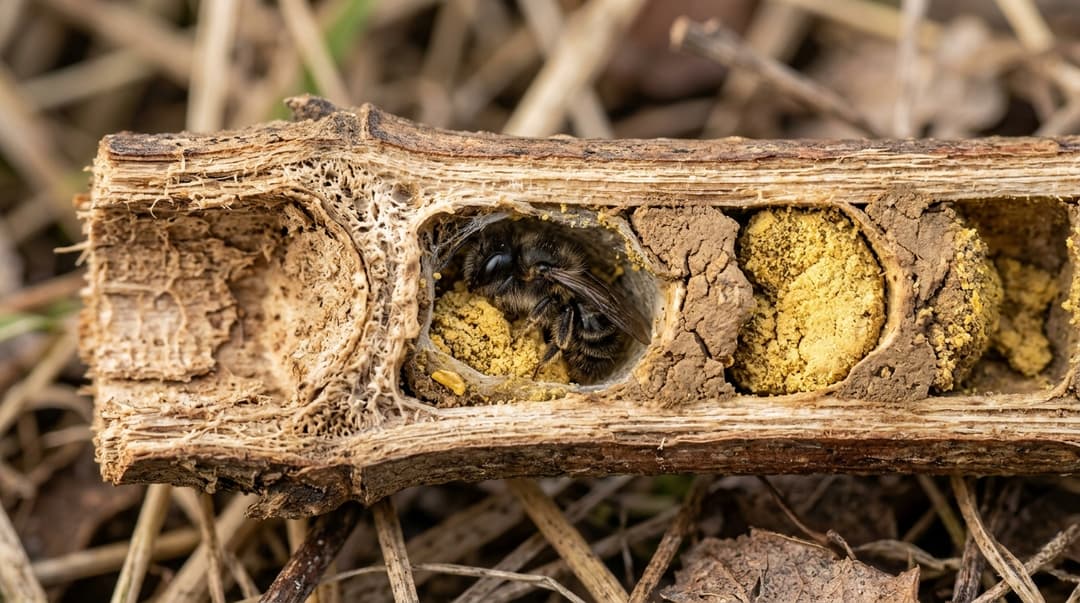
New Stems vs. Already Occupied Stems
Here's the distinction most cleanup advice skips: the stems in your border are doing two different jobs, and they need different handling.
Already occupied older stems may hold developing bees right now — larvae or pupae sealed inside chambers from last season's nesting. These are the residents you're protecting by leaving stems standing through winter. Cutting and bagging them removes the bees along with the stems.
Fresh stalks cut in spring become something else: newly opened nesting entrances. When you trim a hollow or pithy stem, the exposed opening is exactly what a searching female needs to start a new nest during the coming growing season. This is why the spring cut matters — but it only works if last year's occupied stems were left alone long enough to produce the bees that will use the new openings.
Treating "cut in spring" as the entire plan misses this. The habitat cycle runs longer than one spring cleanup.
The Two-Season Nesting Timeline
Xerces' nesting guidance shows spring-cut stems being used through summer and the following winter — the cycle spans roughly two growing seasons, not one. Here's how it unfolds:
Diagram: the two-season stem habitat cycle (illustrative, not a documented field observation).
- Autumn – stalks stand: healthy stems stay upright. Some already hold developing bees from summer nesting; seedheads feed birds.
- Winter – residence: larvae and pupae rest inside stems through cold months. Nothing to do but leave them be.
- Spring – opening: cut suitable stalks at varied heights to expose fresh nesting entrances. Keep every cutting on site.
- Summer – nesting: females claim the new openings, provisioning chambers through the growing season.
- Second winter – residence again: the new generation overwinters in the stubble. Leave it standing.
- Following spring/summer – emergence: new adults chew out and the cycle renews.
📣 Share this: "That stem you cut this spring may be next winter's bee nursery." If you spot a neat round entrance hole in a stem this summer, note the plant and the date — and please don't open the stem to look inside. Observation beats dissection.
How to Cut and Keep Stems
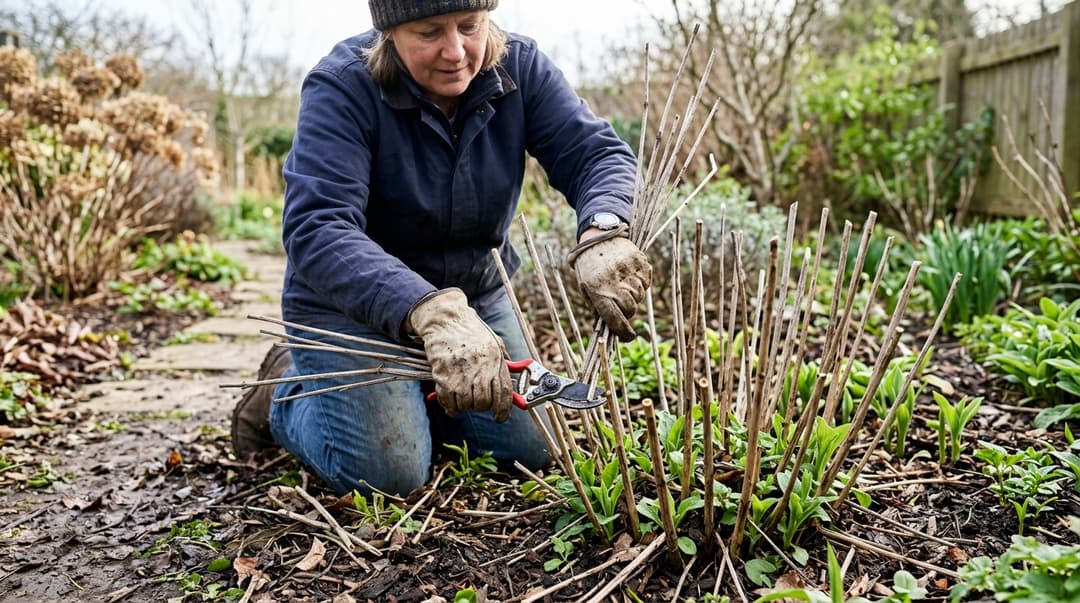
✂️ Sprouty's Perennial Stem Protocol
- Leave stems standing through winter. Do nothing in autumn: no cutting, no bagging. Standing stalks shelter sleeping bees, catch snow that insulates crowns, and feed seed-eating birds.
- Cut in spring at varied heights. One widely cited approach is cutting stems back to heights between 8 and 24 inches — treat it as a flexible option, not an exact requirement. Vary the heights so different stem diameters and openings are available. Never cut flush to the soil.
- Don't watch the thermometer for emergence. The timing of when insects emerge differs by species and region — no single temperature reading tells you every resident has left. The real safety net is the next step.
- Keep every cutting on site. Lay cut pieces loosely in a sheltered spot — under shrubs or in an out-of-the-way corner — so any bees still inside can finish developing and exit. Avoid wet piles where stems rot instead.
- Leave the stubble through the next winter. Those cut stems become this summer's nurseries and next winter's shelter. Removing them after one season breaks the two-season cycle.
Disease and Fire-Safety Exceptions
Stem habitat is for healthy stems. Here's when cutting back — even in fall — is the right call:
- Diseased foliage comes out. Plants with severe powdery mildew, rust, or fungal blights should be cut and bagged for disposal in autumn; spores overwinter on tissue and reinfect next year's growth. If you're deciding about peonies, see our guide on when to cut peony foliage — diseased peony leaves are one of the clearest cases for fall removal.
- Soft, mushy leaves aren't habitat. Hosta, daylily, and squash foliage has no hollow stems for bees. In wet-winter regions it collapses into slimy mats that harbor slugs and crown rot — clean it up without worry.
- Fire safety comes first. If you live in a wildfire-prone area, follow your local fire-safe guidance: California's defensible-space rules, for example, call for a noncombustible zone within 0 to 5 feet of structures. Site your stem habitat in beds farther from buildings and check your local fire-safe council for the specifics that apply to you.
Hardy mums deserve a special mention here: their stems are worth leaving standing too. See why we leave hardy mum stems up after blooming before reaching for the shears.
Plants to Try and What to Observe
Not all garden plants make good bee nurseries. The best candidates have naturally hollow tubes or soft, easily excavated pith:
What to observe: come summer, look for neat round entrance holes in cut stem ends, or bits of leaf and mud sealing an opening. Note the plant species and the date. That's a nest — leave it alone and let the season play out. For more on planning the planting side, see our Xerces' year-round garden habitat guidance.
🌿 Sprouty's Rule of Thumb
In fall, keep the hedge shears inside. A "tidy" garden in October is an empty garden in May. Leave the hollow stems standing, admire the frost on the seedheads, and rest easy knowing your flower bed is quietly nursing next season's pollination crew — a cycle that runs two seasons deep, not one.
Planning your autumn garden tasks? Check out our complete Fall Gardening Guide & Seasonal Playbook, discover why you must stop removing dead leaves to save your garden soil, and learn why pruning lilacs in September deletes spring blooms.