

As autumn arrives, the urge to tidy up garden borders reaches an all-time high. Hostas are starting to flag, summer annuals are petering out, and herbaceous peony clumps (Paeonia lactiflora) often stand tall with sprawling, slightly weathered green foliage. It is tempting to grab your bypass pruners, shear the bush flush to the ground, and check "peony cleanup" off your fall to-do list.
Resist that impulse! Cutting back still-green peony foliage in September—or anytime before a killing frost—is one of the most common reasons peonies fail to flower vigorously the following spring.
That exact scenario unfolded on a crisp autumn afternoon in Sophie's garden. Standing over a large herbaceous peony bed with bypass pruners in hand, Sophie aligned her blades at the base of the leafy green stems, ready to neaten the border before winter. Before the blades could close, Sprouty stepped in to stop her:
Sophie: (Positioning sharp pruners near the base of leafy green stems) "Time to tidy up these peony stems for fall!"
Sprouty: (Gently raising a paw to hold back the blades) "Hold on, Sophie! Those green leaves are still photosynthesizing and pumping vital sugars down into the roots. Cut them now, and you starve next spring's flowers!"
Sophie: (Lowering her pruners and inspecting the lush canopy) "So I wait until after the frost?"
🌸 On-Screen Lesson: Never cut green peony foliage in early fall. Wait until after a hard freeze destroys the top growth, then cut stems near ground level!

Watch Sprouty & Sophie on Fall Peony Pruning
See why snipping green peony foliage early deletes next spring's flower buds in our quick video companion.
The Botanical Engine: How Peonies Build Next Year's Blooms in Autumn
To understand why cutting green foliage in September damages your plant, you have to look beneath the soil surface. Unlike woody shrubs that store energy in above-ground trunks and branches, herbaceous peonies are perennial geophytes. Their entire survival strategy relies on thick, fleshy underground storage roots and a central crown.
Peonies bloom for a brief 2 to 3 weeks in late spring. Once those glorious flowers fade, the plant does not enter dormancy—it shifts into overdrive. Throughout July, August, September, and into October, the expansive green foliage functions as a miniature solar energy plant.
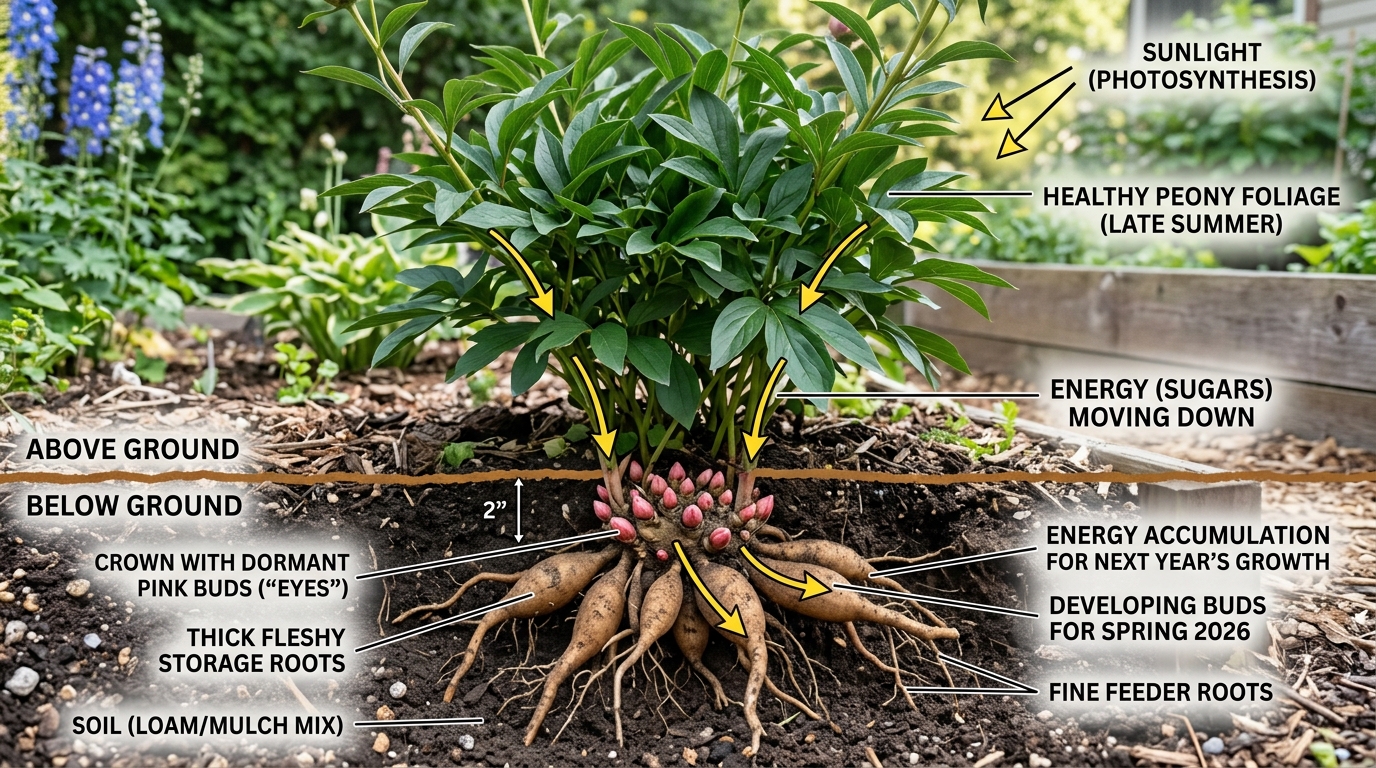
Through photosynthesis, the green leaves convert late-season sunlight into complex carbohydrates (sugars and starches). These energy reserves are translocated downward through the vascular stems and deposited into two critical places:
- Fleshy Tuberous Storage Roots: These fat, finger-like roots act as the peony's long-term energy bank, maintaining root vitality through sub-zero winter temperatures.
- Dormant Crown Buds (the "Eyes"): Tucked just 1.5 to 2 inches beneath the soil surface, the crown is actively developing next spring's renewal buds—the bright pink or reddish "eyes." The number, size, and floral fertility of these buds are directly determined by the amount of photosynthetic energy the leaves synthesize during late summer and early autumn.
When you cut down green foliage in late August or September, you prematurely sever this energy pipeline. The crown eyes are left underdeveloped, and the root reserves remain depleted. As a result, the plant produces weak vegetative stems with fewer—or zero—flower buds come May.
What University Research Confirms: The Iowa State Extension Findings
This is not just gardening folklore. Horticultural researchers have documented the negative impacts of premature peony pruning for decades. According to the Iowa State University Extension and Outreach Peony Cutback Guide:
"Cut back peony foliage after it has been destroyed by a hard freeze. In Iowa, late October or early November is generally a good time to cut back peonies. Cut off the stems near ground level. If the peonies experienced foliar disease problems, remove the plant debris from the area and destroy it. Plants cut back in August or early September may have fewer blooms than those cut back in fall."
In their comprehensive horticulture manual on Growing Peonies in Iowa, Extension specialists reiterate that healthy peony foliage should remain standing as long as it is green. Peonies are cold-hardy perennials capable of living for 50 or more years in the same location if their natural seasonal cycle is respected.
🌡️ When is the True "Hard Freeze"?
A light frost (temperatures hovering around 32°F) will often leave peony leaves standing with only minor leaf-tip crisping. A true killing hard freeze occurs when temperatures drop to 28°F or below for several consecutive hours. This freezes the water within leaf cells, collapsing the vascular system and turning the foliage completely bronze, yellow, or collapsed brown. That collapse is nature's signal that carbohydrate translocation is 100% finished. You can look up your local first frost and hard freeze window anytime using our free Frost & Heat Date Growing Window Planner.
Why You Must Cut in Late Autumn: The Sanitation Factor
If leaving the foliage alone feeds the roots, you might wonder: "Why not leave peony stems standing all winter like native grasses or coneflowers?"
With wildlife-friendly perennials like echinacea, rudbeckia, or hollow-stemmed goldenrod, leaving stems standing over winter provides crucial nesting chambers for solitary native bees (as explained in our guide on why cutting dried perennial stems in fall evicts native bees). However, herbaceous peonies are the critical exception to this rule.
Peonies are uniquely susceptible to foliar fungal pathogens, most notably Botrytis blight (Botrytis paeoniae) and peony measles (Graphiopsis chlorocephala, formerly Cladosporium paeoniae). These fungal spores produce black spots, stem rot, and withered flower buds ("bud blast").
Fungal spores overwinter directly on dead peony stems and collapsed leaves. If dead foliage is left lying over the crown all winter, spring rain splashes millions of viable spores directly onto fresh, tender pink shoots as they emerge from the soil in April.
Therefore, proper fall peony sanitation requires a two-step approach:
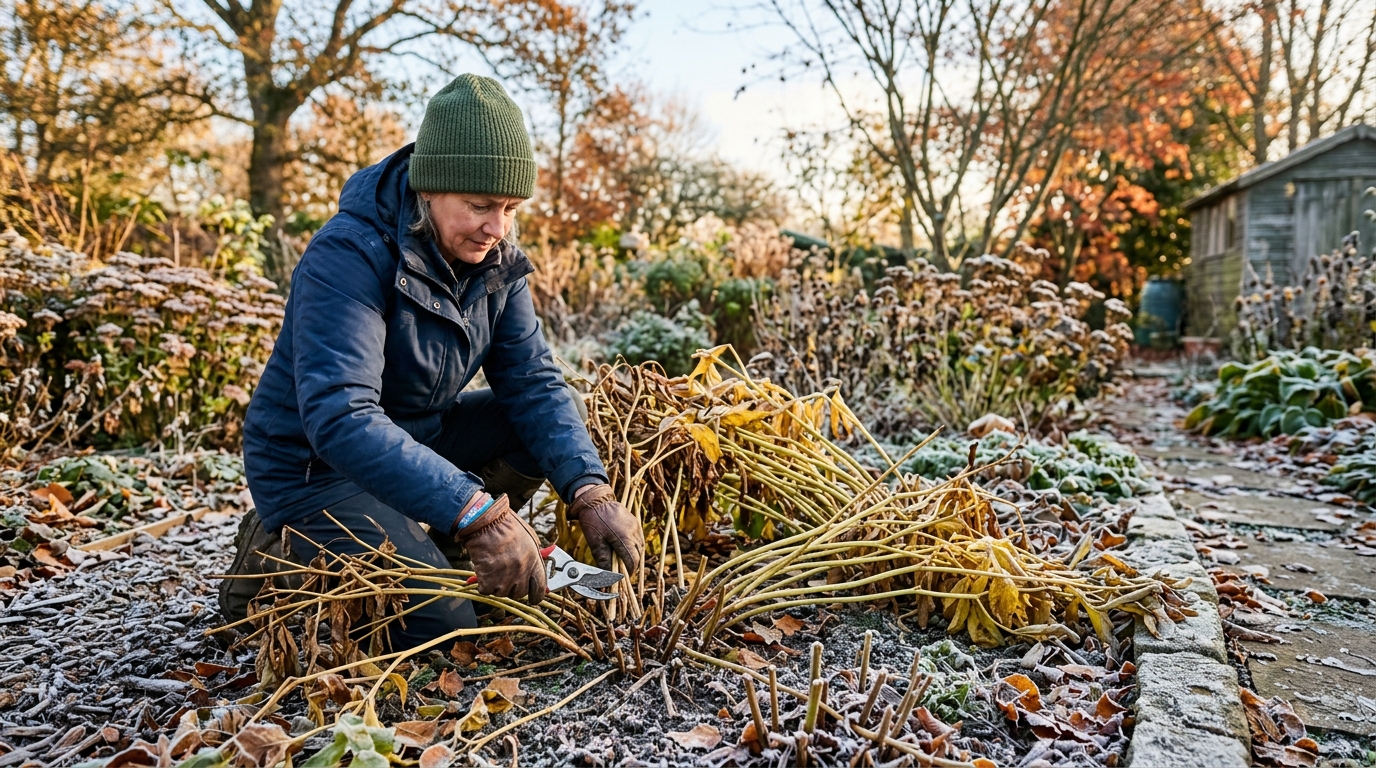
- Wait for the freeze: Allow the foliage to stand completely undisturbed through September and October until a hard freeze turns the stems limp and brown.
- Clean cut and bag: Cut stems back within 1 to 2 inches of the soil line using clean, sharp bypass pruners. Remove all trimmed debris from the bed and dispose of it in municipal yard waste or trash. Do not throw diseased peony debris into backyard home compost piles, because home piles rarely sustain the 140–165°F core temperatures needed to eliminate fungal microsclerotia (read more in our guide on why cool compost fails to kill plant pathogens).
Herbaceous vs. Tree vs. Itoh Peonies: Don't Make This Pruning Error
Before making any cuts in late fall, you must confirm which type of peony is growing in your garden:
🌿 Sprouty's Peony Golden Rule
Green leaves are plant food factories. As long as peony foliage has chlorophyll, it is feeding next spring's spectacular blooms. Keep your pruners sheathed in September and October. When the killing hard freeze arrives and turns the foliage limp and bronze, cut stems near ground level, bag the cuttings, and top the crown with a light mulch blanket. Your peonies will reward you with massive, dinner-plate blossoms come May!
Planning the Rest of Your Autumn Garden Chores
Curious how other garden plants should be managed before winter? Explore our full Fall Gardening Guide & Seasonal Cleanup Playbook, check our guide on top flowering plants to plant in September (including peony planting depth), discover why pruning lilacs in September deletes next May's blooms, and avoid costly mistakes with our breakdown of 7 pruning mistakes gardeners make every season.