
Every spring, millions of gardeners pick up their pruning shears with the best intentions—and accidentally set their plants back by months, or even years. Bad pruning isn't just an eyesore. It opens wounds that let disease in, removes this season's flowers before they've had a chance to bloom, and can permanently disfigure a tree or shrub that took decades to grow.
The good news? Every single one of these mistakes is easy to avoid once you know what to look for. Here are the 7 most common pruning mistakes and, more importantly, exactly what to do instead.
Mistake #1: Pruning Spring-Blooming Shrubs in Early Spring
This is the single most common—and heartbreaking—pruning mistake. You look out at your lilac, azalea, forsythia, or rhododendron in late winter and think, "I should tidy that up before spring." You prune it tidily. Then spring arrives, and it doesn't bloom. Not a single flower.
Here's why: spring-blooming shrubs set their flower buds on "old wood"—stems that grew last summer and fall. When you prune in early spring, you're cutting off every bud that was quietly waiting to open. You've just removed an entire year's worth of flowers.
The Golden Rule: Old Wood vs. New Wood
Spring-bloomers (prune AFTER flowering): Lilacs, forsythia, azaleas, rhododendrons, viburnums, weigela, mock orange, mountain laurel.
Summer-bloomers (prune in early spring, before growth starts): Panicle hydrangeas, spirea, butterfly bush, rose of Sharon, crape myrtle. These bloom on new growth they'll put out this season—so pruning now encourages exactly the vigorous new growth you want.
The fix: If you're unsure whether a shrub is a spring or summer bloomer, simply wait. Watch it bloom. Once you see the flowers, you'll know whether to prune immediately after (spring bloomer) or wait until next late winter (summer bloomer). One season of patience saves years of frustration.
Mistake #2: Making a Flush Cut on Tree Branches
When removing a branch from a tree, many gardeners cut it off as close to the trunk as possible—a "flush cut"—thinking it looks cleaner and heals faster. It's actually the opposite. A flush cut removes the branch collar, the slightly swollen ring of tissue at the base of every branch where the tree concentrates its wound-healing cells.
Without the branch collar, the tree can't form a protective callus over the wound. The result is an exposed wound that decays inward for years, creating rot and providing an entry point for disease and insects.
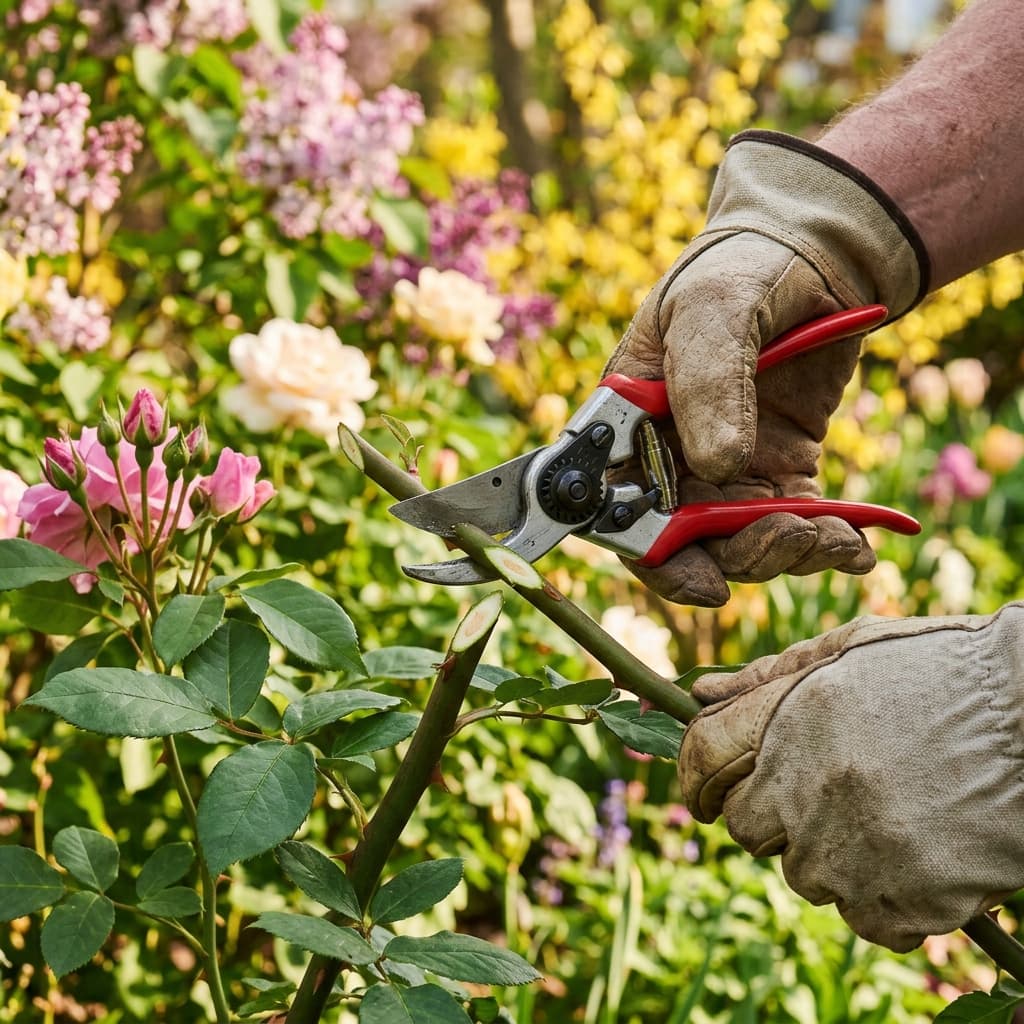
The fix: Always make your cut just outside the branch collar—not through it, not beyond it. You'll see a subtle ridge or wrinkle where the collar begins. Your cut should be angled just past that ridge, leaving the collar intact. The tree will naturally seal itself over within a season or two.
Mistake #3: Topping Trees
"Topping" means cutting back the main leader (the central upward-growing stem) or reducing the entire tree's crown by cutting major branches off at arbitrary points in the middle of their length. It's done to reduce a tree's height—and it's one of the most damaging things you can do to a tree.
Here's what actually happens when you top a tree:
- The tree responds to the sudden, massive wound by sending out dozens of weak, fast-growing water sprouts—long, vertical stems that grow up to 3 times faster than normal wood but with weak attachment points
- Within 2–3 years, the topped tree is often taller than it was before, and significantly more hazardous
- Large, unprotected wounds at each cut are entry points for fungi and wood-boring insects
- The tree's structural integrity is permanently compromised
The fix: If a tree is too large for its space, work with a certified arborist on a multi-year reduction program using proper reduction cuts. If a tree is fundamentally the wrong size for its location, the most effective long-term solution is removal and replanting with an appropriately sized species. A dwarf tree planted correctly beats a topped large tree every time.
Mistake #4: Pruning More Than One-Third at Once
It's tempting—especially with a badly overgrown shrub—to take it all the way back in a single session. But removing more than one-third of a plant's total leaf area at once triggers a stress response. The plant rushes to put out new growth, often in a chaotic, weakened way, and its immune defenses against disease are significantly reduced during this vulnerable period.
There's a specific exception: some shrubs (forsythia, lilac, ninebark) actually respond well to hard rejuvenation pruning—cutting the entire plant down to 6–12 inches from the ground every 8–10 years to renew the root system. But this is a deliberate technique, not a halfway measure, and is best done in early spring when plants are dormant.
The fix: For overgrown shrubs, spread your renovation over 3 years. Year 1: remove the oldest, thickest one-third of stems at the base. Year 2: repeat with the next-oldest third. Year 3: final third. By year 3, you have a fully renewed, young-stemmed shrub with uninterrupted bloom production throughout.
Mistake #5: Using Dull or Dirty Tools
A dull pruning blade doesn't cut—it crushes and tears. A crushed stem heals far more slowly than a clean cut, and the ragged wound surface is dramatically more susceptible to fungal infection. This is why a plant pruned with dull shears often looks worse two weeks later than it did on pruning day.
Dirty tools carry an equally serious risk: you can transmit diseases between plants. This is especially critical with fire blight (a devastating bacterial disease of apples, pears, and ornamental crabapples) and mosaic viruses that affect roses and dahlias. A single pass with contaminated blades from an infected plant to a healthy one can spread disease throughout your garden.
The fix:
- Sharpen your bypass pruners at the start of every spring season with a whetstone or dedicated sharpening tool. It takes 3 minutes and makes an enormous difference.
- Keep a spray bottle of 70% isopropyl alcohol in your garden kit. Spray blades between plants—especially when you know you're working around diseased material.
- Wipe oil (mineral oil or any food-safe oil) onto blades before storing to prevent rust.
Mistake #6: Shearing Flowering Shrubs Into Boxes and Balls
Electric hedge trimmers are fast, satisfying, and deeply harmful when used on flowering shrubs. Shearing creates three serious problems:
- Reduced flowering: Shearing removes flower buds indiscriminately. The dense outer shell that forms looks "tidy" but blooms poorly.
- Dense exterior, dead interior: The thick outer layer of foliage blocks light and airflow to the interior of the shrub. The interior gradually dies, leaving a hollow shell that looks fine from the outside but collapses embarrassingly when any part is damaged.
- Increased disease susceptibility: Poor airflow inside the dense shell creates the warm, humid conditions that fungal diseases like powdery mildew and black spot thrive in.
The fix: For flowering shrubs, use hand pruners or loppers to selectively remove branches at their point of origin—either at the base or at a natural branching point. This maintains an open, airy structure and encourages flower production on the outer surface of the entire plant. Reserve hedge trimmers for formal hedges (boxwood, yew, privet) where a precise, geometric line is the actual design intent.
Mistake #7: Cutting Into Old Wood on Lavender and Conifers
Lavender, rosemary, and most conifers share a critical trait that catches many gardeners off-guard: they will not regenerate new growth from bare, brown, old wood. Cut too far back into the woody base of a lavender plant, and that branch simply won't produce new growth. Cut large branches back to bare wood on most conifers (spruce, pine, fir), and you'll be left with a permanently bare stub.
This contrasts with most deciduous shrubs, which can be cut to the ground and will flush back vigorously from the roots.
The fix:
- Lavender and rosemary: Prune in spring after new growth has started, removing only the current year's growth (the soft, flexible green stems). Trim back by up to one-third, but always leave a good amount of green foliage on every branch. Never cut back to bare gray-brown wood.
- Conifers: Prune lightly, removing only the outermost "candle" of new growth (on pines) or shearing only the current season's extension. Never remove more than the most recent year's growth, and never cut back to branchless wood.
Your Spring Pruning Checklist
Before you pick up your shears this season, run through this quick checklist:
- ☐ Identify bloomers: Is this plant a spring-bloomer (prune after flowering) or a summer-bloomer (prune now)?
- ☐ Check your tools: Are blades sharp? Have you wiped them clean since the last use?
- ☐ Locate the branch collar: For any tree branch, find the collar before you cut
- ☐ Plan your one-third limit: Step back and assess—are you removing more than one-third of the plant's volume?
- ☐ Check for green wood on old-wood plants: For lavender, rosemary, and conifers, ensure your cut lands on green, leafy wood
- ☐ Remove the 3 Ds first: Dead, Damaged, and Diseased branches can be removed any time, regardless of rules—always start here
The Bottom Line: Prune with Intention, Not Just Enthusiasm
The most important pruning tool isn't a sharp blade—it's knowledge. A few minutes spent understanding how a specific plant grows, when it blooms, and what it responds well to will save you years of waiting for a plant to recover from a well-intentioned mistake.
Prune thoughtfully. Prune at the right time. And when in doubt, remember the gardener's most underrated technique: do nothing and observe. Watching a plant through one full season before pruning it aggressively is never a waste of time.
Your plants will reward you with exactly the growth, structure, and bloom you're hoping for—because you gave them what they actually needed, not just what seemed logical in the moment.