 Sprouty
As late summer transitions into early autumn, vegetable patches and flower beds reach the end of their productive lifecycle. Across backyard gardens, spent heirloom tomatoes droop with early blight lesions, zucchini and pumpkin leaves are coated in ghostly white powdery mildew, and cucumber vines show dark angular patches of bacterial wilt. The natural instinct of every conscientious gardener is to clean the beds, gather the trimmings into a wheelbarrow, and wheel them over to the compost bin. After all, composting is the ultimate organic practice—turning garden waste into black gold, right?
Unfortunately, that well-intentioned assumption is one of the most destructive traps in home gardening. When plant debris is infested with fungal spores, persistent bacteria, or viral pathogens, dumping it into a standard backyard compost pile does not destroy the disease. Instead, it turns your compost heap into an incubator that preserves pathogens all winter long and spreads them across every bed you topdress next spring.
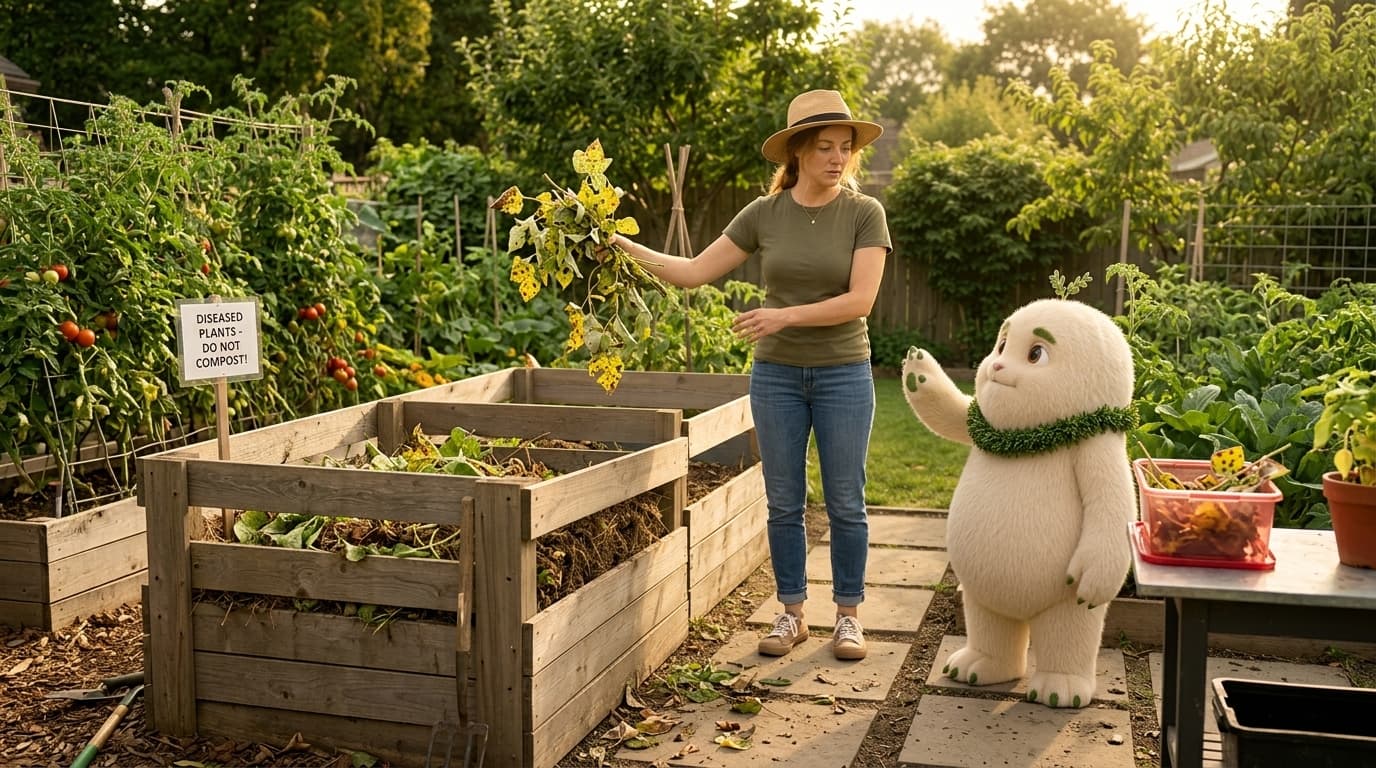
That exact scenario played out in Sophie's backyard on a warm September morning. Having cleared out an entire row of mildewed cucurbit leaves and spotted tomato vines, Sophie wheeled her load over to her wooden compost bay. With shovel in hand, she hoisted a heap of diseased vines, ready to pitch them into the bin. Before the diseased foliage could cross the threshold, Sprouty bounded onto the path, waving both paws in an urgent halt:
Sophie: (Lifting a bundle of spotted, mildewed vines toward the compost bay) "Time to turn you into next year's fertilizer!"
Sprouty: (Rushing over to block the bay) "Not in cool compost! If it stays under 165°F, those pathogens can survive and keep cycling."
Sophie: (Pulling the diseased vines safely back onto the path) "Whoa—good catch, Sprouty! Keep it out of the cool pile: bag it or hot-compost instead."
🦠 On-Screen Truth: Diseased plants in cool compost? Keep them out—pathogens survive under 165°F.
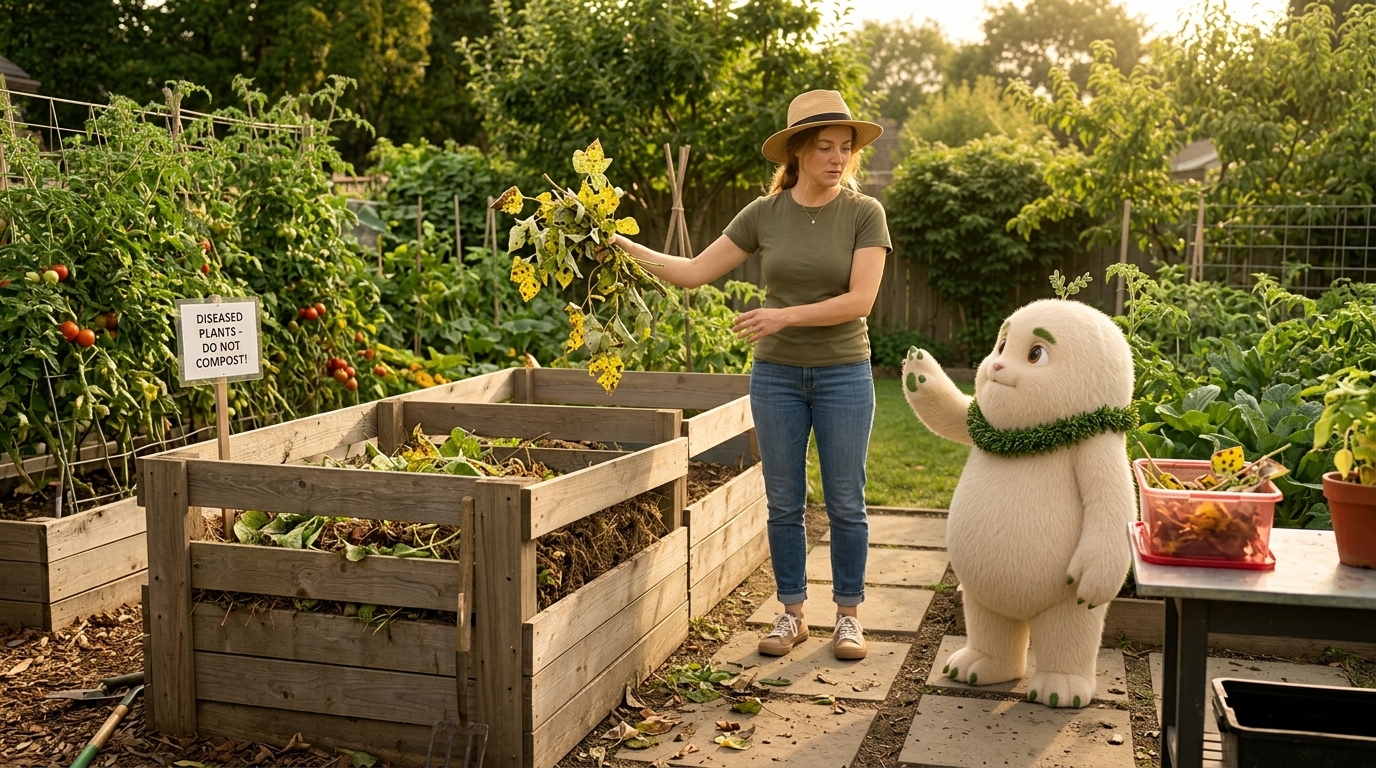
Watch Sprouty & Sophie Halt the Compost Disease Cycle
See why dumping diseased summer plants into cool compost lets pathogens survive and reinfect your garden in our quick video companion.
The Biological Difference: Cool vs. Hot Composting
To understand why dumping sick plants into a home compost pile is so risky, you have to understand the microbiological thermodynamics of decomposition. In horticulture, composting falls into two fundamentally distinct categories: cool (passive) composting and hot (thermophilic) composting.
1. Cool (Mesophilic) Composting: The Typical Backyard Pile
Over 90% of residential backyard gardeners practice cool composting—often without realizing it. You toss vegetable peelings, grass clippings, and garden trimmings into a plastic bin or open wooden bay as they accumulate. The pile decomposes slowly through the work of mesophilic microorganisms (bacteria, actinomycetes, and fungi that thrive in moderate temperatures between 68°F and 113°F / 20°C and 45°C), supplemented by earthworms, sowbugs, and beetles.
Mesophilic decomposition works well for producing rich humus over 6 to 12 months when feeding it clean, healthy materials (like clean fallen leaves; see our guide on why dead leaves save soil). However, the mesophilic temperature range is identical to the optimal growth range for most plant pathogens. At 75°F to 100°F, fungi and bacteria do not perish—they multiply. Furthermore, even if the center of a small home pile reaches 115°F on a warm August afternoon, the exterior 8 to 12 inches, edges, and base stay at ambient outdoor temperature, providing a cool shelter where pathogens survive undisturbed.
2. Hot (Thermophilic) Composting: The Pasteurization Engine
Hot composting is an active biological management process. It requires a specific physical critical mass (a minimum volume of 3 feet by 3 feet by 3 feet, or 1 cubic yard), an optimal carbon-to-nitrogen (C:N) ratio of roughly 25:1 to 30:1, moisture levels maintained at 40% to 60% (resembling a wrung-out sponge), and systematic turning to inject fresh oxygen.
Under these conditions, rapidly reproducing aerobic bacteria generate intense metabolic heat, pushing internal temperatures into the thermophilic phase (135°F to 160°F+ / 57°C to 71°C+). At these elevated temperatures, cellular proteins denature, cell membranes dissolve, and pathogenic structures are pasteurized. However, maintaining this level of heat across every cubic inch of material requires rigorous management that few casual home gardeners have the time or volume to sustain.
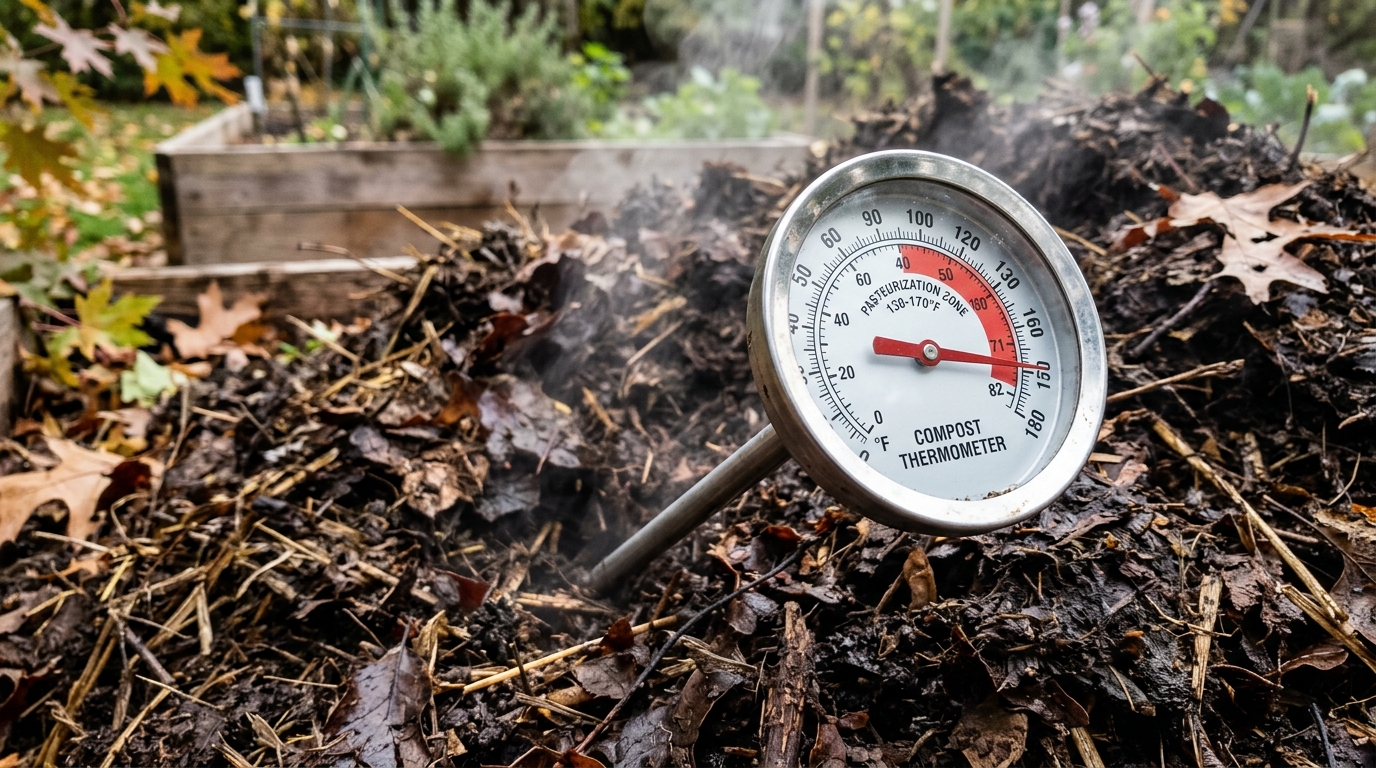
The Plant Pathology: Why Pathogens Survive Under 165°F
Why is 160°F to 165°F the critical horticultural benchmark? Because evolutionary pressure has equipped plant pathogens with specialized survival structures specifically designed to endure harsh freezes, prolonged droughts, and biological competition. Unless internal pile temperatures breach their specific thermal death point for a sustained duration, they emerge from the compost pile fully virulent.
As documented in research by the University of Minnesota Extension Composting in Home Gardens Guidelines, home compost piles routinely fail to achieve the sustained thermal thresholds needed to kill stubborn plant diseases and weed seeds. Consider the survival mechanisms of common garden culprits:
- Fungal Resting Sclerotia (Verticillium, Sclerotinia, Rhizoctonia): Soilborne fungi like Verticillium dahliae (which causes devastating vascular wilt in tomatoes, peppers, potatoes, and strawberries) do not survive solely as fragile mycelium. They produce microsclerotia—dense, microscopic clusters of thick-walled, melanized cells. According to university plant pathology trials and UC Statewide IPM Soil Solarization Guidelines, microsclerotia can persist dormant in soil for 10 to 15 years. They can withstand dry heat above 135°F for hours; destroying them in organic matter requires sustained moist heat between 140°F and 150°F+. In a cool pile hovering at 90°F, microsclerotia remain 100% viable.
- Oospores and Late Blight (Phytophthora infestans): Late blight, the notorious water mold that turns tomato foliage into blackened grease and rots tubers, forms thick-walled resting sexual spores called oospores when both mating types are present. Oospores resist freezing and moderate decomposition, requiring heat above 130°F to 140°F for guaranteed inactivation.
- Powdery Mildew Cleistothecia: While powdery mildew conidia are relatively delicate, late-season powdery mildew fungi produce sexual overwintering structures called chasmothecia (or cleistothecia) on dying summer foliage. As highlighted in the UC IPM Guidelines for Powdery Mildew on Vegetables, these dark, thick-coated spheres latch onto organic residue and crack open in spring to release airborne ascospores directly into your seedling beds.
- Plant Viruses (Tobacco Mosaic Virus, Tomato Brown Rugose Fruit Virus): Viruses are not living cellular organisms; they are stable strands of genetic material protected by an extraordinarily rigid protein capsid. Tobacco Mosaic Virus (TMV) and related tobamoviruses are among the most indestructible plant pathogens known. Plant pathology data confirms that TMV requires exposure to temperatures of 160°F to 165°F (71°C to 74°C) for at least 30 minutes to reliably denature. In a cool backyard pile, TMV can survive in undecomposed stalk tissue for years.
- Bacterial Cankers and Wilts (Clavibacter, Ralstonia, Xanthomonas): Bacterial spot and bacterial canker colonize the vascular bundles and xylem tissues of tomato and pepper stems. In cool compost, bacteria shelter inside woody stem fibers, emerging unharmed when the compost is distributed. (Learn more about Solanaceae disease management in the UC IPM Tomato Pest Management Guide).
The Re-Inoculation Trap: How Cool Compost Ruins Next Spring
The danger of adding diseased debris to a cool compost pile is compounded by how finished compost is used in the garden. When you toss blighted tomato stems or spotted cucumber vines into a cool pile in September, the material will eventually break down. By May or June of the following year, worms and mesophilic fungi will have reduced those vines to dark, crumbly, earthy-smelling organic compost.
To the naked eye, the compost looks pristine. But microscopically, it is teeming with viable resting spores and viral fragments. When you proudly work two shovelfuls of that compost into each tomato planting hole, topdress your raised beds, or blend it into your seedling potting mix, you are doing something tragic: you are mechanically inoculating your garden's root zone with the very diseases that plagued your plants the year before.
When warm spring weather and seasonal rains arrive, the newly planted seedlings send tender feeder roots straight into the spore-laden compost. Within weeks, the pathogen penetrates root hairs or splashes onto lower leaves during irrigation, reigniting the infection cycle. Many gardeners spend hundreds of dollars on organic sprays, copper fungicides, and disease-resistant hybrids, completely unaware that their own homemade compost pile was the disease vector all along.
💡 The Sanitation Rule: Orchard Hygiene Applies to Annuals Too
Just as leaving fallen fruit under fruit trees lets brown rot and codling moths overwinter (see our breakdown on why removing fallen diseased fruit breaks the fungal loop), leaving diseased summer vegetable stalks on the soil or dumping them into cool compost creates a biological reservoir. Clean soil sanitation is always more effective than attempting to cure a runaway infection mid-season.
How to Safely Dispose of Diseased Summer Plants
If diseased plant debris must never enter a cool backyard compost pile, what should you do with that wheelbarrow full of mildewed squash leaves and blighted tomato vines? Gardeners have three reliable, scientifically backed options:
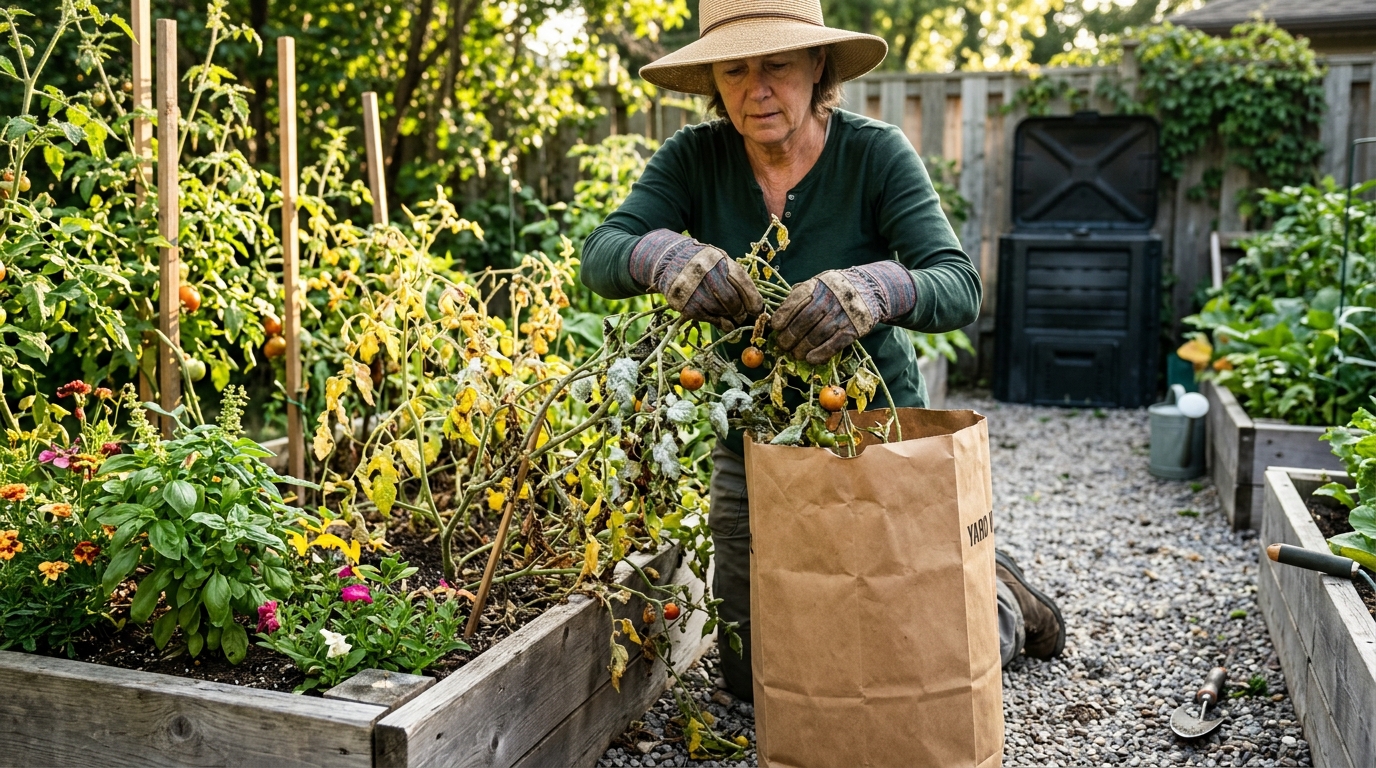
1. Municipal Green-Waste Collection (The Best Solution)
For the vast majority of suburban and urban gardeners, the municipal green-waste cart (your curbside yard-waste bin) is the safest destination for diseased plant material. Unlike backyard piles, commercial municipal composting facilities operate massive industrial windrows or aerated static piles governed by EPA 503 standards (Process to Further Reduce Pathogens). These industrial piles routinely sustain core temperatures between 150°F and 170°F (65°C to 77°C) for consecutive weeks, with specialized machinery turning and homogenizing the windrows. This industrial heat thoroughly pasteurizes fungal spores, bacterial blights, viral proteins, and weed seeds, converting the material safely into certified commercial mulch.
2. Double-Bagged Trash Disposal
If you live in a rural area or jurisdiction without municipal green-waste collection, place severely diseased plant debris into heavy-duty plastic or paper bags, seal them tightly, and dispose of them with regular municipal solid waste. While sending organic matter to a landfill is generally discouraged, sacrificing a small batch of heavily diseased vines protects thousands of pounds of future healthy garden produce and keeps persistent pathogens out of local soils.
3. Deep Trench Burial (>18 to 24 Inches Deep)
If you cannot use municipal collection and refuse to send organic matter to landfill, deep trench burial is an accepted horticultural alternative for fungal-infected tissue (excluding viruses like TMV). Dig a trench at least 18 to 24 inches deep in an unplanted area far away from vegetable beds or future cultivation zones. Lay the diseased debris in the bottom and cover it with at least 18 inches of compacted native soil. Deprived of oxygen, light, and root-surface contact, fungal spores are smothered and decomposed by deep anaerobic and microaerophilic soil microbes before they can ever reach the surface.
The Hot Composting Exception: How to Hit 160°F+ at Home
Can you compost diseased plant debris at home if you practice true hot composting? Yes—but only if you possess the equipment, volume, and discipline to manage the thermal process scientifically. If you choose this path, you must follow the strict four-rule protocol:
- Maintain Minimum 1 Cubic Yard Volume: A pile smaller than 3 feet wide by 3 feet long by 3 feet tall (27 cubic feet) loses heat faster than microbes can generate it. The mass of organic material acts as insulation; without sufficient bulk, core temperatures will never breach 135°F.
- Balance Carbon and Nitrogen (30:1 Ratio): Construct the pile in alternating layers of brown, carbon-rich materials (shredded cardboard, dry straw, chopped autumn leaves) and green, nitrogen-rich materials (fresh green clippings, vegetable scraps, manure). Too much carbon stalls heating; too much nitrogen leads to anaerobic slime and ammonia gas.
- Monitor Daily With a Long-Stem Probe Thermometer: Never guess internal pile temperatures. Insert a 19-inch to 24-inch stainless steel compost thermometer straight into the center. The core must reach between 140°F and 160°F (60°C to 71°C) and hold that range for at least three to five consecutive days.
- Execute 3 to 5 Complete Turnings: When you turn the pile, use a pitchfork to peel away the cool outer 8 to 10 inches of material and place it directly into the center of the new pile, while shifting the hot core material to the perimeter. Every piece of diseased tissue must spend several days inside the thermophilic core to ensure comprehensive kill.
If you lack a compost thermometer, lack the 27 cubic feet of bulk material, or cannot commit to turning the pile every 3 to 5 days, err on the side of caution and keep diseased debris out of your pile.
What Summer Debris Is 100% Safe for Cool Compost?
Banning diseased plants does not mean your compost bin must go hungry this autumn. You can safely add large volumes of healthy spent garden residue to cool and hot piles alike:
- Healthy Annual Crop Foliage: Spent bush beans with clean green leaves, bolting lettuce, disease-free carrot and beet greens, and clean corn stalks (shredded or chopped first).
- Clean Autumn Leaves: Deciduous tree leaves that show no fungal tar spot or powdery mildew make exceptional carbon bedding.
- Untreated Grass Clippings & Kitchen Scraps: Raw vegetable peelings, apple cores, coffee grounds, and tea leaves.
- Pruning Cuttings: Trimmings from healthy perennial herbs and shrubs.
Frequently Asked Questions About Compost Safety & Plant Diseases
Does vermicomposting (worm bins) kill plant pathogens?
No. Composting worms (such as red wigglers, Eisenia fetida) thrive at moderate temperatures between 55°F and 77°F (13°C to 25°C). Temperatures exceeding 95°F will kill the worms. Because vermicomposting is strictly a cool, low-temperature biological process, worm bins provide zero pasteurization and must never receive diseased plant material.
Can I solarize my diseased garden trimmings in black plastic bags?
Baking diseased foliage inside sealed black contractor bags in full summer sun (often called "trash bag solarization") can generate temperatures between 130°F and 145°F during peak July or August heat in sunny regions like California's Central Valley or the American Southwest. However, in September or cooler climates, solar heating inside bags is erratic and rarely achieves the uniform 160°F required to neutralize resilient viruses and sclerotia throughout the bundle. It is useful as a pre-treatment before municipal disposal, but bagged material should still be kept out of cool compost piles.
What about powdery mildew—doesn't it die when the leaf dies?
Powdery mildew fungi are obligate biotrophic parasites—meaning they require living host tissue to feed. When the leaf dies and turns brown, the active vegetative fungal mycelium dies with it. However, toward the end of summer, powdery mildews produce specialized sexual resting structures called cleistothecia (chasmothecia) embedded in the dying leaf tissue. These microscopic black spheres survive freezing winter cold and physical desiccation, discharging infectious spores in spring when warmed by rising ambient temperatures.
Ready to elevate your garden soil and sanitation practices? Explore our beginner's roadmap with Composting 101: A Beginner's Guide, discover why dead leaves belong on soil instead of bags, see why you should mulch while soil is still 55–65°F, check how to handle white powdery mildew outbreaks quickly, learn orchard sanitation in our guide on picking up fallen diseased fruit, and browse our comprehensive Seasonal Gardening Playbook.