
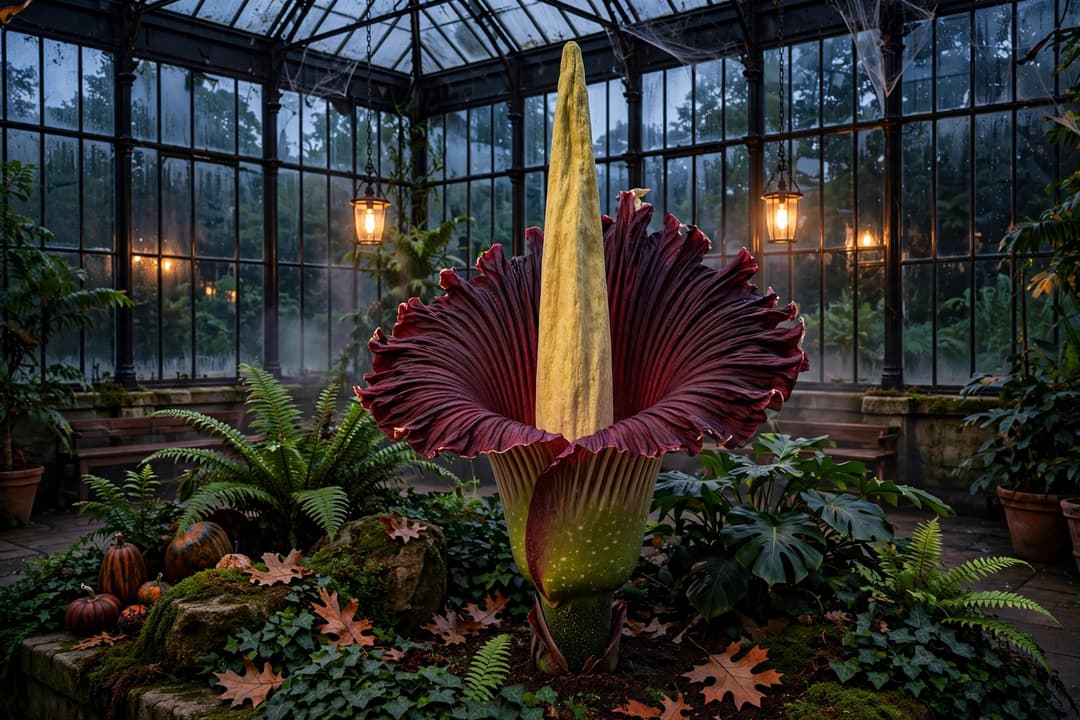
The UC Santa Cruz Arboretum's corpse flower is expected to bloom within days — possibly right on top of Halloween 2026 — in what will be only its second bloom since arriving in 2012, Lookout Santa Cruz reported on October 19, 2026. The first bloom, on August 2, 2022, drew thousands of visitors, and Arboretum's Rick Flores says staff realized about a week prior that this one was about to open. Once it does, the window is brutally short: the foul-smelling bloom lasts roughly 24 hours before the flower collapses and disintegrates. Nobody can precisely predict the exact hour, so check the Arboretum's official bloom page — which posts a dated series of bud-development photos — before heading to Santa Cruz.
Estimates below are as of October 21, 2026. The window is real but narrow — check the Arboretum's official page for the latest before you go.
Sophie: (Reading the news) "A giant flower at UC Santa Cruz is about to bloom for Halloween and it smells like rotting meat? Is this real, Sprouty, and can we actually go see it?"
Sprouty: (Grinning) "Real — and really rare, Sophie! It is not one flower at all, but a whole cluster blooming together. The stink is a trap: it lures in the flies that pollinate it. And yes, we can go — if we time it right."
💀 Takeaway: The corpse flower is an inflorescence — hundreds of tiny flowers, not one — and its stink is a pollination strategy, not an accident.
What a corpse flower actually is
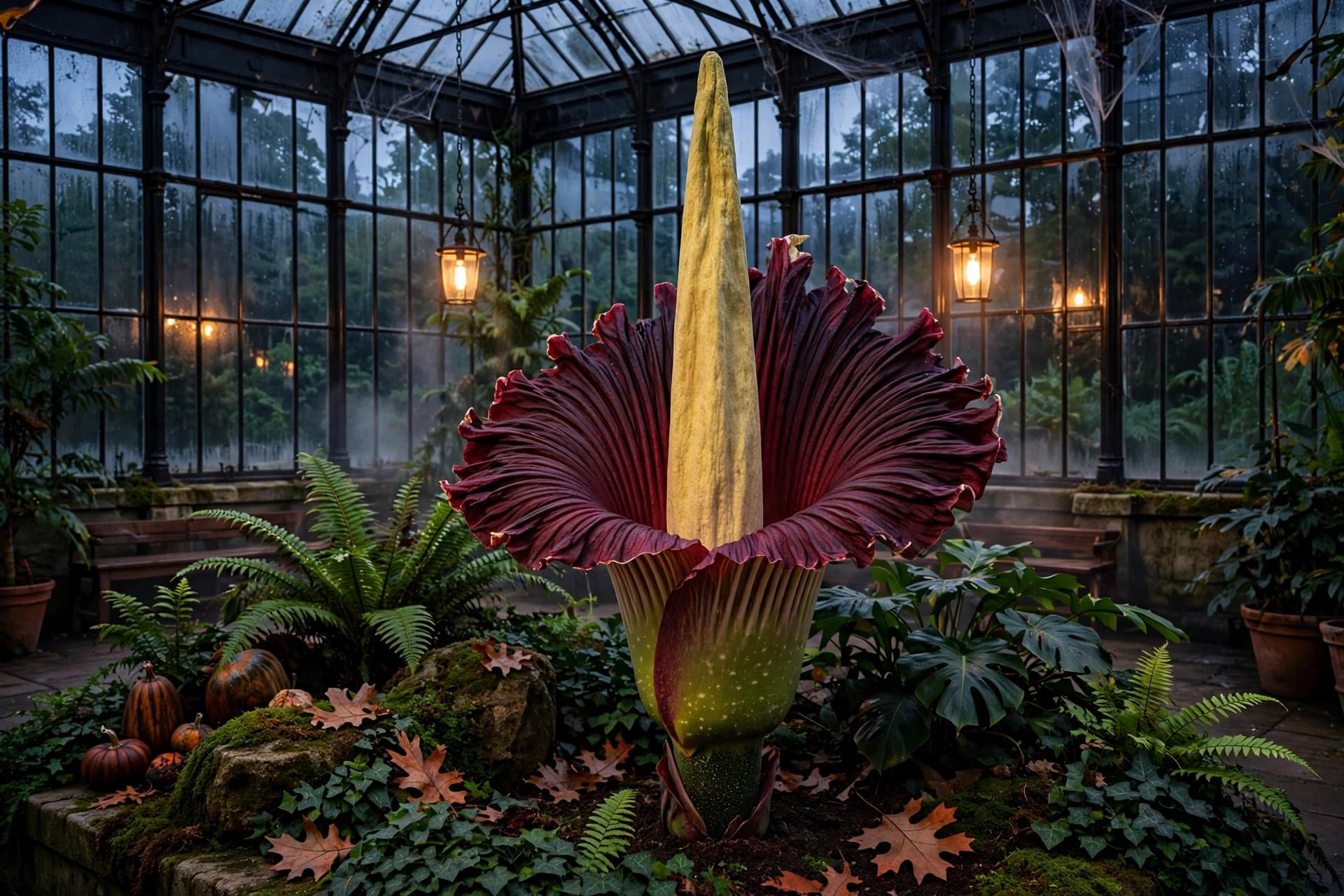
The corpse flower is Amorphophallus titanum (Becc.) in the family Araceae (UCSC Arboretum). Botanically, it is not a single flower at all but an inflorescence: a cluster of many tiny flowers borne on the spadix, the tall central spike, which rises from a deep magenta-red spathe, the huge modified leaf that looks like a petal (Lookout Santa Cruz). The infamous foul odor — UC Santa Cruz Arboretum's Martin Quigley told the Mercury News in October 2026 it smells like "a very large pile of very rotten meat with an overlay of (poop), some dead fish and a few other things" (Mercury News) — exists to attract the flies that pollinate the flowers on the spadix. On the bloom cycle, 2026 sources disagree: the Mercury News reported the plant takes 7 to 10 years to mature and then blooms briefly once every 3 to 5 years, while Lookout's October 19, 2026 coverage puts it at roughly 5 to 8 years between blooms, with Flores noting that "every four years is kind of early" (Mercury News; Lookout Santa Cruz).
Why the timing is genuinely unpredictable
"Nobody can precisely predict" when a corpse flower will bloom, as the Mercury News put it in October 2026 (Mercury News). The UCSC bloom was expected "within the next week to week-and-a-half" as of about October 19, with blooms that tend to begin in the late afternoon or evening (Lookout Santa Cruz). The bloom lasts only about 24 hours — some 2026 reporting puts the window at 24 to 36 hours (Lookout Santa Cruz; Mercury News) — which means most hopeful visitors will miss it entirely. The Arboretum is tracking the bud with development photos dated October 1, 9, 14, and 19, 2026, on its official bloom page, and that's the page to watch rather than guessing. This is a banner month for the phenomenon: corpse flowers at San Jose State University and UC Santa Cruz were both expected to be fully open "early next week" around October 20, 2026, with simultaneous blooms also reported at UC Riverside, the Cincinnati Zoo & Botanical Garden, and a Georgetown, Massachusetts nursery, while the Missouri Botanical Garden's plant had just finished (Mercury News).
Planning a visit: the honest logistics
If the timing lines up, go — but plan it like a mission. The UCSC Arboretum sits on the east side of High Street, about a half-mile past the main campus entrance; use the address "1 Arboretum Road" (Lookout Santa Cruz). While the bud is still developing it is on public display during normal hours, 9am to 5pm; on the day it opens, the Arboretum sends an email announcement and extends hours to 7am–7pm (UCSC Arboretum). Admission is $13 for adults, $10 for seniors, $7 for youth ages 4–17 — free for kids under 4, Arboretum members, and UCSC students (UCSC Arboretum; Lookout Santa Cruz). The Arboretum warns that parking is extremely limited and parking on Empire Grade is prohibited and ticketed — walk, bike, Uber/Lyft, or take public transit is the Arboretum's stated "Best Option," and overflow visitors should park at the UCSC East Remote or other campus lot (UCSC Arboretum). The 2022 bloom drew thousands of visitors, so expect crowds if the Halloween-week timing holds. And remember: with a bloom lasting about 24 hours, check the official page the morning of any trip — a flower that opened yesterday evening is already on its way out.
Quick answers
When will the UCSC corpse flower bloom?
It is expected to bloom within days of Halloween 2026 — roughly a week to a week-and-a-half from October 19, 2026 (Lookout Santa Cruz). The exact timing cannot be predicted (Mercury News); check the Arboretum's official bloom page for the latest bud photos before driving over.
How long does a corpse flower bloom last?
About 24 hours — Lookout's October 2026 coverage says the flower collapses and disintegrates within roughly a day of opening, and other 2026 reporting puts the window at 24 to 36 hours (Lookout Santa Cruz; Mercury News). Blooms tend to begin in the late afternoon or evening.
Why does the corpse flower smell so bad?
The foul, rotting-flesh odor attracts flies, which pollinate the many small flowers on the spadix (Lookout Santa Cruz). The stink is the pollination strategy, not a defect.
Is the corpse flower one flower?
No — it is an inflorescence, a cluster of many flowers on the spadix, rising from a deep magenta-red spathe (Lookout Santa Cruz). Its scientific name is Amorphophallus titanum, family Araceae (UCSC Arboretum).
Could I grow a corpse flower at home?
Not realistically. The Arboretum's plant is a rare tropical giant pampered by greenhouse staff, and it took from its arrival in 2012 to its first bloom on August 2, 2022 — a decade — to reach flowering size (UCSC Arboretum; Lookout Santa Cruz). Enjoy this one in person.