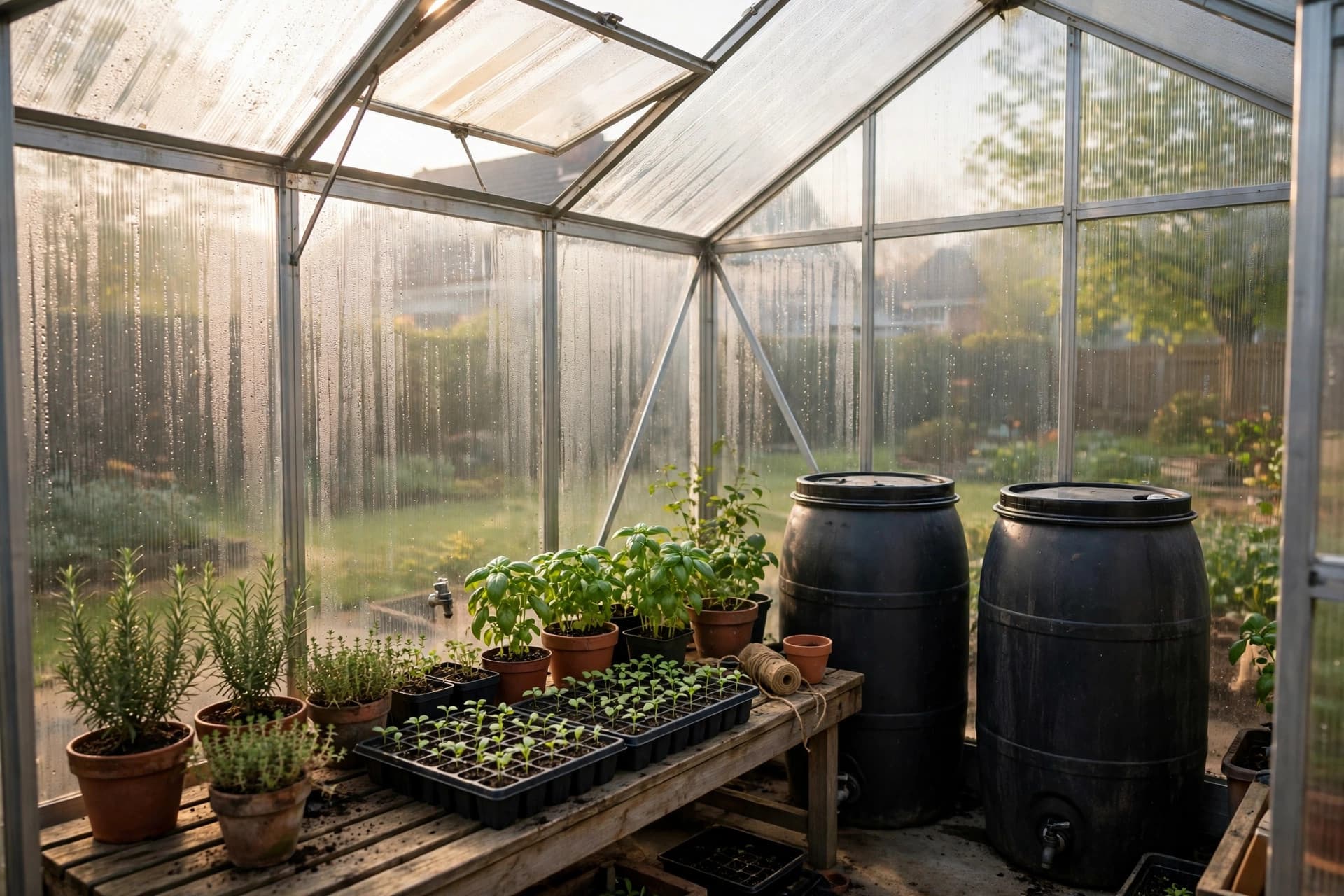

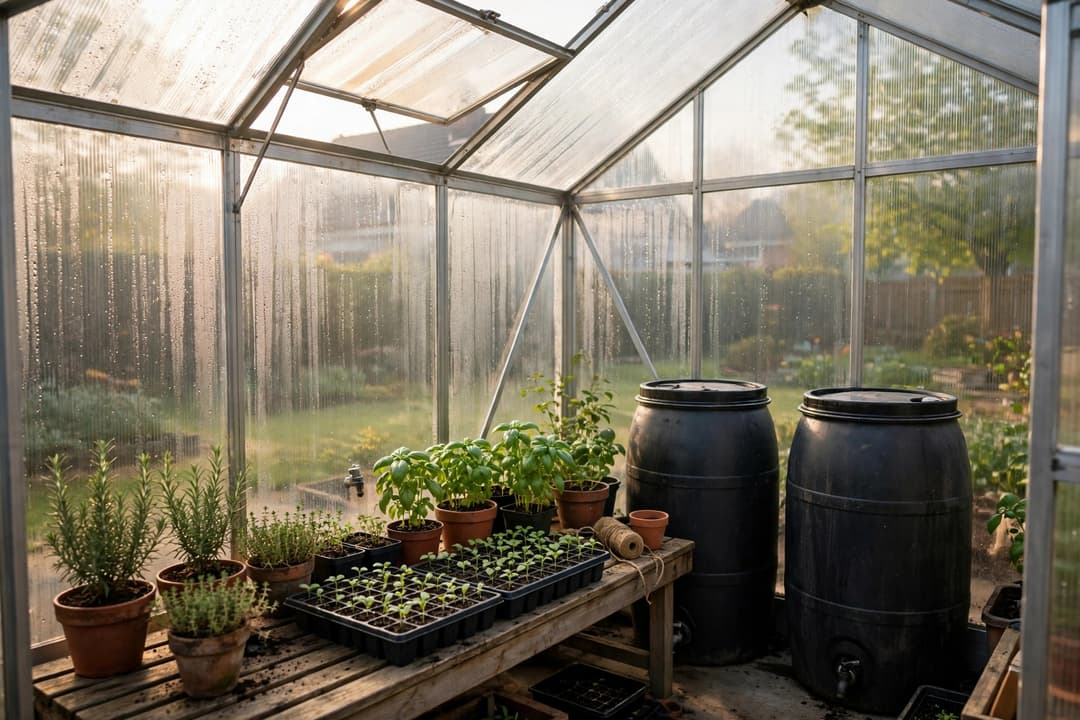
A home greenhouse is a solar trap: it overheats by midday even on cool, sunny days, then sheds its heat fast after sunset. Caring for one is a daily rhythm for managing that swing — opening vents and watering in the morning, letting heat escape during the day, and holding a safe minimum temperature at night with a thermostat-triggered heater and thermal mass such as water barrels. Nebraska Extension lists exactly these levers — heaters, heat mats, and thermal mass for cold weather, and shade cloth, fans, and roof vents against overheating. Get those habits right and most herbs, seedlings, and hardy plants can live in the greenhouse year-round. Tender tropicals cannot overwinter in an unheated one, and basil is damaged below 50°F, according to Cornell Cooperative Extension.
Sophie: "A gardener at the market swore by a bucket of water in his greenhouse. Said it warms up all morning and keeps the place humid overnight. Real, or garden folklore?"
Sprouty: "Real — it is thermal mass, and there is a whole section on it below. But a bucket is the small version. Sealed, dark barrels in the sun bank far more heat, and even they will not save a tender plant on a hard-freeze night."
Sophie: "Banked heat and an honest warning in one answer. Thanks, Sprouty."
What Are the Main Types of Home Greenhouses?
For homes, four shapes cover nearly everything, and the right one depends on your space and how serious the habit is about to get:
- Freestanding greenhouse: a standalone structure — the classic backyard greenhouse. It offers the most growing space and design options, and total freedom of placement, but it needs the room.
- Lean-to greenhouse: built against the side of a house or garage, using the existing wall for support. It saves space and, per Nebraska Extension, shares the heat from the adjacent building — a real advantage on winter nights.
- Cold frame: a small, low box with a clear lid, usually wood or plastic. Simple and inexpensive, and ideal for starting seedlings and hardening off plants in early spring and late fall. It is the beginner's greenhouse in miniature.
- Hoop house (high tunnel): flexible hoops covered with plastic film — a cost-effective way to extend the growing season over in-ground beds (Nebraska Extension).
The covering matters as much as the shape. Glass has excellent light transmission and looks beautiful, but it is heavy and expensive. Polycarbonate is lightweight, durable, and provides good insulation — the practical default for most homes. Polyethylene film is the cheapest glazing and the shortest-lived, which is why it belongs on hoop houses and cold frames rather than permanent structures. Frames follow the same logic: aluminum is lightweight and rust-resistant, while wood looks natural but needs maintenance against rot (Nebraska Extension).
The Daily Rhythm: What to Do in the Morning, at Midday, and at Night
Morning is the important visit. First, read a maximum-minimum thermometer: how cold did it actually get last night? That one number tells you whether your heating is sized right. Second, open a vent or the door on any mild morning to change the air — a closed greenhouse collects humid, still air overnight, and excess humidity is what feeds fungal disease; Nebraska Extension notes that mechanical ventilation and dehumidification are the standard defenses. Third, water in the morning, at the base of the plants, so foliage dries quickly in the day's warmth. Morning watering is one of the easiest disease-prevention habits a greenhouse owner can build.
Midday is about escaping heat. On a sunny day the inside temperature climbs far faster than the weather outside suggests, and a sealed house can stress or scorch plants while the yard still feels cool. Roof vents, side vents, and roll-up sides let hot air out naturally; fans and exhaust systems do it mechanically, and shade cloth cuts the gain in summer (Nebraska Extension). If you work away from home, automatic vent openers (below) are not a luxury — they are the difference between a greenhouse and an oven.
Night is about holding the floor. Close vents in the late afternoon, before the temperature starts to fall, so you trap the day's warmth instead of chasing it. Make sure the heater's thermostat is armed at your neediest plant's minimum. Then let thermal mass do its quiet work: the water barrels that soaked up sun all day release that heat slowly through the night. On a forecast hard-freeze night, add one layer — fleece or horticultural bubble wrap over the tenderest pots, or move them against the warmest wall.
Temperature-Triggered Heaters: Which Type Should You Get?
"Temperature-triggered" simply means thermostat control: the heater fires only when the greenhouse drops to the temperature you set, then shuts off. That one feature saves real money, because a greenhouse usually needs help for a few hours on cold nights, not a blast furnace running until dawn.
- Electric fan heater with a built-in thermostat — the default pick for most homes. If you can run power to the greenhouse, start here. Electric heat adds no moisture to the air (fuel heaters do), and the fan keeps air moving, which itself discourages fungal disease. Choose a model made for damp greenhouse use, with overheat cutoff and tip-over shutoff, and plug it directly into a GFCI-protected outlet — never through an extension cord, which is a genuine fire risk at heater wattages.
- A plug-in thermostat controller. If your heater's own dial is vague, a separate thermostat plug gives you an accurate set point and lets you place the sensor at plant height, where the temperature actually matters. This is the cheapest accuracy upgrade in the whole greenhouse.
- Tubular and low-wattage background heaters. Gentle, steady warmth designed to hold a house just frost-free rather than to grow in. Cheap to run and perfect for shepherding a few tender plants through winter — but not enough alone in a cold climate if you want active growth.
- Propane and gas heaters. Serious heat for larger structures, but combustion produces water vapor and carbon monoxide, so these heaters need ventilation to be safe and effective. In a small, sealed hobby greenhouse, that trade usually argues for electric.
- Paraffin heaters. The off-grid classic: no electricity at all, low and steady heat. They also add moisture, need ventilation, and want regular wick care. Keep one as a power-cut backup if you like, but where safe power exists, a thermostatic electric heater is cleaner and easier.
Cooling can be temperature-triggered too. A thermostatic exhaust fan kicks on at the temperature you set, and wax-cylinder automatic vent openers need no power whatsoever: the wax expands as it warms and pushes the roof vent open, then contracts and closes it as the house cools.
Set the thermostat for the job you are actually doing. Holding a house frost-free — a set point around 40 to 45°F, a deliberate safety margin above the 32°F line where frost actually bites — keeps most overwintering plants alive at modest cost. Actively growing plants want more: most herbs, for example, prefer days around 60 to 70°F (Oklahoma State University Extension). Heating to growing warmth all winter costs far more than frost-free keeping, so be honest about which job your greenhouse has.
On heater size: heaters are sold by wattage, and the right size depends on your greenhouse's volume, its glazing, and how cold your nights get — use the manufacturer's rating for your square footage and climate rather than a universal number, and size up if you keep tender plants. Insulation shrinks the heater you need: insulated materials and double-layer glazing retain heat (Nebraska Extension).
The Water Bucket Trick: Banked Heat and Humidity Overnight
The tip going around — park a bucket of water in the greenhouse so it warms by day and keeps things humid overnight — is real physics with honest limits. Water is thermal mass: it absorbs heat slowly while the sun is up and releases it slowly after dark, flattening the temperature swing. Nebraska Extension lists water barrels among its greenhouse heating methods (Nebraska Extension).
To get the real effect rather than the folklore version:
- Go bigger and darker. A single bucket makes a small dent; one or two 55-gallon barrels make a noticeable difference in a small house — and the bigger the house, the more mass it takes to move the needle. Dark-colored or black-painted containers absorb more sun.
- Put them where the sun lands — in the sunniest spot that does not shade your plants; along the north wall is the classic placement in the Northern Hemisphere, catching low winter sun without stealing light from crops.
- Keep lids on. A sealed barrel still banks and releases heat, but it does not lose warmth to evaporation, grow algae, or breed mosquitoes.
- Know the limit. Thermal mass smooths the overnight dip — it takes the edge off the coldest hour. It is a buffer, not a furnace: on a hard-freeze night, tender plants still need the thermostat heater.
About the humidity half of the tip: an open bucket does release moisture, and many plants enjoy higher humidity — Oklahoma State Extension even suggests pebble trays of water under pots to raise it for herbs. But in a cold, still greenhouse, excess humidity is the main disease driver: grey mould thrives in exactly that damp, stagnant air. That is why the morning venting habit matters, and why the sealed-barrel version of this trick gives you the heat without the swamp.
What Can Stay in the Greenhouse All Year — and What Can't
Can stay in an unheated house in mild climates — or a frost-free one anywhere: hardy perennial herbs such as thyme, sage, and oregano, plus rosemary where winters are mild (in cold climates, rosemary needs the house kept frost-free); dormant perennials resting for winter; and cool-season greens like spinach, kale, and chard, which keep growing slowly through cold weather that would kill tender crops. Seedlings started in late winter are the greenhouse's spring superpower.
Can stay only if the house stays frost-free: pelargoniums (the bedding "geraniums"), which overwinter happily on a bench kept above freezing and on the dry side; fuchsias; and citrus — lemons and limes especially — and other tender exotics, which need frost-free air and good light all winter. (Hardier citrus such as satsumas shrug off a light frost, but don't bet a lemon tree on it.) Glass alone will not protect tender citrus through freezing nights, so they are the plants that justify background heat.
Cannot stay in an unheated greenhouse through a freezing winter: basil, which is damaged below 50°F (Cornell Cooperative Extension) — treat scented geraniums as nearly as tender and give them the same protection; true tropical houseplants, many of which are damaged by temperatures in the 50s and below, and injured outright by real cold; and summer crops like tomatoes and peppers if you expect them to keep producing — they will not grow or fruit through winter cold and short days. The greenhouse restarts them from seed in spring instead, weeks ahead of the garden.
One reverse warning: in summer, almost nothing can stay in a sealed greenhouse. Heat, not cold, is the greenhouse killer with the least warning, which is why ventilation and shade come before heaters in every budget.
Is a Greenhouse Good for Herbs?
Yes — arguably the best first use of one. Herbs reward exactly what a greenhouse controls: light, drainage, warmth, and air movement. Mediterranean herbs — rosemary, thyme, sage, oregano — love the bright, relatively dry air and the sharp drainage you can give them in pots. Soft herbs like parsley, cilantro, and chives do well in the cooler, slightly shadier spots. Basil is the prize and the diva: it thrives in the greenhouse's summer warmth and keeps producing weeks past the first outdoor frost, but it must be held above 50°F (Cornell Cooperative Extension).
The numbers are forgiving. Most herbs can survive down to almost 40°F (Cornell Cooperative Extension). For active growth, Oklahoma State University Extension puts herbs' preference at daytime temperatures around 60 to 70°F, with at least five hours of sunlight from a southern exposure (Oklahoma State University Extension). Water at the base in the morning, keep Mediterranean herbs on the dry side, and never let pots sit in water — overwatering, and the root rot it causes, is a common killer of greenhouse herbs. Give mint a pot of its own unless you want it to annex the greenhouse floor. If you want to actively grow (not just hold) herbs in the darkest weeks, Cornell's guidance for herbs under lights is to place containers 6 to 12 inches under two 40-watt cool white fluorescent bulbs for 14 to 16 hours a day — modern LED grow lights follow the same idea.
Beginner Picks: The Starter Setup
- The structure: a 6x8-foot twin-wall polycarbonate kit on an aluminum frame, with at least one roof vent. Polycarbonate insulates better than single glass, will not shatter, and forgives beginner mistakes; Nebraska Extension's siting advice is to choose maximum sunlight — especially winter sun — with easy access to water and electricity (Nebraska Extension). If your only sunny spot is against the house, choose a lean-to and let the wall help you heat. If you only want seedlings and a longer season, save the money and start with a cold frame.
- The five extras that matter more than size: a maximum-minimum thermometer (or a Wi-Fi sensor that alerts your phone), an automatic vent opener, a thermostatic electric fan heater if you have power, one or two dark water barrels, and shade cloth for summer. Add horticultural bubble wrap to clip inside the glazing on cold snaps.
- The first residents: herbs, seedlings, and overwintered geraniums. Prove your heating through one cold snap before anything tropical moves in.
Frequently Asked Questions
Do I need to heat a greenhouse at all?
Only as warm as your neediest plant requires. Frost-free keeping — a thermostat set around 40 to 45°F, safely above the freezing line — shepherds overwintering plants and hardy herbs through winter cheaply. Many beginners heat nothing at all and use the house for seedlings, herbs, and season extension — heating is for tender plants and winter growing, not for the structure's sake.
Does a bucket of water really keep a greenhouse warm overnight?
It genuinely helps: water banks the day's heat and releases it overnight, softening the coldest dip. Scale and sealing decide how much — the full breakdown is in the water-barrel section above.
Glass or polycarbonate for a first greenhouse?
Polycarbonate, for most beginners: Nebraska Extension describes it as lightweight, durable, and a good insulator, and it will not shatter (Nebraska Extension). Choose glass if the greenhouse is also a garden showpiece and the budget stretches — Nebraska credits it with excellent light transmission, and it lasts for decades.
Can I leave my herbs in the greenhouse all winter?
The hardy ones, yes — rosemary, thyme, sage, and oregano handle a frost-free or even unheated house in mild climates, and most herbs survive down to almost 40°F. Basil is the exception, for the reason covered in the Herbs section above: it either gets the heated corner or a sunny indoor windowsill.