
Start with the crop and its intended outdoor planting date, then count back using the seed packet's indoor-sowing guidance. Sow into a clean, suitable growing medium, keep moisture even, and provide enough light as soon as seedlings emerge. Most failures come from a mismatch in timing, moisture, temperature, or light — not from missing an expensive piece of equipment.
Sprouty: "You need a date on the calendar, a bag of decent mix, and light that's actually close enough. The kit is optional. The timing isn't."
Which Crops Should You Start Indoors?
Not every seed belongs under your grow lights. The decision comes down to one question: does this plant need more frost-free days than your season provides? If yes, start it indoors. If not, direct sow and save yourself the shelf space.
For slow-maturing crops like tomatoes, peppers, and eggplant — which need 60–90+ days from transplant to harvest — starting indoors isn't just helpful, it's essential in most climates. Without it, these plants simply run out of season.
A note on the old "direct sow only" rule: root crops like carrots and radishes really should be direct-sown, since disturbing their taproots causes forking. But beets, peas, beans, and corn can be transplanted successfully in suitable systems — soil blocks, biodegradable pots, or careful handling of young seedlings. The blanket "do not transplant" advice is too absolute; match the method to the crop.
Build Your Schedule From Frost Dates
The single most important number in seed starting is your last spring frost date. Every sowing calculation flows from it:
- Find your last frost date — see our frost-date planting planner for how to pin it down for your exact location.
- Check whether your USDA hardiness zone has shifted recently; zone changes can move your planting windows.
- Read each seed packet — it will say something like "Start indoors 6–8 weeks before last frost."
- Count backward from your frost date to get your sowing date, and write the whole schedule down before buying a single packet.
Seed Starting Calendar — Weeks Before Last Frost (check your packet; varieties differ)
| Weeks Before Last Frost | What to Start |
|---|---|
| 12–14 weeks | Onions, leeks, celery, celeriac (very slow growers) |
| 8–12 weeks | Peppers, eggplant (long, warm season needed — peppers often want the earlier end of this range) |
| 6–8 weeks | Tomatoes, basil, annual flowers (impatiens, petunias, marigolds) |
| 4–6 weeks | Broccoli, cauliflower, cabbage, kale, lettuce, spinach |
| 2–4 weeks | Cucumbers, squash, melons (fast growers — don't sow too early) |
| Direct sow at/after frost | Carrots, radishes (taproot crops — don't transplant) |
| Direct sow preferred, transplantable with care | Beets, peas, beans, corn (use soil blocks or biodegradable pots to avoid root disturbance) |
A Minimal Setup — and Optional Upgrades
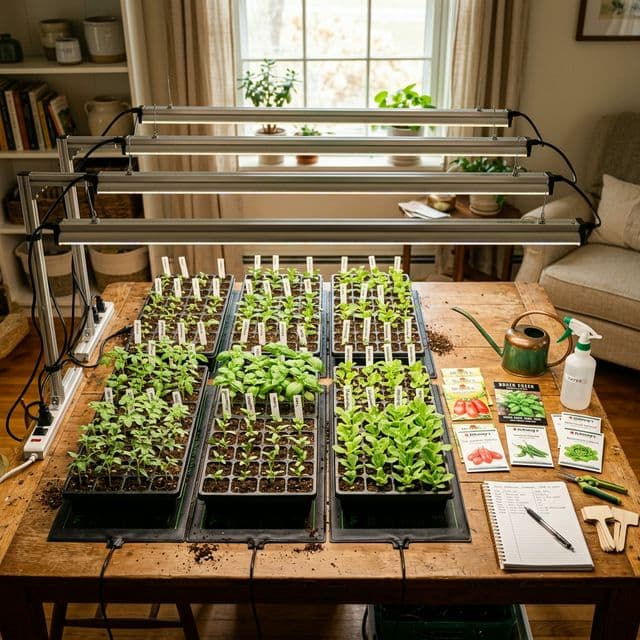
You don't need expensive equipment to start seeds indoors — but the right basics make a dramatic difference in germination rates and seedling health. Here's the honest minimum, plus what's worth adding later.
Equipment — Minimum vs. Nice to Have
| Item | What to Look For | Budget Pick | Worth Splurging? |
|---|---|---|---|
| Seed trays | Plug trays + a solid watertight tray underneath | Any garden-centre 10×20" flat | No — all work equally |
| Growing medium | Fine-textured, soilless, low in nutrients | A quality soilless potting mix | Not necessarily — a special seed-starting mix is not essential for general vegetable sowing (University of Maryland Extension) |
| Grow lights | Full-spectrum; enough to cover your trays | T5 fluorescent 2-bulb shop light | Yes — LED is worth it long-term |
| Heat mat | With thermostat; set by crop (see below) | Any seedling heat mat + thermostat | Helpful for peppers and other heat-lovers; optional for cool-season crops |
| Humidity dome | Fits your trays, with vents | Repurposed clear lid or plastic wrap | No — any cover works pre-germination |
| Labels & marker | Won't fade under lights | Popsicle sticks + pencil (doesn't fade like marker) | No |
| Spray bottle | Fine mist for the soil surface | Any kitchen spray bottle | No |
Sowing: Depth and Light Requirements by Packet
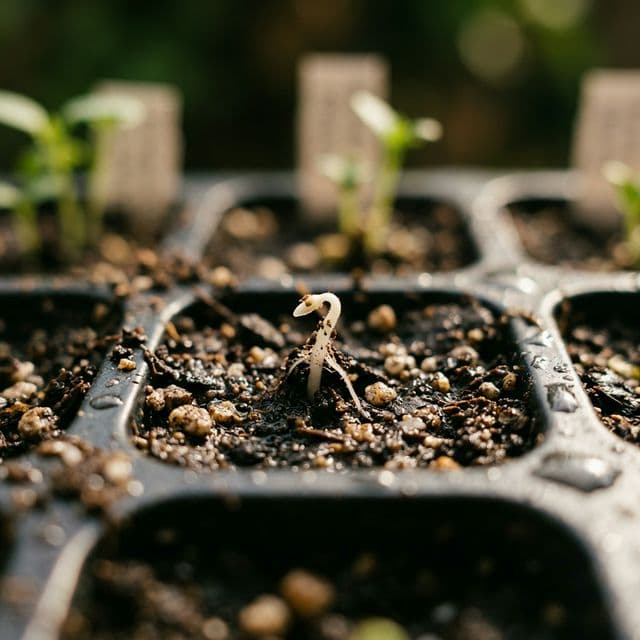
1. Pre-moisten your mix
Before sowing, moisten your mix thoroughly in a bucket. Squeeze a handful — it should hold its shape but release only a few drops of water. Dry mix repels water and leaves seeds exposed; overly wet mix suffocates them. Pre-moistening is far more even than trying to water after filling cells.
2. Fill cells and firm gently
Fill each cell to the top, then press down gently with your fingertip. No air pockets — seeds sitting in air pockets don't make root contact and fail to germinate. Refill and firm again if needed.
3. Sow at the correct depth — and check light needs
The general rule: sow seeds at a depth of 2–3× their diameter. But light requirements vary by species, so follow the seed packet:
- Seeds that need light to germinate (press onto the surface, don't cover): petunias, begonias, snapdragons, lettuce.
- Seeds that germinate fine covered: most vegetables — including basil, which does well with a light covering of mix despite often being grouped with surface-sown seeds.
- Seeds that prefer darkness: some, like calendula and phlox, germinate better with a covering of mix or a dark cover.
Germination doesn't universally happen in darkness or in light — it depends on the species. The packet is the authority.
4. Label every tray immediately
Two weeks after sowing, a tray of unlabelled seedlings is completely unidentifiable. Include the variety name, sowing date, and target transplant date.
5. Water gently and cover
Mist the surface gently — heavy watering dislodges tiny seeds. Cover with a humidity dome or plastic wrap to hold moisture and warmth during the germination window.
6. Apply bottom heat — by crop, not by rule
Warm soil speeds germination, but the right temperature depends on the crop: peppers and eggplant prefer 80–85°F and germinate sporadically below 65°F; tomatoes and most warm-season vegetables do well at 70–80°F; cool-season crops like lettuce and spinach germinate fine at 60–65°F and don't need a mat at all. Use a thermostat — unregulated mats can overheat small trays.
7. Check daily — remove the dome at first sprout
Once you see the first sprout in a tray, remove the humidity dome promptly and move the tray to strong light. Seedlings left under domes stretch, weaken, and invite damping-off fungus.
Light, Water, and Feeding After Emergence
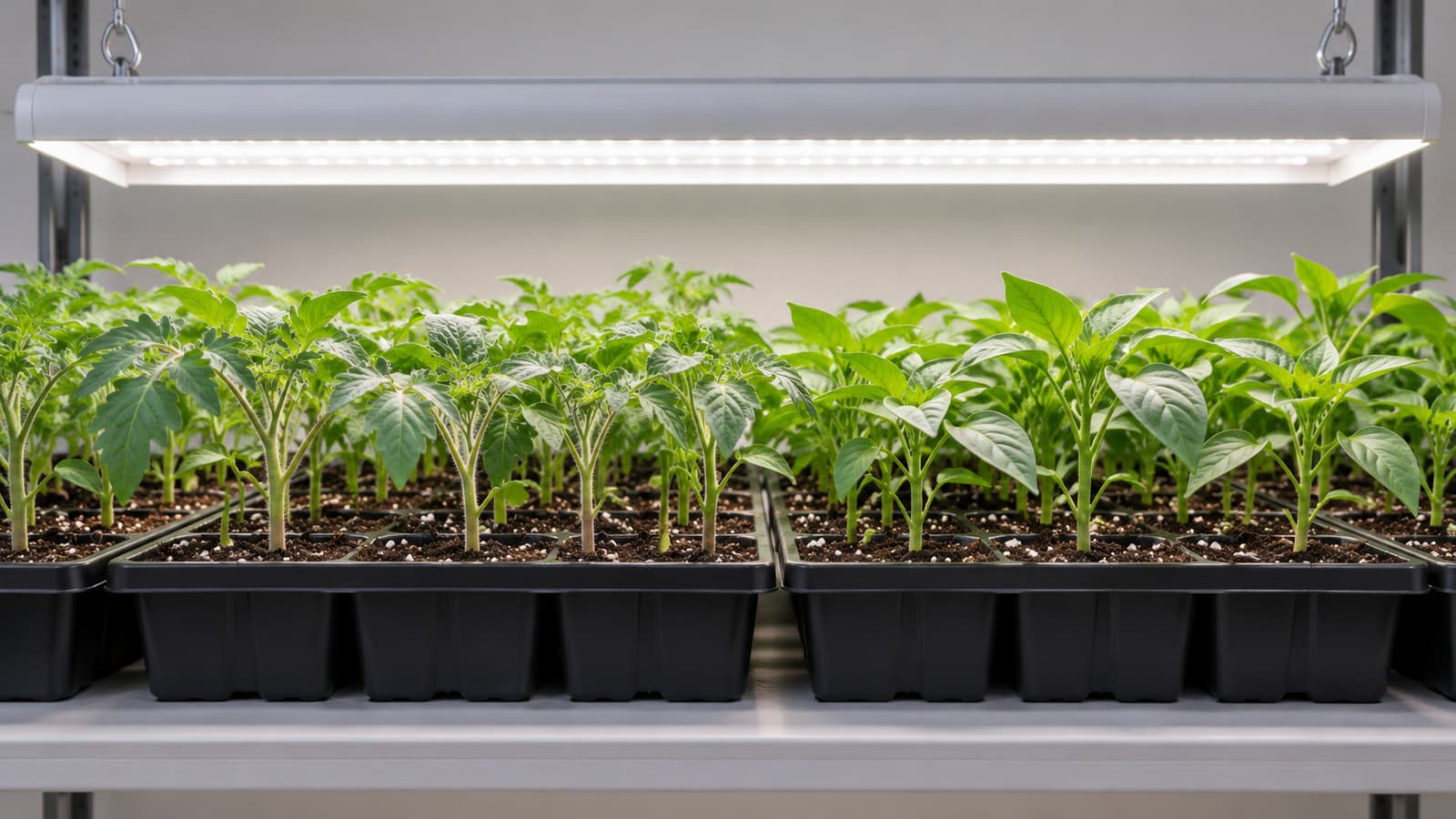
Light is the number one reason indoor seedlings fail. A windowsill — even a south-facing one — provides only a fraction of the intensity seedlings need. The result: leggy, pale, weak plants that struggle after transplanting. (UMN Extension's seed-starting guide is a solid reference for setup details.)
Here's what actually matters:
- Distance depends on the fixture. The classic "2–3 inches above seedlings" guidance was written for low-output T5 fluorescent shop lights. Stronger LED grow lights often need 12 inches or more — follow the manufacturer's recommended hanging height and watch plant response: stretching means too far or too weak; bleached, crispy leaf edges mean too close. Raise lights as plants grow.
- Duration: 14–16 hours on, 8–10 hours off. Use a timer — consistency matters more than total hours.
- Shopping by lumens is only a rough guide. Lumens measure brightness as human eyes perceive it, not plant-usable light. Use lumen ratings to compare fixtures in the same category, but go by the manufacturer's stated coverage area and your seedlings' response — not a fixed lumen number.
- Spectrum: Full-spectrum or "daylight" (5000–6500K) for vegetative seedling growth. White full-spectrum LEDs are the most versatile choice for seedlings.
Watering: The goal is consistently moist — never soggy, never dry. Bottom watering (pour water into the solid tray beneath and let it wick up) encourages roots to grow downward, avoids disturbing delicate seedlings, and keeps the surface drier, which reduces damping-off.
Feeding: Most seed-starting media contain little or no nutrients by design — fine for germination, since seeds carry their own energy reserves. Once seedlings develop their first true leaves (the set after the initial cotyledons), begin liquid feeding at ¼ strength weekly with a balanced water-soluble fertiliser. If your mix already contains nutrients, wait until growth visibly slows before feeding — more fertiliser is not better.
Seedling Problem Troubleshooter
| Symptom | Likely Cause | Fix |
|---|---|---|
| Tall, thin, falling-over stems | Not enough light | Bring lights to the manufacturer's recommended distance; run 14–16 hrs/day |
| Seedlings collapse at soil level | Damping-off fungus | Improve airflow; don't overwater; use fresh sterile mix; remove dome sooner |
| No germination after 2 weeks | Too cold, old seed, sown too deep | Check soil temperature for the crop; test seed viability; check sowing depth |
| Yellow lower leaves | Nitrogen deficiency (or overwatering) | Begin ¼-strength liquid feed at the first-true-leaf stage; check drainage |
| Purple undersides on leaves | Phosphorus uptake slowed by cold roots | Warm the root zone; start light feeding |
| White crusty deposits on soil surface | Salt buildup from fertiliser | Flush once with plain water from the top; reduce feeding |
| Fungus gnats around the soil | Overwatering, constantly wet surface | Bottom-water only; let the surface dry between waterings; yellow sticky traps |
Potting Up: When and How
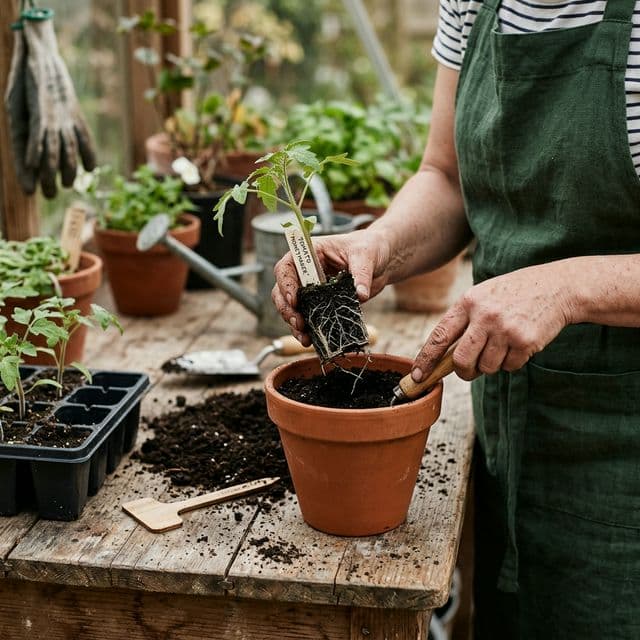
Potting up means moving seedlings from small plug cells into larger containers as they outgrow their space. Signs it's time:
- Roots visible through the drainage holes of plug cells
- Plants drying out within a day of watering
- Growth has slowed despite good light and feeding
- Plants look disproportionately large for their containers
Move to the next size up — roughly doubling the volume at each step. Jumping to a much larger pot leaves a waterlogged outer zone where roots haven't reached yet.
Special tip for tomatoes: bury tomato stems deeply at every pot-up, up to the lowest set of leaves. They form roots along any buried stem, building an exceptionally strong root system by transplant time.
Hardening Off: The Final Critical Step
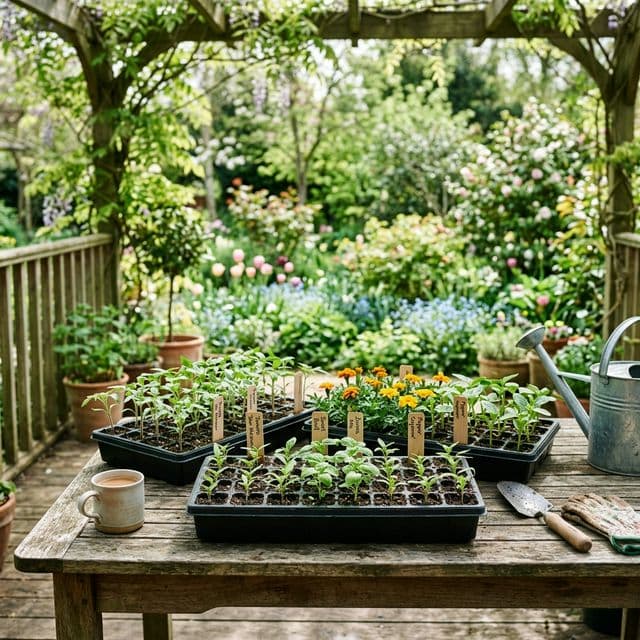
Hardening off gradually acclimates indoor-grown seedlings to wind, temperature swings, and far more intense sunlight than any indoor setup provides. Moving directly from indoors to full sun causes severe sunscald and often kills plants.
Here's one workable 10-day schedule — adjust for your weather and crops (tender warm-season seedlings need more caution than hardy brassicas):
- Days 1–2: Full shade outdoors, 2–3 hours. Bring in before temperatures drop below 50°F (warm-season crops).
- Days 3–4: Full shade, 4–5 hours. Watch for wilting — wind stresses plants more than sun at first.
- Days 5–6: Morning sun (1–2 hours), then shade for the rest of the time outside.
- Days 7–8: Half day of sun, half shade. Leave out a little longer.
- Days 9–10: Full day outside, including full sun. Bring in only if frost threatens.
- Day 11+: Ready to transplant.
Transplanting Day
- Transplant in the evening or on a cloudy day — not midday in full sun. Heat and sun stress newly disturbed roots before they re-establish.
- Water thoroughly the day before so plants are hydrated and the soil holds together as a plug.
- Add compost to the planting hole — a handful of well-aged compost gives roots an immediate nutrient boost.
- Plant at the same depth as in the pot — except tomatoes, which can go much deeper.
- Water immediately after planting to settle soil around roots and eliminate air pockets. Some gardeners add a dilute liquid fertiliser (fish emulsion or kelp) to this first watering — optional, not required.
- Protect for the first week — a floating row cover (even just overnight) shields against wind, late frost, and pests while roots re-establish.
Your Printable Sowing Planner
Copy this table into a notebook or print the page — one row per crop keeps the whole season on track. For month-by-month regional guidance, see our Vegetable Planting Calendar.
| Crop & Variety | Last Frost Date | Weeks Before | Sow Date | Notes |
|---|---|---|---|---|
| Example: Tomato 'Cherokee Purple' | Apr 15 | 6–8 | ~Feb 20 | Heat mat 75°F; pot up once |
| Example: Pepper 'California Wonder' | Apr 15 | 8–10 | ~Feb 5 | Heat mat 82°F; slow to germinate |