
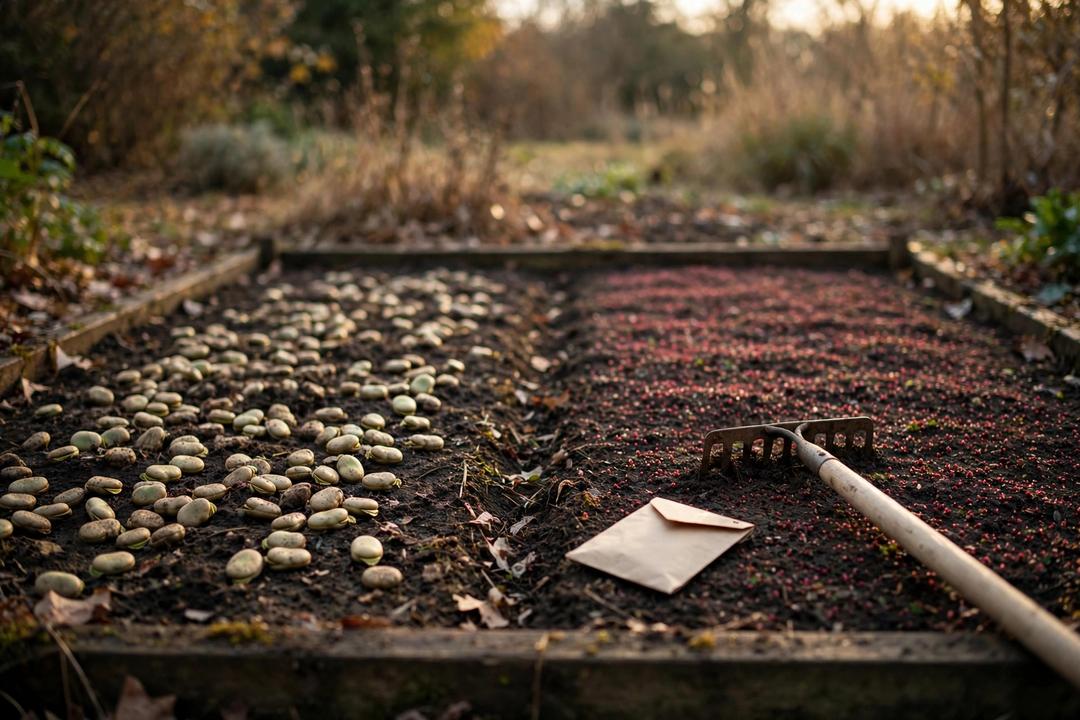
You can still plant a winter cover crop this week — but this is the last call for a good stand, not the middle of the season. UC Master Gardeners of Alameda County say cover crops can be seeded from late September to mid-November, which puts a November 12 sowing at the very tail of the window. The two legumes worth sowing now are fava beans and crimson clover: both pull nitrogen from the air into the soil, both grow through California's mild, rainy winter, and both get cut down in spring to feed the bed they grew in. Which one you sow depends on your bed, your back, and whether you want dinner from it.
Sophie: It's already mid-November. Isn't the cover crop window closed?
Sprouty: For daikon it is — that one needed September warmth. But fava beans and crimson clover are still in it this week. Sow now, sow a little thick, and don't let this weekend slide into next week.
The window closes this week
The deadline is real, and it depends on where you garden. In Alameda County, UC Master Gardeners put the seeding window at late September to mid-November. Around Monterey Bay, the UC Santa Cruz Center for Agroecology guide says cover crops can be planted from mid-October through early December — but adds that earlier sowings, before mid-November, are easier to establish and less vulnerable to bird predation, and that if you sow later in the season you should sow more seed as a hedge against bird damage and cool, wet conditions. UC Santa Clara County notes that as a cover crop, favas can be planted at any time of year — though with no expectation of pod production — so a later sowing is not impossible, only a weaker stand with no food payoff.
Contra Costa County's guide says September or October is a good time to plant, Alameda County allows seeding to mid-November, and the Monterey Bay guide stretches to early December. Read together, the honest position is this: mid-November is the last call for a good stand in most of California, and a late sowing needs thicker seed and realistic expectations — slower establishment than an October sowing, not a guaranteed stand. Inland valleys have mild weather on their side this week: overnight lows in the Sacramento area are forecast mostly in the 40s this week, dipping into the high 30s by next week, according to the ten-day forecast. That is still establishment weather. It will not stay that way for long.
Fava beans: the tall, edible workhorse
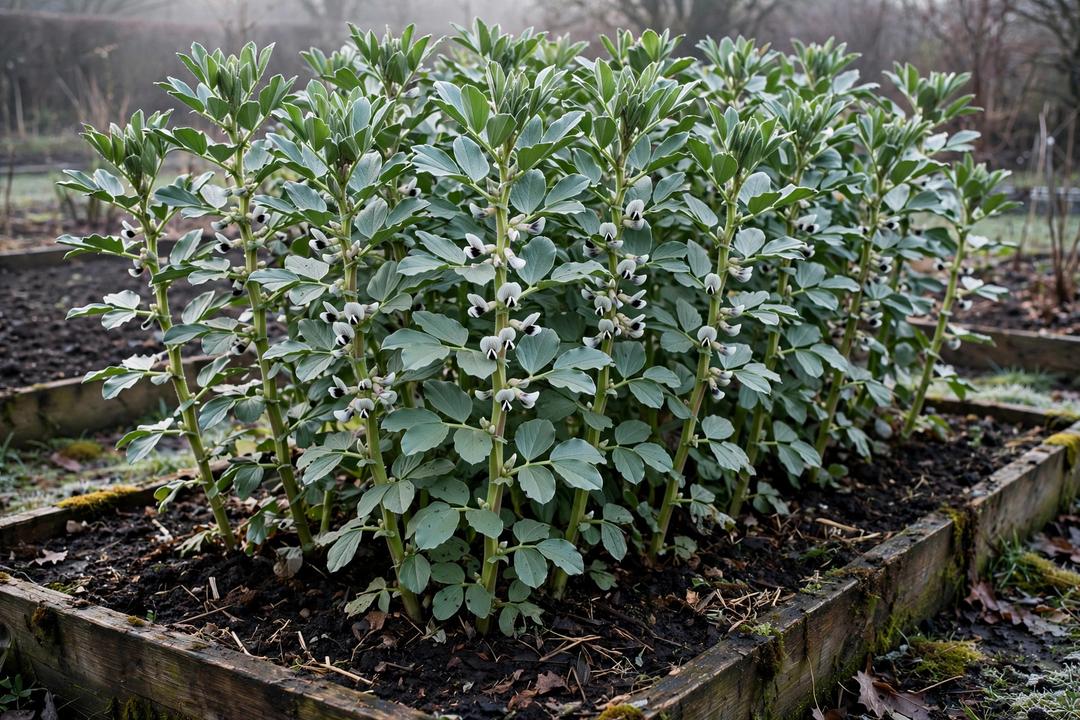
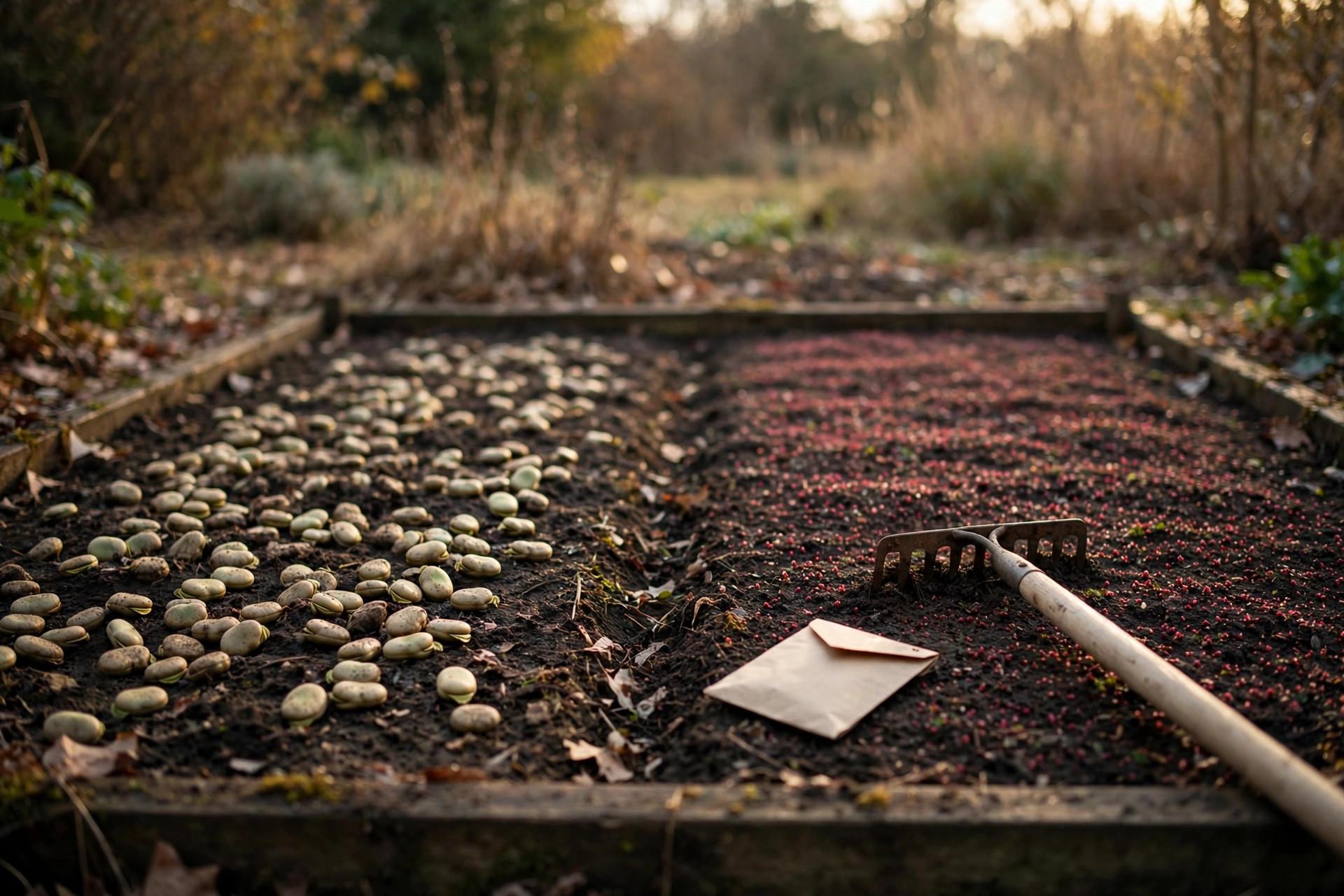
Fava beans (Vicia faba, family Fabaceae) are the heavyweight option. UC Master Gardeners of Sonoma County recommend sowing in late summer to November to overwinter for early spring picking, seeding 1 to 2 inches deep, 6 to 8 inches apart in rows 18 inches apart (the UC Santa Cruz guide gives a denser spacing of 4 to 6 inches apart in rows 8 to 12 inches apart in its bell bean mix — either spacing works in a home bed). A legume inoculant specifically for fava beans is recommended for a first planting — the inoculant is the bacterium that helps the roots fix nitrogen, and on new ground the plants fix less without it than they would with it.
The nitrogen trick has a catch that decides how you manage the crop. Sonoma County's guide notes that the nodules on fava roots contain rhizobium bacteria that fix airborne nitrogen — but only before bean pods form. So if soil is the goal, cut the plants at flowering and do not wait for pods. UC Santa Clara County gives the same instruction for cover-crop favas: cut down the stalks when flowers appear, then chop up and dig into the soil. UC Marin Master Gardeners put the cut at about half the plants blooming, cutting off the stalk and leaving the roots to decompose in place.
What you get for the effort is biomass and structure. Sonoma County notes that fava stems and foliage may be cut to the ground and turned under as green manure, that deep roots loosen soil and bring up nutrients, and that the plants act as a winter cover crop deterring erosion by protecting topsoil from wind and rain, while thick foliage slows winter weed growth. The tradeoff is handling: fava stalks are thick and woody by spring, so expect to chop them before digging them in — and expect to pay more for the seed. Alameda County's guide notes that fava beans work well but their seeds tend to be more expensive than other cover crops.
The food bonus is real, and it is a choice, not a free extra. Mature fava pods hold large beans that may be eaten raw, freshly boiled, or dried and cooked like any other dried bean. But pods and soil improvement pull in opposite directions: once pods form, the nitrogen-fixing nodules stop working. If you want both, plant two patches — one to eat, one to cut at flowering.
Crimson clover: the low, bee-friendly carpet
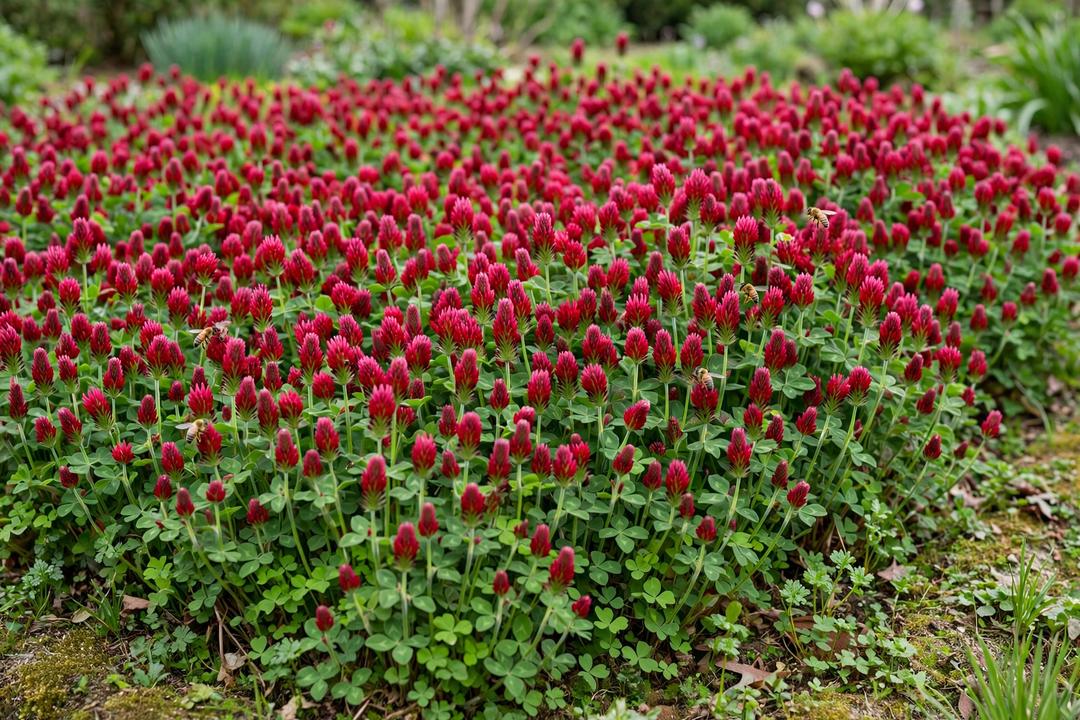
Crimson clover (Trifolium incarnatum, family Fabaceae) is the opposite build: a cool-season annual legume that stays low, covers the bed quickly, and is far easier to turn under by hand than a stand of woody fava stalks — SARE notes its simple taproot makes crimson clover easy to kill mechanically. Its seed is tiny, so it goes in shallow — NC State Extension gives a seeding depth of one-quarter to one-half inch, drilled at 8 to 20 pounds per acre or broadcast at 15 to 30 pounds per acre. That broadcast rate works out to roughly half an ounce to just over an ounce of seed per 100 square feet of bed — a small packet covers a lot of ground.
The nitrogen numbers for clover come from field research, so read them as scale, not as a promise for one raised bed. SARE's Managing Cover Crops Profitably puts crimson clover's nitrogen contribution at 70 to 150 pounds per acre as a winter annual, with 3,500 to 5,500 pounds of dry matter per acre by mid-May in Zone 8, where it overwinters dependably. NC State Extension, measuring in North Carolina, reports nitrogen fixation up to 50 to 125 pounds per acre and biomass of 2,000 to 5,000 pounds per acre. A home bed gets a proportional share of that — the point is that clover is a serious nitrogen fixer, not a garnish.
Two details decide how much of that nitrogen your spring crop actually gets. First, timing: NC State notes the highest nitrogen is available at late bloom or early seed set, and that terminating earlier, in the late vegetative stage, can cut nitrogen fixation by up to 50 pounds per acre. Let it flower. Second, breakdown speed: crimson clover has a low carbon-to-nitrogen ratio of 17, which causes faster breakdown of residues than grasses and a more rapid release of nitrogen. That is the practical payoff of choosing a legume over a grass cover crop — the nitrogen comes back sooner.
Clover also earns its place for what it does above ground. UC Marin Master Gardeners note that clover can attract beneficial insects to the garden, and its red flower heads are early-season forage for pollinators. It needs the right soil to do its work, though: SARE's guidance is well-drained soil — clover does poorly on heavy clay, waterlogged, or very acid or alkaline ground — and NC State gives a soil pH of 5.5 to 7 as appropriate, and warns that a pH under 5 can hamper nodule formation and stop nitrogen fixation. And like fava, it needs its inoculant on a first planting — UC Marin advises inoculating any legume seed at planting time.
Which one fits your bed?
There is no single winner — there is a right plant for the bed you have. Use the tradeoffs, not a ranking:
| Fava beans | Crimson clover | |
|---|---|---|
| Build | Tall, heavy stems and leaves; deep roots loosen soil | Low carpet; covers the bed fast |
| Food | Yes — edible pods, but pods end nitrogen fixing | No — soil and pollinators only |
| Spring termination | Chop thick stalks first, then dig in | Easy to kill and dig in — its simple taproot makes it easy to kill mechanically |
| Pollinators | Black-and-white flowers in late winter | Red flower heads; attracts beneficial insects |
| Seed cost | Higher than most cover crops | Low — a small packet covers a lot of ground, roughly half an ounce to just over an ounce per 100 square feet |
| Best for | A bed you will dig hard in spring, or a gardener who wants beans too | A bed you will turn by hand, or a pollinator-friendly winter cover |
And there is a third option the UC guides themselves suggest: sow both. Alameda County's guide notes the three types of winter cover crops — legumes, annual grasses, and miscellaneous plants including mustards — are commonly used together, and a fava-and-clover mix is the home-garden version of that: the fava brings biomass and food, the clover fills the gaps between the wide-spaced beans and covers the soil the fava leaves bare. Sow the fava first at its spacing, then broadcast the clover between the rows.
How to sow this week
Five steps, in order — an afternoon's work for a typical raised bed.
- Clear the bed. Pull the spent summer crops and any weeds. A cover crop is not a rescue for a bed still full of dead tomato vines.
- Rake it level and water if it is dry. Sonoma County advises irrigating beds in the absence of fall, winter, or spring rains — seed needs moist soil to germinate, and a dry November bed will not do it alone.
- Inoculate the seed. Buy the inoculant powder with the seed — Contra Costa County's guide describes wetting the seeds and rolling them in the powder before planting, and Sonoma County recommends a legume inoculant specifically for fava beans on an initial planting. This is the step first-timers skip and then wonder why the cover crop did nothing.
- Sow at the right depth — and sow thick, because it is late. Fava seed goes 1 to 2 inches deep, 6 to 8 inches apart in rows 18 inches apart. Clover seed is broadcast on the surface and raked into the top quarter to half inch. Alameda County's target is 8 to 10 cover plants per square foot — and because this is a late sowing, err on the dense side. The UC Santa Cruz guide says so directly: sow more seed when you sow late.
- Water it in and keep it moist. A gentle watering settles soil around the seed without washing the tiny clover seed into corners. Keep the bed evenly moist until the seedlings are up.
The spring payoff
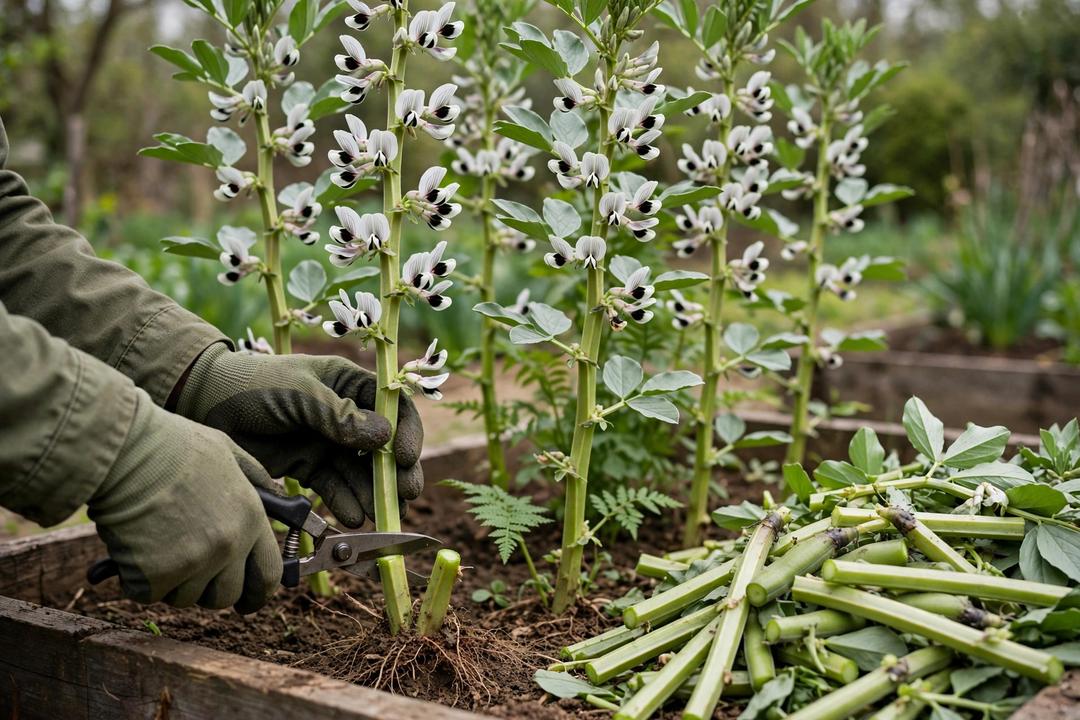
The nitrogen is not instant, and that is the point most first-time cover croppers miss. A legume does not fertilize its neighbors while it grows — it stores nitrogen in its own tissue and nodules. UC Marin explains that cutting these legumes down in spring and letting them decompose releases that nitrogen into the soil for the next crop. The payoff comes from the cutting, not the growing.
Time the cut for flowering. Contra Costa County's guide gives the rule: cut or mow after flowering starts in spring and before seed production begins, when 50 to 60 percent of the plants have developed flower heads — for most gardeners, late February or March — cutting as close to the soil as possible and leaving the roots and their attached nitrogen nodules to decompose. Alameda County gives the same window as late February to early April. For clover, cut at the same moment — late bloom, before seed matures — so reseeded clover does not become a weed in the bed. SARE advises killing crimson clover before seed set where regrowth from hard seed would cause a weed problem.
Then wait. Contra Costa County advises allowing several weeks for the cut mass to decompose before planting something else, and the cut material can be chopped into small pieces, added to the compost pile, or layered on the soil as mulch. Leave the roots in the ground either way — the nodules on them are part of the payoff, and digging them out throws nitrogen away. A bed sown this week, cut at flowering in late February or March, and left to break down for several weeks is ready for spring planting on a schedule that costs nothing but seed and one afternoon of cutting.
Quick answers
Is it too late to plant a winter cover crop in mid-November in California?
No, but the window is closing in days. UC Master Gardeners of Alameda County allow seeding to mid-November, and the Monterey Bay guide stretches to early December — but both say earlier sowings establish better, so sow this week and sow thicker than you would have in October.
Fava beans or crimson clover — which is better?
Neither — they solve different problems. Fava gives heavy biomass, deep roots, and edible pods, but costs more and needs chopping in spring. Clover is cheap, low, easy to turn under by hand, and feeds pollinators, but gives no food. A bed with room can hold both: fava at its spacing, clover broadcast between the rows.
Do I need inoculant for a cover crop?
Yes, on a first planting. The inoculant is the bacterium that lets legume roots fix nitrogen, and UC Master Gardeners in Marin, Sonoma, and Contra Costa counties all recommend inoculating legume seed at planting time. Buy the inoculant labeled for the crop you are sowing.
When do I cut the cover crop down?
At flowering in late February to early April — when about half the plants are blooming and before seed production begins. Cut close to the soil, leave the roots and their nodules in the ground, and let the cut material decompose for several weeks before spring planting.
Can I eat the fava beans and still improve the soil?
Not from the same plants. Fava nodules fix nitrogen only before pods form, so a plant left to make pods stops feeding the soil. Plant one patch to eat and one patch to cut at flowering.
Can crimson clover reseed and become a weed?
It can, if you let it set seed — NC State notes reseeded clover can turn into a weed in some areas. Cut it at late bloom, before seed matures, and it will not self-seed around the bed. The same rule applies to fava: cut before seed production begins.
Related reading
- Wait Until November to Sow Daikon Cover Crop and You Miss the Soil-Breaker Window: Why Bio-Drilling Demands Sept–Oct Sowing
- Can You Plant Native Plants in November?
- When Should You Plant Onions in the Fall?
- Is November Too Late to Plant Tulip Bulbs?
- When Is Your First Frost? Plan by the Early Date, Not the Average