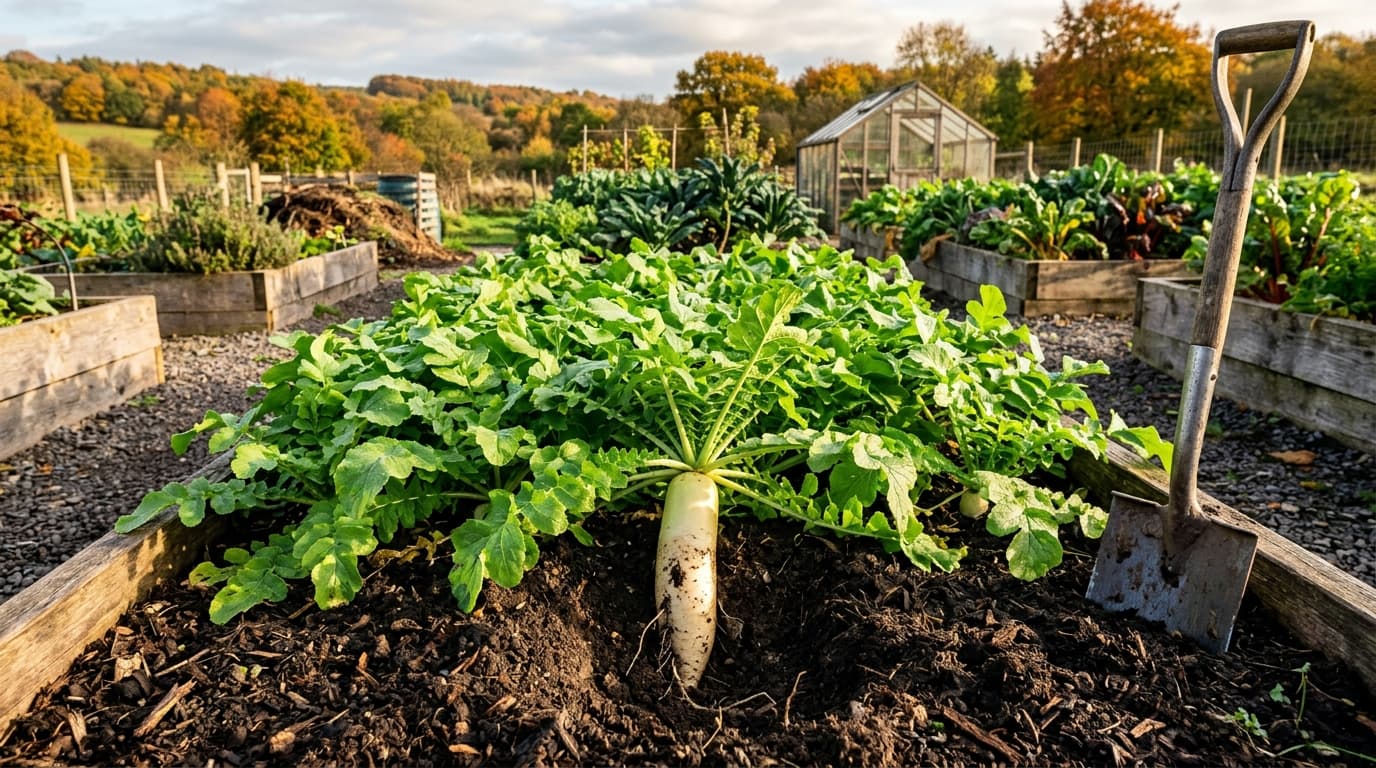

As summer vegetable beds finish producing their final tomatoes, peppers, and beans, gardeners face a crucial crossroads for next year's harvest. In late September, Sophie was sweeping the garden paths and admiring her cleared raised beds, holding a packet of daikon cover crop seed:
Sophie: "I just pulled out the summer vines and cleaned up the beds. I'm going to sow this Daikon radish cover crop to break up our heavy subsoil, but the weather is still warm, so I figure I'll wait until November once winter officially settles in."
Sprouty: "Stop right there, Sophie! If you wait until November to sow daikon, you've completely missed the soil-breaker window!"
Sophie: "Wait, isn't daikon a cool-season winter cover crop?"
Sprouty: "It tolerates cold once established, but daikon is a biological drill! To punch a massive, deep taproot through hardpan and heavy clay, it needs the warm soil and long daylight hours of September and October. Wait until November and all you'll get are puny pencil roots that leave your spring beds just as compacted as before!"
Daikon radish (Raphanus sativus var. longipinnatus)—often branded by agronomy extensions as tillage radish or forage radish—has revolutionized organic soil care. Rather than renting noisy mechanical tillers that pulverize soil aggregates and destroy delicate fungal hyphae, smart gardeners let daikon do the heavy tilling biologically.
However, treating daikon like winter rye or hairy vetch—which can germinate in chilly late-autumn soils and resume vegetative growth next spring—is the single most common reason home gardeners fail with bio-drilling. Daikon has a strict, uncompromising biological calendar: sow in September or early October, or miss the entire benefit for your spring beds.
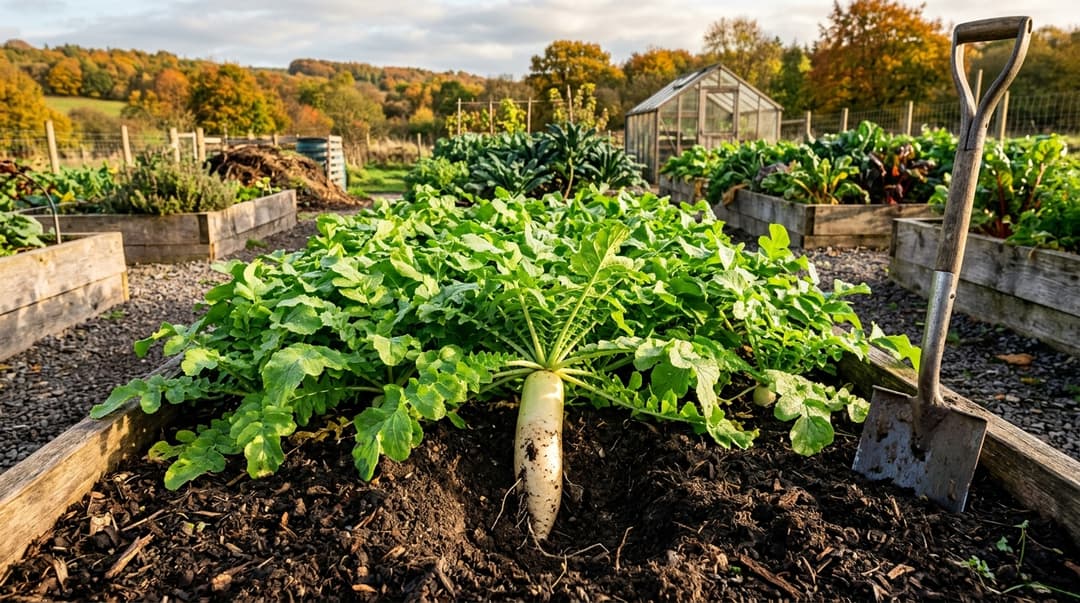
Watch Sprouty & Sophie Break Down the Daikon Cover Crop Window
See why waiting until November misses the soil-breaker window and leaves you with puny pencil roots in our quick video companion.
What Is "Bio-Drilling"? The Botany of Daikon Soil-Breaking
Mechanical rototilling creates an optical illusion of fluffy soil. The spinning tines churn the top 6 inches into fine powder, but beneath that fluff, the tines smear and compress the subsoil, forging an impenetrable, concrete-like "plowpan." Even worse, mechanical tillage shears fungal hyphae, destroys crumb structure, and accelerates the oxidation of precious organic matter into carbon dioxide.
Bio-drilling operates on the opposite principle. As documented in the UC Davis SAREP Cover Crops Database, forage and daikon radishes produce powerful, fleshy taproots capable of generating tremendous axial growth pressures—often exceeding 290 pounds per square inch. While fine root hairs of lettuce or shallow grasses bounce off compacted subsoil, a daikon taproot drives directly downward through heavy clay, hardpan, and compacted wheel tracks.
A healthy, early-sown daikon taproot typically achieves:
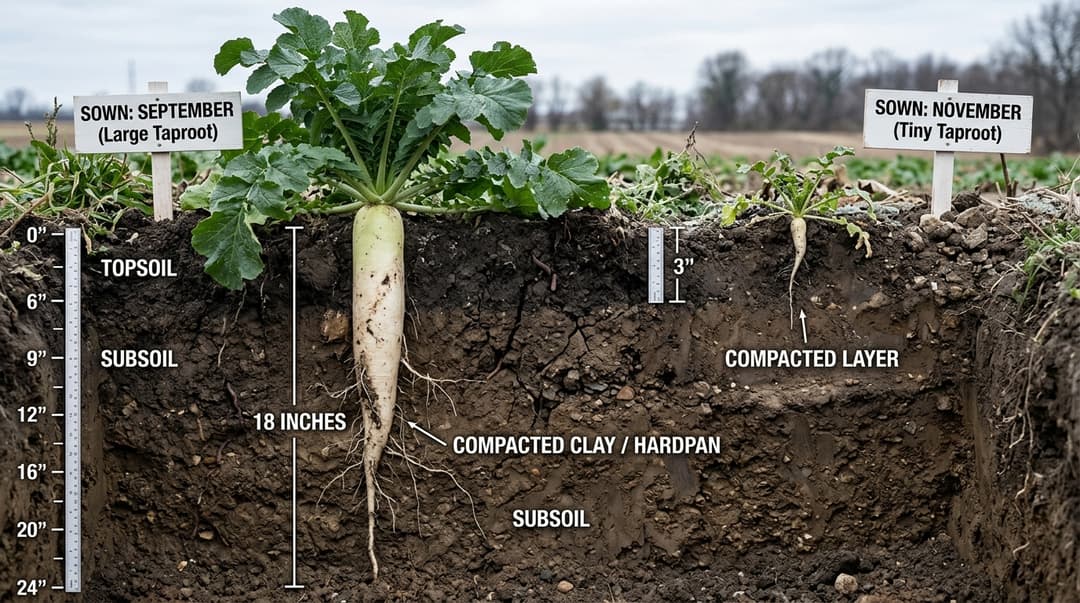
- Fleshy Upper Taproot: 12 to 18 inches in depth and 2 to 4 inches in diameter right through the upper plow layer.
- Deep Capillary Taproot: An additional thin, hair-like root tip extending 4 to 6 feet deep into the subsoil profile.
- Radial Expansion: As the root fattens sideways, it wedges apart clay particles, naturally creating lateral fissures that loosen surrounding soil without pulverizing it.
Why November Sowing Completely Misses the Window
Why can't you just throw daikon seeds into your garden beds in November alongside your winter garlic or cereal rye? The answer lies in thermal biology and solar photoperiod.
1. The Growing Degree Day (GDD) Deficit
Daikon radish requires roughly 500 to 700 base-40°F Growing Degree Days to develop its full foliar rosette and expansive storage taproot. In September and October, average daily temperatures between 60°F and 75°F accumulate GDD rapidly. Daikon seeds germinate within 3 to 4 days, expand large leafy umbrellas, and begin rapid downward root elongation by day 10.
By November, however, daily solar radiation hits its annual low point, and ambient soil temperatures drop below 50°F. While daikon seeds might still sprout in November, root cellular division grinds nearly to a halt. Instead of a thick, 2-to-3-pound subterranean wedge, November-sown radishes produce little more than a thin, pencil-sized stringer that barely scratches 2 or 3 inches into the surface.
2. Leaf Canopy vs. Root Bulking
A daikon radish cannot produce a massive taproot without a massive photosynthetic engine above ground. In September, the plant builds a lush, 18-inch-wide rosette of dark green foliage in under a month. This canopy captures warm autumn sunlight and pumps photosynthates directly into the root. In November, low light angles and short days prevent foliar canopy expansion, depriving the root of energy.
3. Comparison: September vs. November Sowing
The Double Bonus: Nitrogen Scavenging & Spring "Biopores"
Breaking hardpan is only half the magic of September-sown daikon. The other half is what happens beneath the surface through winter and into spring:
1. Locking Up Soluble Nutrients
Over the course of a long summer, gardeners apply compost, organic granular feeds, and liquid amendments. When summer vegetables stop growing in September, substantial residual nitrates linger in the soil. Heavy autumn and winter rainstorms normally wash these soluble nitrates down past root zones and into groundwater.
As detailed in research from Pacific Northwest Extension (PNW 636) on Plant-Available Nitrogen Release, fast-growing brassica cover crops act as aggressive nutrient vacuums. A vigorous stand of September-sown daikon captures between 100 and 170 pounds of nitrogen per acre, storing it inside plant tissue until spring decomposition releases it right at root level for your tomatoes and sweet corn.
2. The "Rot-Out" Miracle: Spring Biopores
What happens when winter arrives depends on your climate zone:
- Zones 7 and Colder (Winterkill Zones): Daikon radish foliage and roots freeze when sustained temperatures drop below 20°F to 25°F. Unlike cereal rye, which requires intense mowing or spring tilling, daikon dies cleanly on its own. Over the winter, the thick fleshy root rots in place. By March, where an 18-inch daikon root once sat, there is an open, unobstructed vertical tunnel known as a biopore.
- Zones 8–10 (Mild Winter / California Valleys): Daikon radishes often overwinter without freezing out. In these zones, allow them to grow through January and February. Simply terminate them by slicing the crown with a flat spade or mowing them down 3 to 4 weeks before your spring planting date. The roots will rapidly decay in warm spring soil.
These decaying channels are lined with organic films and earthworm castings. In spring, young vegetable transplants drop their tender feeder roots directly down these pre-drilled superhighways, accessing deep subsoil moisture and nutrients without having to fight compacted soil layers.
How to Sow Daikon Radish Cover Crop: The 4-Step Protocol
🌱 Sprouty's Step-by-Step Daikon Sowing Playbook
- Clear Spent Summer Crops Early: Don't let half-dead tomato or zucchini vines linger into late October. Pull spent vines in mid-to-late September to free up bed space.
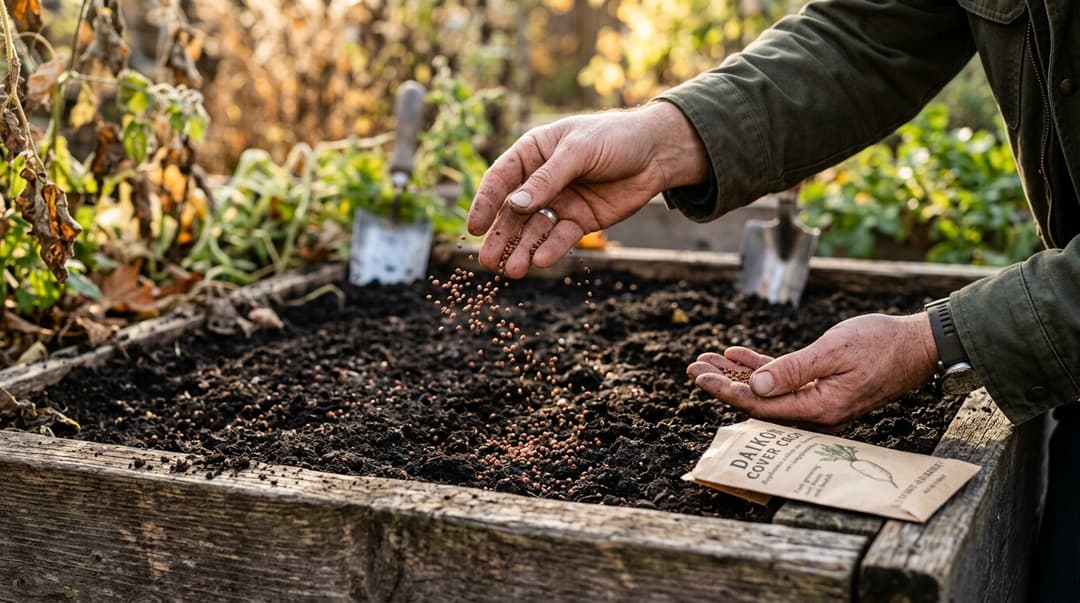
- Broadcast at Proper Density: For raised beds and home garden plots, sow daikon seed at roughly 1 lb per 1,000 square feet (approximately 1 to 1.5 ounces per 100 square feet, or spaced 4 to 6 inches apart). Sowing too densely causes roots to crowd each other into slender pencils; proper spacing gives each taproot room to swell to 3 inches thick.
- Rake Lightly & Water In: Cover seed with 1/4 to 1/2 inch of loose soil or finished compost. Water immediately with a gentle spray nozzle to settle soil around seeds without washing them into corners. Keep the seedbed evenly moist for the first 4 days until cotyledons emerge.
- Optional Cover Crop Cocktail: For maximum ecological benefit, blend daikon radish with Crimson Clover (a nitrogen-fixing legume) and Oats or Winter Rye (for fibrous root structure and surface erosion control). The daikon drills deep, the clover fixes atmospheric nitrogen, and the grasses protect surface crumb structure.
Extension agronomy guides, including the University of Minnesota Extension Cover Crops Guide, confirm that multispecies mixes containing brassicas optimize both biological tillage and nutrient retention.
🌿 The Bottom Line
If you want soft, deeply aerated, crumbly garden soil next spring without breaking your back behind a rototiller, let nature's biodrill do the heavy lifting. But don't wait for winter to arrive. Sow your daikon cover crop in September or early October while the sun is still warm and the soil is active. Your spring vegetable roots will thank you with the most vigorous growth you've ever seen!
Looking for more autumn soil and bed preparation techniques? Check our guide on using fallen leaves as free soil fertilizer, read about planting inland fall potatoes in September, and consult the complete SproutySpeaks Fall Garden Soil & Cover Crop Guide.