
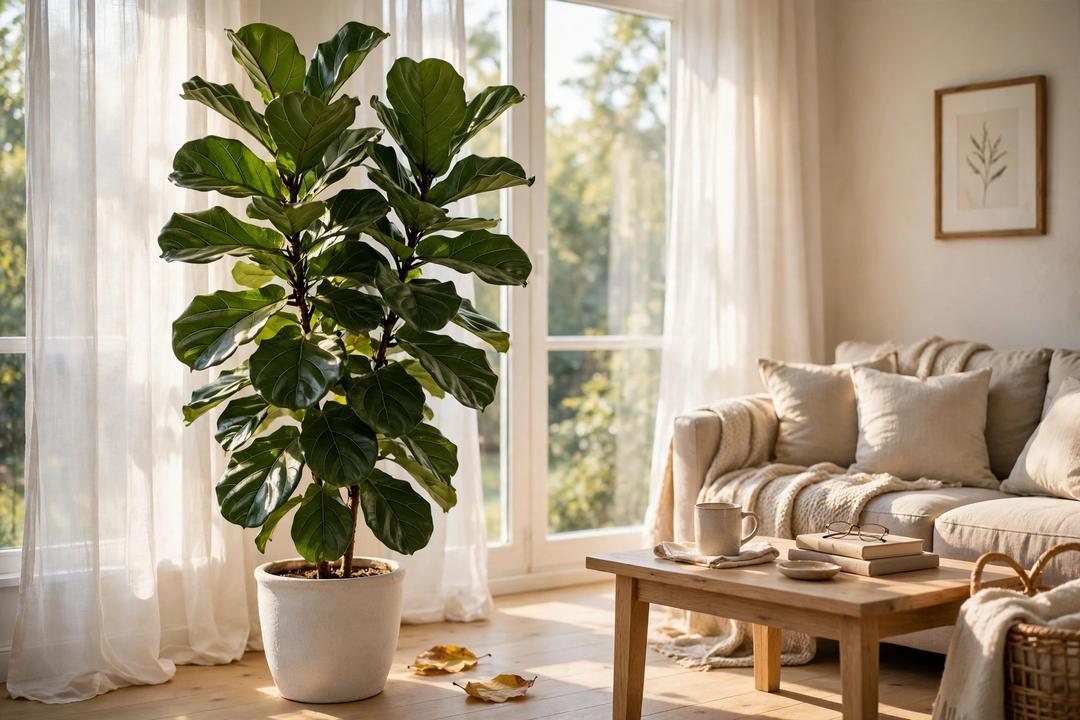
It is almost never one dramatic mistake. In November, a fiddle leaf fig is usually answering three small changes that arrived together: the days got shorter and its light dropped, the heater came on and started drying the air and blowing drafts across it, and the summer watering routine no longer fits a plant that is barely growing in low light. The plant's answer to all three is the same — it drops leaves. The fix is diagnosis first: read which leaves are falling and what they look like, change the one thing that matches, and then leave the plant alone. University of Maryland Extension describes exactly this autumn pattern: as houseplants adjust to less light indoors, leaf yellowing and leaf drop are possible. The University of Missouri's integrated pest management program calls this kind of sudden shed "shattering" — a term it attaches most often to weeping fig — and notes it happens when a Ficus is stressed by an environment change, cold temperatures, or inconsistent watering, and that it is not necessarily a sign of a problem unless the leaves keep dropping over time.
Sophie: It was fine all summer. I haven't changed anything — so why is it dropping a leaf every morning?
Sprouty: You haven't changed anything, but November changed everything around it. Shorter days, the heater on, cooler nights — your plant got a new season and the same routine. It is protesting the only way a Ficus knows how.
Why November is the month it happens
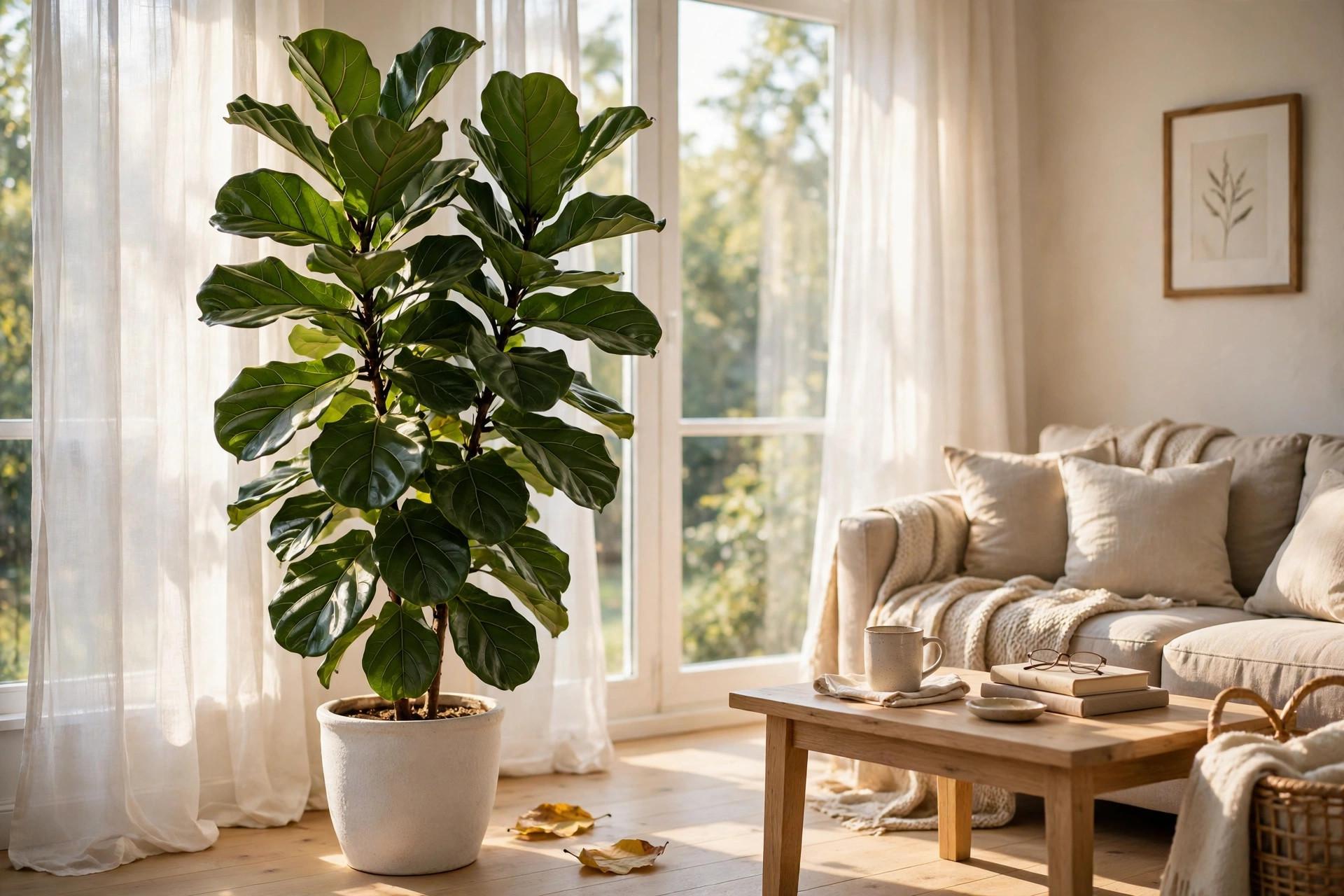
A fiddle leaf fig, Ficus lyrata (mulberry family, Moraceae), is a tropical tree from the rainforests of western Africa, where it grows 60 to 100 feet tall in steady warmth, humidity, and filtered light. As a houseplant it stays 2 to 10 feet tall, with lyre-shaped leaves up to 18 inches long — and it keeps the rainforest's expectations. North Carolina State Extension describes it as a plant that wants bright indirect light or partial shade, moist well-drained soil, medium humidity, and temperatures above 55°F. Summer in a California house delivers most of that without trying. November takes it away, three ways at once.
The light drops first. Days shorten, so the plant gets fewer hours of light, and the room that was bright in July is dim by late afternoon. University of Maryland Extension makes the consequence explicit: as houseplants adjust to less light indoors, leaf yellowing and leaf drop are possible, and grow lights can minimize the shed. University of Missouri Extension is blunter still about this genus: Ficus species do best in a medium light range, and low light may result in a drop of foliage.
Then the heater comes on. A fiddle leaf fig dislikes drafts, and UC Agriculture and Natural Resources warns specifically against sitting one next to a heating source, where the relative humidity is lower. Missouri's IPM program adds that blasts of air noticeably warmer or cooler than the room can cause leaf yellowing and leaf drop — a heating vent is exactly that kind of blast. The plant that spent summer in still, humid air is suddenly sitting in a dry wind tunnel every time the furnace cycles.
Then the watering schedule stops fitting. With less light, the plant grows slowly or not at all, and it drinks less. Maryland Extension's November guidance is to let most of the soil dry out during this slow-growth period — not bone dry, but not too moist, because wet soil causes root rot. A weekly summer watering kept on autopilot into November is a common way a healthy plant ends up sitting in wet soil. Missouri IPM notes that most gardeners also stop fertilizing in winter, when light levels decrease and the days get shorter, because with less light the plant has less energy to grow and uses fewer nutrients.
There is one more reason this November stings more than most: 2026 is officially the Year of the Ficus. The National Garden Bureau selected Ficus as its 2026 Houseplant of the Year, according to Missouri IPM.
Read the leaves — diagnose before you do anything
A common mistake is treating leaf drop as one problem with one fix. It is a symptom with several causes, and the pattern of which leaves fall — and what they look like on the way down — points at the cause. Check the table before you water, move, or feed anything.
| What you see | Most likely cause | What the sources say |
|---|---|---|
| Lower leaves turn yellow, then drop | Too little light | Missouri Extension lists lower leaves turning yellow and dropping among the signs of too little light; low light may result in a drop of foliage. |
| Yellow or brown leaves dropping while still soft | Watering is wrong — too much or too little | UC ANR: both overwatering and underwatering cause yellow or brown leaves that drop prematurely. |
| Dark brown or black spots on leaves, then drop | Root rot from soil staying wet | Penn State Extension Master Gardeners advise checking for brown spots, which indicate root rot; UC ANR: letting a plant sit in excess water will cause root rot. NC State adds that brown spots can also follow temperature swings at a heating or cooling vent. |
| Small raised bumps or blisters, often on leaf undersides, turning brown | Edema — roots taking up more water than the leaves can release | UMD Extension: edema is a physiological disorder, not a disease; the bumps can be misdiagnosed as disease or insect damage. Fix: allow more drying time between waterings, especially when the soil is cool. |
| Brown, crispy edges on otherwise green leaves | Air too dry — or overfed | UC ANR: browning of the leaf margin signals lacking humidity, and overfeeding causes burnt leaf margins. |
| Long bare stretches of stem, small new leaves, pale growth | Too little light over weeks | Missouri Extension's low-light signs: long stretches of stem between leaves, new leaves smaller than the old ones, pale stems and foliage. UC ANR: an unhappy plant looks spindly and leggy. |
| A big shed right after a move, a cold night, or a new spot by a vent | Shock from a sudden change | Missouri IPM: stress comes from environment change, cold temperatures, and inconsistent watering; a Ficus that sheds after a stress is not necessarily unhealthy. |
One reassurance before the fix: losing a leaf now and then is normal shedding, not a crisis. The problem is a steady daily drop, or a sudden shower of leaves after a change. Missouri IPM's rule is the one to hold onto — a Ficus that sheds a bunch of leaves after a stress is not necessarily unhealthy. It becomes a real problem only if the leaves keep dropping, week after week, after you have fixed the cause.
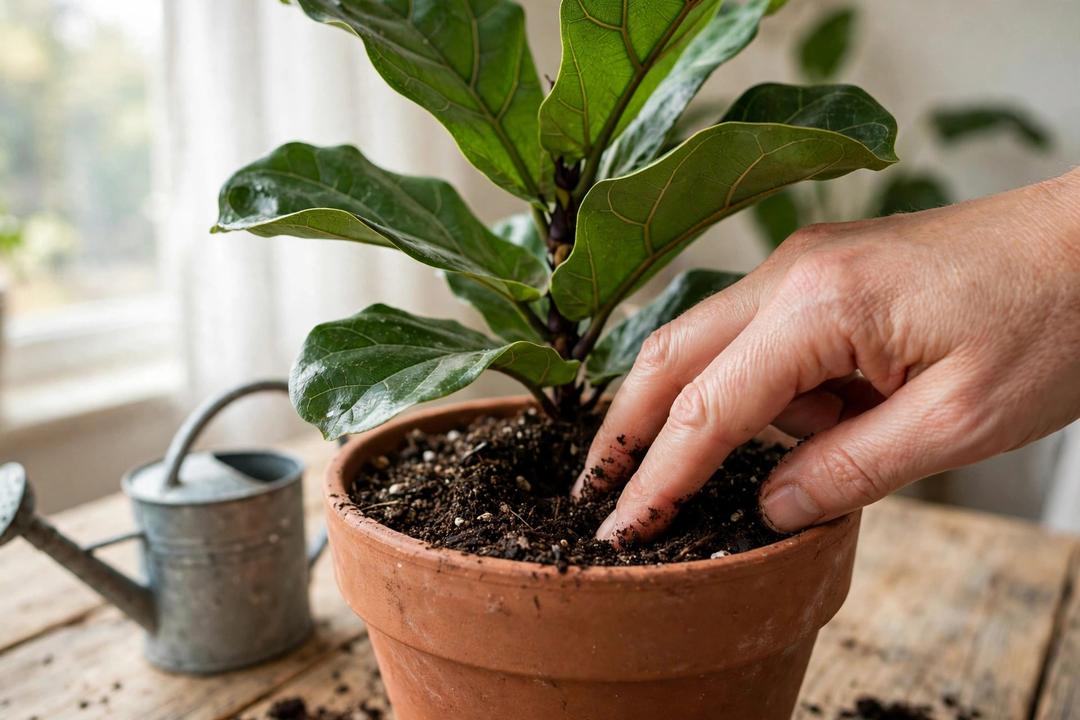
The fix, in order
Work through these in order and change one thing at a time, so you know what worked.
1. Check the water before you pour any. Push a finger two inches into the mix, as UC ANR recommends — or, in Missouri IPM's version, water as the top 25 to 50 percent of the potting mix dries to the touch. For a small pot the two rules agree; for a large pot, use Missouri IPM's deeper 25–50% check. Water only when it is dry at that depth, water until it drains from the bottom, and empty the saucer: UC ANR is explicit that a pot must not sit in its drained water. If the soil has dried out so far that it has pulled away from the pot, Penn State Extension warns that water will only run down the inside of the pot and never reach the root ball — aerate the mix with a fork or chopstick first, then water. If you spot small raised bumps on the undersides of leaves, that is likely edema, not disease — let the soil dry more between waterings, per UMD Extension. And remember the direction of the error matters less than you think: UC ANR says both overwatering and underwatering cause the same yellow-and-drop symptom, so "more water" is not the rescue move for a plant that is already dropping leaves from wet roots. Too much water suffocates the roots, per Missouri IPM.
2. Give it the brightest spot you have. Fiddle leaf figs want a well-lit location and love morning sun, per UC ANR — and protection from afternoon sun, per NC State Extension, which notes that too much direct sun scorches the leaves. Sources label the need differently — Illinois Extension and Missouri Extension list it as a medium-light plant, while NC State and Missouri IPM call for bright light — but they agree on the direction: more light beats less, short of direct afternoon sun. Missouri IPM's practical rule is to sit the plant within about four feet of a good-sized east-, west-, or south-facing window, or to add plant lights. If the only bright spot is the one it already occupies, add a grow light on a timer — Maryland Extension notes that grow lights can minimize the leaf drop as plants adjust to less light indoors. Rotate the pot a quarter turn when you check it, as Penn State Extension recommends, so all sides get their share.
3. Fix the air around it. Move it away from heating and cooling vents and out of the path of drafts — UC ANR says it does not like drafts, and Missouri IPM says hot or cold blasts cause yellowing and drop. If the leaf margins are browning, the air is too dry: UC ANR suggests grouping plants together or placing a small humidifier next to the plant. Misting the leaves and wiping them with a soft cloth, as UC ANR recommends for grooming, helps in the short term — but the room's dryness is fixed by grouping or a humidifier, not by a spray bottle. While you are wiping, check the undersides: UC ANR advises looking for insects and disease every time you water, and NC State lists the usual suspects as scale, aphids, mealybugs, thrips, and spider mites. A dust layer on those big leaves also cuts the light reaching the leaf surface, per Missouri IPM — wiping is light management, not housekeeping.
4. Then leave it alone. This is the hardest step and the most important. A Ficus that has just been stressed by a season change does not want a second change. Missouri IPM lists environment change and cold temperatures among the stresses that make Ficus shed leaves — so do not keep shifting it around the house hunting for a better spot. UF/IFAS Extension's interiorscape Ficus guidelines make the same point for a newly placed plant: do not move, prune, repot, or fertilize it for at least four weeks, because the plant does not need additional stresses. Do not fertilize it: UC ANR says to feed once or twice a year, in spring and summer, at half the label strength, and Missouri IPM notes most gardeners stop fertilizing in winter entirely. Clemson Extension's indoor-plant guidance is the same — during the short days of winter, when plants enter a resting stage, do not give them fertilizer. And do not repot a plant that is actively dropping leaves. Being root-bound is not, on its own, a reason for a November drop — Penn State Extension notes fiddle leaf figs love to be potbound — so don't repot to fix it. Repotting every year or two is a spring job for a healthy plant, per Missouri IPM, not a rescue move for a stressed one in November.

What not to do
- Don't water more to "make up" for the drop. If the cause is wet roots, more water is the cause, not the cure. Check first; pour second. Missouri IPM: too much water suffocates the roots.
- Don't feed it. Fertilizer does not stop leaf drop, and overfeeding burns leaf margins, per UC ANR. A plant in winter rest does not want food; Clemson Extension says not to fertilize during the resting stage.
- Don't keep moving it. Every new spot is a new shock, and Ficus answer shocks by dropping leaves. Pick the brightest draft-free spot and commit to it for the winter.
- Don't cut it back in a panic. A bare lower stem looks alarming, but the plant can sprout new leaves from the trunk if cut back, per UC ANR — that is a deliberate spring decision, not an emergency response. Pruning a stressed plant in November adds a wound to a stress.
- Don't assume it is diseased. NC State Extension notes the fiddle leaf fig has no serious insect pests or diseases as a houseplant. Pests happen, but a November leaf drop is almost always light, water, or air — check those three before reaching for a spray.
Will it come back?
Yes — with one honest caveat. The leaves that dropped will not regrow on that bare stretch of stem. New growth comes from the tips, and from the trunk if it is cut back: UC ANR notes that it will sprout new leaves from the trunk after a cut, and that pinching the new growth off the ends of the branches encourages a thicker, bushier plant. So the plant you get back is not the plant you had — it is a plant that grows forward from the top, and fills out if you pinch it in spring. That is the recovery to expect, and it is a good one: a healthy fiddle leaf fig can grow as tall as ten feet, per UC ANR, and Missouri IPM notes it takes well to pruning.
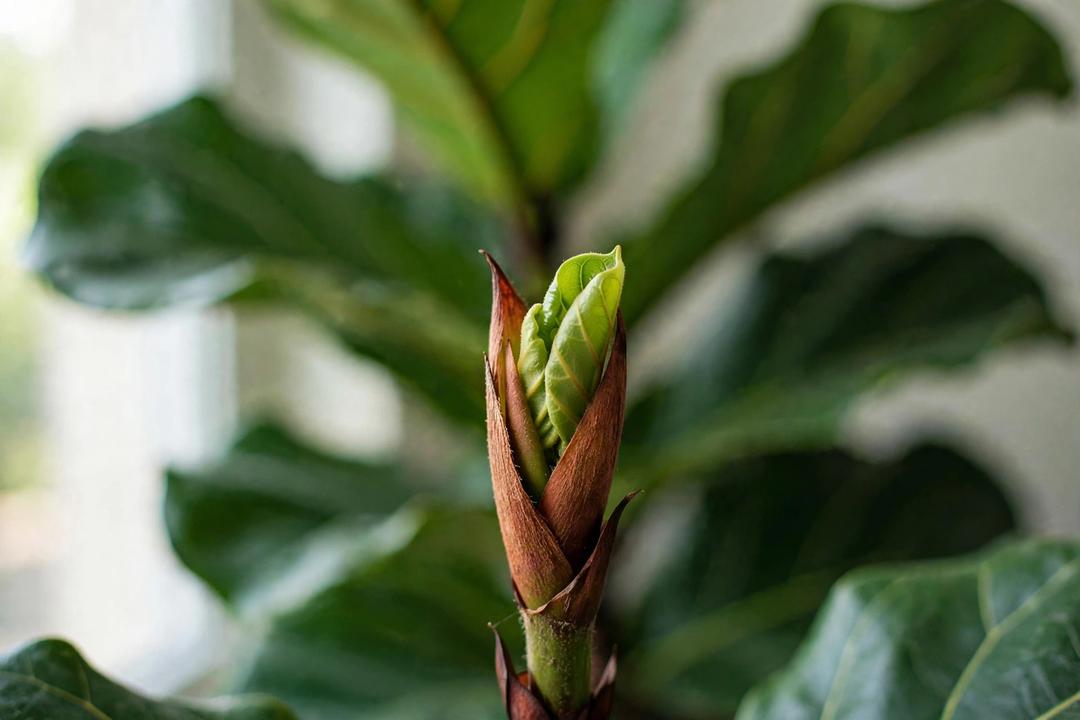
Give the fix a few weeks. If the daily drop slows and then stops, it was stress, and the plant is past it. If the drop continues after the light, water, and air are all right, look harder at the roots and the undersides of the leaves: brown spots point to root rot, per Penn State Extension, and the pest list from NC State — scale, aphids, mealybugs, thrips, spider mites — is worth a close inspection with the plant out of its decorative pot, saucer emptied, soil checked by hand.
The fiddle leaf fig's reputation as the fussiest houseplant is only partly deserved. It is not fragile; it is consistent. It wants the same bright spot, the same watering check, and the same still air, week after week — and November is the month all three quietly change at once. Fix the change, leave the plant alone, and it will do the rest. In 2026, the Year of the Ficus, that is a lesson worth learning before the next leaf hits the floor.
Quick answers
Why is my fiddle leaf fig dropping leaves in November?
Three seasonal changes arriving together: shorter days cut the light, the heater dries the air and blows drafts, and a summer watering routine no longer fits a plant growing slowly in low light. Maryland Extension describes leaf yellowing and drop as houseplants adjust to less light indoors, and Missouri IPM lists environment change, cold temperatures, and inconsistent watering as the stresses that cause Ficus to shed leaves.
How often should I water it in winter?
There is no fixed schedule — check the soil. Water only when the top two inches are dry, per UC ANR, or when the top 25 to 50 percent of the mix has dried, per Missouri IPM. For a large pot, use the deeper 25–50% check. In winter's slow growth, that usually means watering less often than in summer; Maryland Extension's November guidance is to let most of the soil dry out between waterings, without letting it go bone dry.
Will the dropped leaves grow back?
Not on the same bare stretch of stem. New growth comes from the tips and, if the trunk is cut back, from the trunk itself, per UC ANR. Pinching new growth at the branch ends encourages a thicker, bushier plant.
Is my fiddle leaf fig dead?
Almost certainly not — a Ficus that sheds leaves after a stress usually recovers once the cause is fixed. Worry only if the drop continues week after week after the light, water, and air are all corrected (the test in 'Will it come back?' above).
How much light does a fiddle leaf fig need?
Bright indirect light is the target, with morning sun welcome and afternoon sun avoided — UC ANR says it loves morning sun, and NC State Extension says to protect it from afternoon sun, which scorches the leaves. Missouri IPM's rule: within about four feet of a good-sized east-, west-, or south-facing window, or add plant lights. Missouri Extension adds that low light may result in a drop of foliage.
Should I mist my fiddle leaf fig?
Misting and wiping the leaves is good grooming — UC ANR recommends misting with water and wiping with a soft cloth — but it does not fix dry room air. If leaf margins are browning from low humidity, group the plant with other plants or run a small humidifier next to it, per UC ANR.
Is a fiddle leaf fig toxic to pets?
Yes. NC State Extension notes it is toxic to humans, cats, and dogs if ingested, causing oral irritation, drooling, and vomiting, and that the milky sap can irritate skin — gloves are recommended when handling it. UC ANR advises keeping it away from children and pets.
Can I put it outside?
Not for winter in most of California. NC State Extension lists it as hardy outdoors only in zones 10 through 12, and UC ANR notes that in coastal areas an outgrown plant can move to a sheltered patio if protected from wind, sunburn, and cold. Indoors, keep it above 55°F and away from drafts.