
Tropical milkweed can remain leafy through mild winters, providing conditions for year-round monarch breeding and greater OE parasite exposure. Conservation groups recommend choosing milkweed native to your region instead. If tropical milkweed is already growing in your garden, follow current regional guidance for management and replacement — timing and habitat recommendations vary, so a single mid-September deadline is too broad for every climate.
In early autumn, Sophie stood admiring her flower patch, where the tropical milkweed was still blazing with orange and gold blossom clusters:
Sophie: "This milkweed still looks amazing — and the monarchs are still visiting. Should I just leave it standing all winter so they have food?"
Sprouty: "Tempting — but that's tropical milkweed, and in our mild winters it never dies back. Staying green year-round can let monarchs breed out of season and gives the OE parasite more chances to spread. No panic needed — just a plan: check your regional guidance, and think about swapping in native milkweed."
🌿 The Short Version
- Planting new milkweed? Choose species native to your region — in much of California that means narrowleaf or showy milkweed. The Xerces Society's milkweed FAQs cover regional choices.
- Already growing tropical milkweed? Don't rip it out blindly — first inspect for monarch eggs and caterpillars, then follow current local conservation guidance on fall cutback or replacement.
- Keep fall nectar flowing with other flowers so migrating monarchs still find food along the way.
Watch Sprouty & Sophie Break Down the Tropical Milkweed Question
Why evergreen milkweed in mild winters raises OE concerns — and what to plant instead.
Identify Tropical Milkweed Correctly
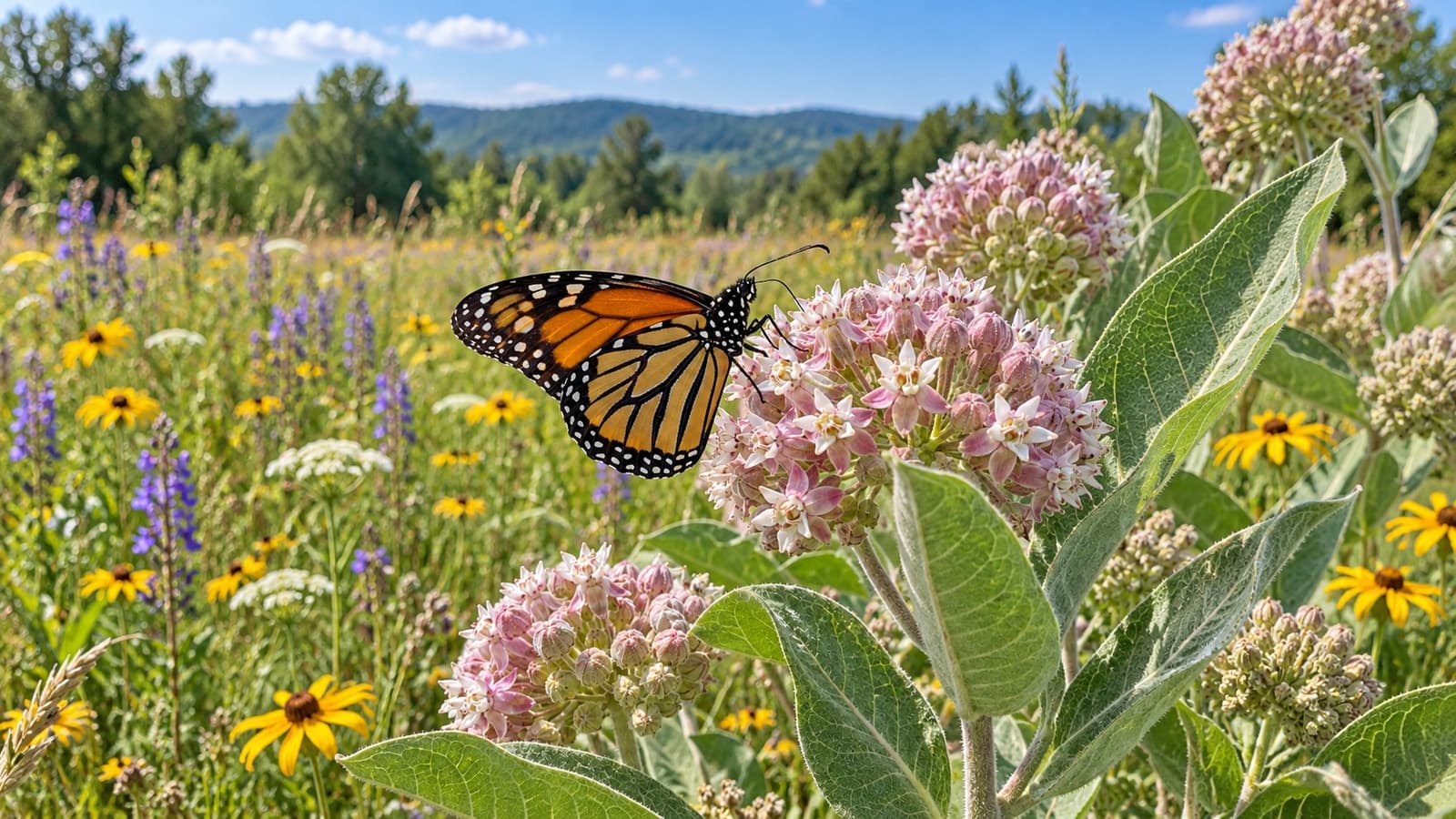
Before deciding anything, make sure you know which milkweed you have. Tropical milkweed (Asclepias curassavica), also sold as scarlet milkweed or bloodflower, is native to the American tropics. Its calling cards are clusters of vivid red-orange flowers with yellow centers, glossy lance-shaped leaves, and a bushy, evergreen habit — in mild-winter regions it simply never goes dormant.
Compare that with California natives: narrowleaf milkweed (Asclepias fascicularis) has fine, narrow leaves in whorls and white-to-pink flower clusters, while showy milkweed (Asclepias speciosa) has broad, velvety blue-green leaves and large pink globe-shaped blooms. Both die back to the ground in fall. If your milkweed is still lush and blooming in December in a frost-free area, that evergreen behavior is itself a strong clue.

How OE Reaches Caterpillars
The concern centers on Ophryocystis elektroscirrha, known as OE — a microscopic protozoan parasite that infects monarch and queen butterflies, documented by researchers at Project Monarch Health (University of Georgia).
The transmission cycle works like this:
- Spore shedding: An infected adult monarch can look normal, but its abdomen carries microscopic dormant OE spores. As it lands on milkweed to lay eggs or nectar, spores rub off onto the leaves.
- Caterpillar ingestion: A newly hatched caterpillar eats its eggshell, then chews foliage — accidentally ingesting spores on the leaf surface.
- Multiplication inside the caterpillar: Spores open in the midgut; the parasite invades gut and skin cells and multiplies as the caterpillar grows and pupates.
- Sporulation: In the final days before emergence, the parasite produces fresh spores on the developing butterfly's scales — and the cycle repeats.
⚠️ What Severe OE Infection Can Do
Heavily infected butterflies may be too weak to emerge from the chrysalis. Those that do eclose can emerge with crumpled, unexpanded wings — unable to fly or feed normally. Even lighter infections are associated with smaller size and reduced flight endurance, which matters for a migration of thousands of miles.
What Research Says About Winter Breeding
Here is where the evergreen habit matters. In mild-winter regions, tropical milkweed foliage persists while native milkweeds have long since died back — and that standing foliage can support monarch breeding outside the normal season. Conservation researchers describe this as a plausible mechanism for elevated OE in winter-breeding populations: more breeding cycles on the same plants means more opportunities for spores to accumulate and pass to the next generation. The Monarch Joint Venture and the Xerces Society both discuss this evidence and recommend regionally native milkweed instead.
Surveys of winter-breeding colonies associated with year-round tropical milkweed have reported OE prevalence far above migratory-population levels in some studies — researchers have reported figures up to 70–95% in such colonies versus under 10% in migratory groups (Satterfield et al. 2015, Proceedings of the Royal Society B; James et al., Northern California winter-breeding study). Treat these as population snapshots, not guarantees: prevalence varies by location, season, and sampling, and the research describes breeding conditions and populations — not a fixed infection rate attached to any single plant. Native milkweed is not automatically OE-free either; its advantage is that seasonal dieback removes spore-carrying foliage each year, reducing carryover rather than eliminating risk entirely.
On migration specifically, the evidence supports a cautious statement: evergreen milkweed may encourage some monarchs to linger and breed out of season rather than migrate. That is different from claiming the plant automatically overrides migration hormones or dooms every visitor — the research does not establish that.
What To Do If You Already Grow It: A Regional Approach
There is no single nationally correct date for dealing with tropical milkweed — California, Florida, and the Gulf Coast have different winters, different monarch phenology, and different local guidance. Xerces discusses fall cutback in mild-winter regions, but recommends checking current local conservation guidance for your area rather than following one universal calendar.

✂️ Before You Cut or Pull
- Inspect for eggs and caterpillars first. Check leaf undersides and stem tips. If the plant is actively hosting monarchs, wait until they have left — or consult local conservation guidance — rather than destroying occupied habitat.
- Check current regional guidance on timing. In many mild-winter parts of California, cutting tropical milkweed back in fall is commonly recommended; other regions differ. Your local extension, native plant society, or Xerces regional resources are the authority — not a single date on the internet. If you are planning around frost dates, fold milkweed timing into that same seasonal plan.
- Cut back or replace. Cutting all stems to a few inches above ground removes the spore-carrying foliage; digging the plant out entirely and replacing it with native milkweed removes the problem at the root. Either way, strip and discard seed pods so it does not reseed.
- Bag and trash the cuttings. Do not compost them and do not leave them as mulch — backyard compost piles may not reliably destroy pathogens. Municipal trash is the cautious route.
- Clean your tools as general hygiene. Wiping pruners with alcohol or a diluted bleach solution between plants is good practice against plant pathogens generally — but do not assume a quick wipe eliminates OE spores specifically.
- Near coastal overwintering sites, check before planting any milkweed. Conservation groups advise extra caution about milkweed plantings close to monarch overwintering groves on the California coast — look up current guidance for your area.
Choose Milkweed Native to Your Region
The most durable fix is replacing tropical milkweed with species that evolved alongside your local monarchs — plants that die back on schedule and fit local soils and rainfall. Below is a California starting point, since that is where SproutySpeaks gardens. If you garden anywhere else, use the Xerces regional milkweed resources to find what is native to your county — state-level native is not specific enough, and site moisture matters as much as geography.
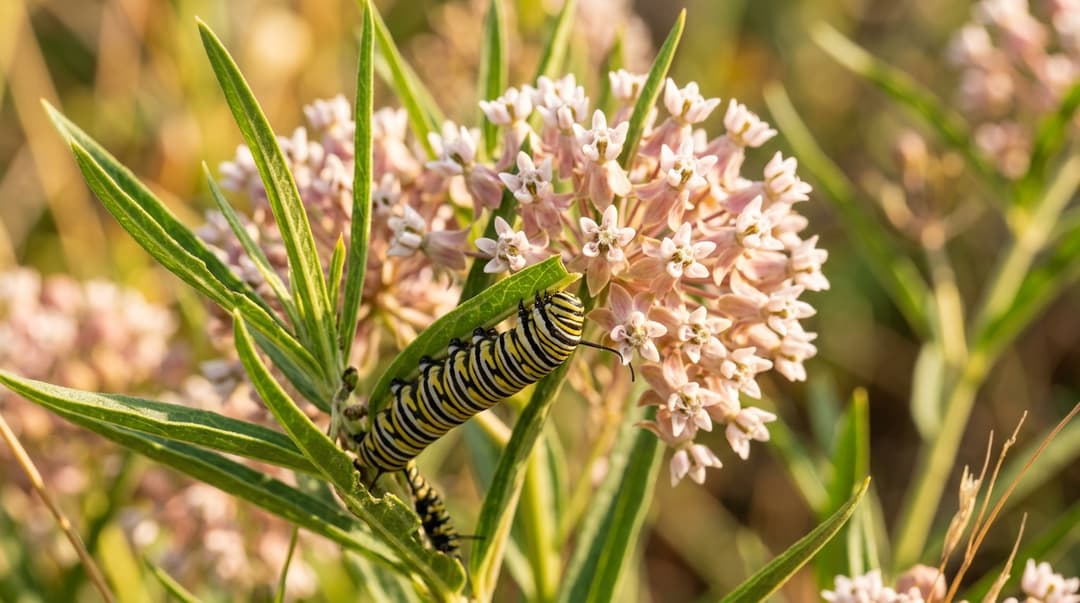
Fall is a good planting window for California natives: as heat eases, roots establish in warm soil ahead of winter rains. Water new plantings through their first dry season; established plants need far less. For timing your broader autumn planting, see our guide to buying California natives in September and planting after the heat.
Keep Fall Nectar Available With Other Flowers
Cutting back tropical milkweed should not leave migrating monarchs without fuel. Adult monarchs need nectar — not milkweed leaves — for migration, and plenty of fall-blooming natives provide it: California goldenrod, coyote mint, and native asters all bloom when monarchs are moving. A garden that pairs native milkweed for caterpillars with late-season nectar flowers for adults supports the full journey. Leaving dried perennial stems standing through winter adds nesting habitat for native bees at no extra cost.
FAQs
Is there one correct date to cut back tropical milkweed?
No — timing depends on your region's winters and monarch phenology. Xerces discusses fall cutback for mild-winter areas, but check current local conservation guidance rather than following a single calendar date.
Is native milkweed completely OE-free?
No. Native milkweed can carry OE spores too. Its advantage is seasonal dieback, which removes spore-carrying foliage each year and reduces carryover — a meaningful reduction in risk, not a guarantee of zero.
What if I find caterpillars on my tropical milkweed right now?
Leave occupied plants alone until the caterpillars have finished and left. Destroying active habitat harms the very monarchs you are trying to help. Plan the cutback or replacement for after they depart, and consult local guidance if you are unsure.
Can I keep tropical milkweed if I cut it back hard every fall?
Strict annual cutback reduces the evergreen-foliage problem, and some gardeners manage it that way. But conservation groups — including Xerces and the Monarch Joint Venture — recommend replacing it with regionally native milkweed instead, which solves the problem without yearly intervention.
🌏 Sprouty's Bottom Line
Helping monarchs starts with the right milkweed for your region. If tropical milkweed is already in your garden, check it for eggs and caterpillars, follow your local guidance on fall cutback or replacement, and plant natives suited to your site.
Save & share: Know a gardener growing tropical milkweed? Send them this — and tell us your region and which milkweed you grow in the comments.
Planning your autumn native garden? Read our complete guide on buying California natives in September and planting after heat, learn how to stop guessing frost dates, see our guide to designing a pollinator garden, and discover how cutting dried stems evicts native bees.