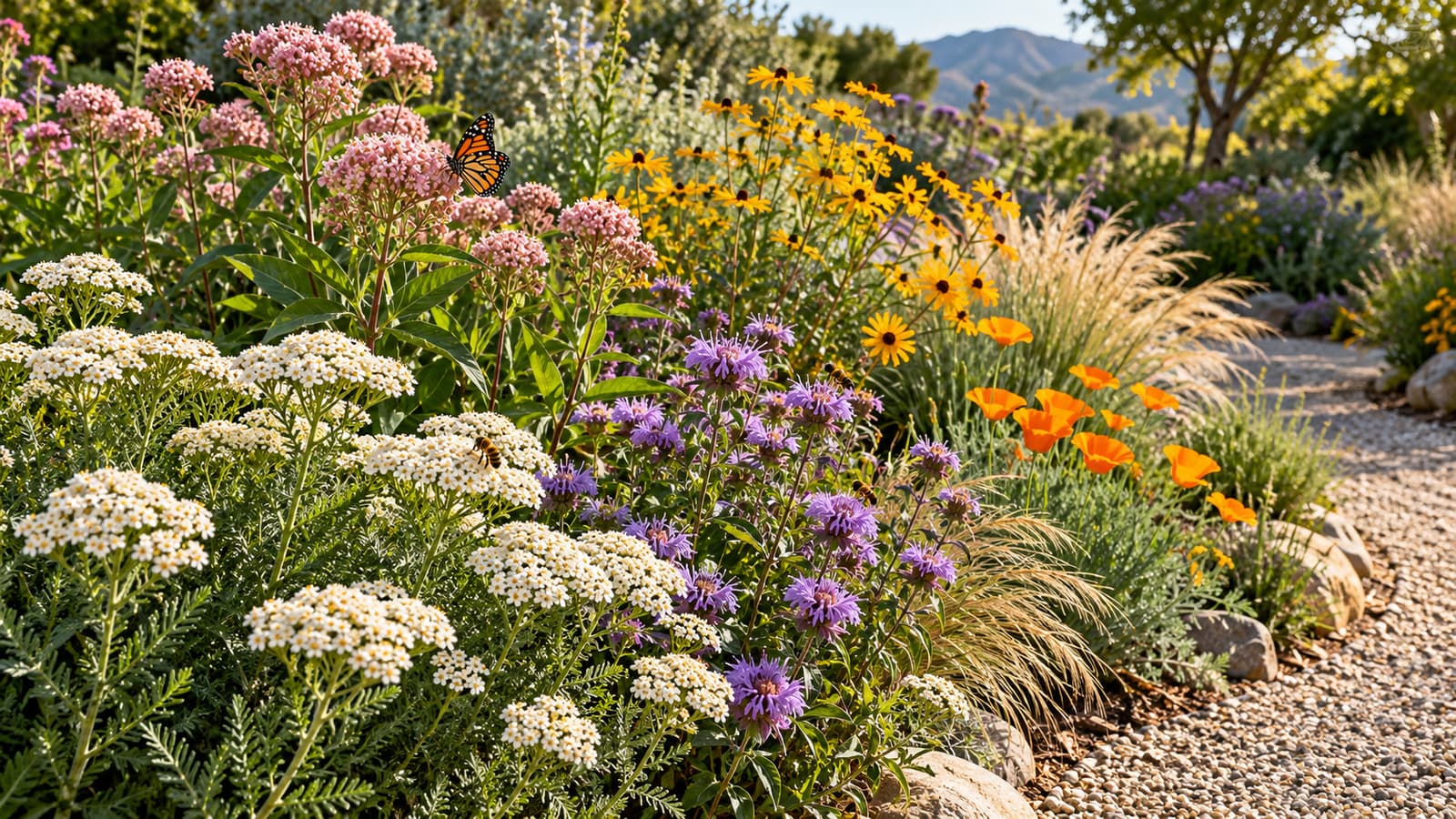

A useful pollinator garden design matches plants to your region, fills gaps in flowering, and leaves room for nesting habitat. Start with your bed's dimensions, light, and soil moisture. Then choose a layout and plant palette that fit those conditions and the plants' mature sizes.
Sophie: "I want a pollinator garden, but every plant list I find says 'best for any garden.' I don't have an any-garden — I have my garden."
Sprouty: "Then let's design for your actual square feet. Measure the bed, note the sun, and pick plants like you mean it — by region, by bloom month, and by how big they get."
New here? Start with the beginner guide first
This page is the design companion to our beginner guide to starting a pollinator garden. That article covers what a pollinator garden is, how to assess your first site, and what to buy on your first nursery trip. This one picks up where it leaves off: layouts, plant spacing, bloom sequencing, visual structure, and region-specific plant palettes — including a complete dimensioned plan for a 4×8-foot bed.
Step 1: Measure Your Space and Read the Site
Before you buy a single plant, get three facts about your bed:
- Dimensions. Pace it off or grab a tape measure. A 4×8-foot bed is 32 square feet — enough for real design decisions, small enough to manage.
- Sun. How many hours of direct sun does it get? Most pollinator workhorses want 6+ hours (full sun). Note which side is south so you can put tall plants at the back (north) where they won't shade the rest.
- Soil moisture. Does the spot stay soggy after rain, or drain fast? This matters more than soil richness.
One correction to a common myth: native plants do not universally prefer lean, sandy soil. That describes some habitats, not all of them. A Central Valley clay-loam suits gumplant and deer grass beautifully, while California fuchsia wants sharper drainage (plant it on a slight mound). Match each species to your actual site — the plant table below lists site needs for every plant in the plan.
Sprouty's Pro Tip: The "Right Plant, Right Place" Rule
The #1 reason pollinator gardens fail is putting the wrong plant in the wrong conditions. A sun-loving coneflower planted in part-shade will be weak, floppy, and disease-prone — despite being a "tough native." Match the plant to the existing conditions, not the other way around.
Step 2: Build a Bloom Sequence, Not a Plant List
Pollinators need food from the moment they emerge in spring until they shut down for winter. The most common design mistake is buying whatever looks pretty at the garden center on a single Saturday — one burst of color, then months of nothing.
Build your garden like a relay team. Every plant should hand off to the next:
- Early season (March–May): feeds queen bumblebees and early solitary bees. In California, fall-sown wildflower seed (California poppy) does this job.
- Mid-season (June–August): the peak. This is where most of your plants live — milkweed, coyote mint, gumplant, yarrow.
- Late season (September–November): the critical stretch many gardens miss. Fall migrants and late bees depend on it — California fuchsia, goldenrod, and Pacific aster carry the garden home.
A quick check before you finalize: write each plant's bloom months on your plan. If any month from March to November is empty, you have a gap to fill.
Step 3: Layout Principles for a Designed Look
A pollinator garden should look intentional, not like an abandoned lot. Four principles get you there:
1. Plant in Drifts, Not Dots
Group the same plant in masses of 3, 5, or 7. A drift of 5 coyote mints reads as a designed statement — and pollinators find grouped flowers far more efficiently than scattered singles.
2. Layer Heights Back to Front
Tall plants at the back (north), medium in the middle, short at the front edge. This "thriller, filler, spiller" layering gives every plant its light and gives you a garden that reads clearly from the viewing side.
3. Give Grasses a Job
Ornamental grasses add structure, movement, and winter interest — and their foliage shelters overwintering insects. One well-placed bunchgrass anchors a small bed better than another flower would.
4. Space for Mature Size, Not Pot Size
A 1-gallon pot looks lonely at 2-foot spacing on planting day. In one season it won't be. Crowding small plants to fill space fast just means digging half of them out later — or watching them sulk.
The Plan: A 4×8-Foot Pollinator Bed for Sacramento / Inland California
Here's a complete, dimensioned plan using plants suited to inland California's hot summers and clay-loam soils — the Sacramento Valley and similar inland valleys. Every plant below is native to California, and most are native to the Central Valley itself. If you garden elsewhere, use this plan as a template and swap in your region's equivalents from the Xerces Society's regional native plant lists.
Top-Down Layout
                  ← 8 ft →
┌─────────────────────────────────────┐
│  Fu         DG           Fu        │  BACK ROW · deer grass 3–4 ft; fuchsia 1–2 ft
│                                     │
│  Mw    Gr     Mw    Gr     Mw      │  MIDDLE-BACK · 2 ft centers
│   Cm     Gp     Cm     Gp     Cm   │  MIDDLE-FRONT · 2 ft centers
│                                     │
│  Ya    As     Ya    As     ★       │  FRONT ROW · short (1–2 ft)
│      · poppy seed drift ·         │  fall-sown seed
└─────────────────────────────────────┘
↓ 4 ft deep · view from the south

Fu = California fuchsia ×2 (low spreader — give it the back-row ends so it spills forward, not hidden) · DG = Deer grass ×1
Mw = Narrowleaf milkweed ×3 · Gr = California goldenrod ×2
Cm = Coyote mint ×3 · Gp = Great Valley gumplant ×2
Ya = Yarrow ×2 · As = Pacific aster ×2 · ★ = 2×2 ft bare-soil patch (front-row spot left unplanted)
+ California poppy seed drift (fall-sown)
Plant counts: 17 plants plus one drift of fall-sown poppy seed. Back row on roughly 2.5-foot centers; middle and front rows on roughly 2-foot centers. One front-row spot at the east end stays unplanted as a 2×2-foot patch of bare, undisturbed soil for ground-nesting bees (marked ★ in the diagram; see the habitat section below).
Bloom Sequence for This Palette
- March–May: California poppy (from fall-sown seed); yarrow begins in May
- June–September: narrowleaf milkweed, coyote mint, Great Valley gumplant, yarrow
- August–October: California fuchsia, California goldenrod; gumplant still going
- September–November: Pacific aster closes the season
- Year-round: deer grass holds the structure, with seed heads from late summer
Plant Details: Botanical Name, Native Range, Role, Site Needs, Mature Size
| Plant | Native range | Role | Site needs | Mature size |
|---|---|---|---|---|
| Deer grass Muhlenbergia rigens ×1 |
California, incl. Central Valley | Structure; overwintering shelter; nesting material | Full sun; tolerates clay; low water once established | 3–4 ft H × 3–4 ft W |
| California fuchsia Epilobium canum ×2 |
Throughout California | Late-season hummingbird nectar | Full sun; needs good drainage — plant on a slight mound in clay | 1–2 ft H × 2–3 ft W |
| Narrowleaf milkweed Asclepias fascicularis ×3 |
California, Oregon, Nevada | Monarch caterpillar host plant; summer nectar | Full sun; adaptable; spreads by rhizomes once established | 2–3 ft H × 1–2 ft W |
| California goldenrod Solidago californica ×2 |
California | Late-season bee forage | Full sun; adaptable | 2–3 ft H × 2 ft W |
| Coyote mint Monardella villosa ×3 |
California Coast Ranges & foothills | Bee magnet; fragrant foliage | Full sun to part shade; medium-low water | 1.5–2 ft H × 2 ft W |
| Great Valley gumplant Grindelia camporum ×2 |
Central Valley endemic | Long-season bee forage (June–October) | Full sun; clay-tolerant; low water once established | 2–3 ft H × 2 ft W |
| Yarrow Achillea millefolium ×2 |
Widespread North America | Long-bloom generalist forage | Full sun; adaptable | 1.5–2 ft H × 2 ft W |
| Pacific aster Symphyotrichum chilense ×2 |
Western North America, incl. Central Valley | Fall nectar for late bees and migrants | Full sun to part shade; adaptable | 1–2 ft H × 1.5 ft W |
| California poppy Eschscholzia californica (seed) |
California | Early-season bee forage (annual) | Full sun; sow seed in fall before the rains | 1 ft H × 1 ft W |
When to Plant It
In California, fall is the planting season for natives — not spring. Plant container stock in October–November, after daytime heat breaks and before the winter rains, so roots establish through the cool wet months. Buy the plants in September when nursery selection peaks, stage the pots in shade, and plant when the heat breaks — our California natives timing guide walks through the whole playbook. Sow the poppy seed directly in fall too. (Gardening outside California? Spring planting after last frost is the usual window — and the UC Master Gardener fall-planting guidance explains why the rainy season matters for Mediterranean-climate natives.)
Maintenance: The Honest Version
"Low maintenance" is true after establishment — here's what the establishment actually takes:
- Year 1 — establishment: water deeply once or twice a week through the first dry season (less for fuchsia and gumplant once rooted). Weed while plants are small and the soil is visible. Expect 10–20% losses; that's normal, not failure — replant gaps the following fall.
- Summer (established): deep, infrequent water; taper natives off once rooted. Deadhead yarrow and coyote mint to stretch bloom; leave milkweed pods standing.
- Dormant season: leave the stems standing through winter — they're bee nurseries (more below). Cut back in mid-spring at 12–18 inches, never flush to the ground. Our guide on why fall stem-cutting evicts native bees explains the timing.
No In-Ground Bed? The Container Version
Three large pots (18–24 inches) on a sunny patio, using the same palette:
- Pot 1: narrowleaf milkweed ×1 (center) + yarrow ×1 (edge)
- Pot 2: coyote mint ×1 + California poppy seed sprinkled on the surface in fall
- Pot 3: California fuchsia ×1 — it trails over the edge and hummingbirds will find it
Add a shallow dish of wet sand nearby as a butterfly puddling station, and keep one small saucer of bare soil for ground-nesting bees. Containers dry out faster than beds, so water more often in summer — and choose your region's natives the same way, via the Xerces regional lists.
Step 4: Design the Habitat, Not Just the Flowers
Flowers are the food. But roughly 70% of native bee species nest in the ground, not in stems or boxes — so the single highest-value habitat feature in your design is undisturbed bare soil. That's the 2×2-foot patch at the end of the bed: no mulch, no tilling, no foot traffic. Leave it alone and ground-nesters will find it.
For the other ~30% — the stem- and cavity-nesters — the habitat is already in your plan: standing dead stems through winter, the deer grass clump, leaf litter under plants. Cut stems back in spring, not fall.
What about bee hotels? They're optional, not essential — and only if you'll maintain them. Use replaceable paper tubes or drilled hardwood blocks, face them southeast, and clean or replace the nesting materials every year; an unmanaged hotel becomes a parasite hotel. If you can't commit to the upkeep, skip it — the bare soil and standing stems help more bees with zero maintenance. The Xerces Society's nesting resources cover both approaches in detail.
Two more habitat touches: a shallow dish of wet sand gives butterflies the minerals they can't get from nectar (a puddling station), and a strict no-insecticide rule in the pollinator zone protects the ground-nesters living under your feet.
A Note on Milkweed: Right Species, Right Region
Milkweeds (Asclepias) are the only plants monarch caterpillars can eat — but which milkweed matters. Butterfly weed (Asclepias tuberosa) is a fine choice in the eastern U.S., where it's native. In California, plant the milkweeds monarchs evolved alongside here: narrowleaf milkweed (A. fascicularis) or showy milkweed (A. speciosa), which go dormant in fall on the monarchs' natural schedule. Skip tropical milkweed (A. curassavica): it stays evergreen through winter and can disrupt migration timing. When in doubt, check what's native to your county before you buy.
Make It Yours: Find Your Regional Palette
This Sacramento plan is one worked example. Your region has its own milkweed, its own mint, its own fall bloomers — and using them is what makes a pollinator garden actually work. Start with the Xerces Society's regional native plant lists, then run any candidate palette through this page's checklist: bloom months with no gaps, drifts of 3–5, heights layered back to front, spacing for mature size, and a bare-soil corner for the ground-nesters.
FAQs
What's the difference between starting and designing a pollinator garden?
Starting is about the first decisions: what a pollinator garden is, assessing your site, and your first plant purchases — that's our beginner guide. Designing is the next layer: measured layouts, bloom sequencing, mature spacing, visual structure, and region-specific plant palettes. Read the beginner guide first if you're new; come here when you're ready to draw the plan.
When should I plant a pollinator garden in California?
Fall — October into November, after the heat breaks and before the winter rains. California natives establish roots through the cool wet season. Buy nursery stock in September when selection peaks, but wait to plant until daytime highs drop. See our California natives timing guide for the full playbook.
How many plants do I need for a 4×8-foot bed?
This plan uses 17 plants plus a drift of fall-sown poppy seed: 1 tall grass plus 2 low, spreading fuchsias across the back, 10 medium plants in two middle rows, and 4 short plants along the front — one front-row spot stays unplanted as bare soil for ground-nesting bees. Each plant sits on roughly 2-foot centers. It looks sparse on planting day and full by the second season. That's correct.
Do I need a bee hotel for a pollinator garden?
No. About 70% of native bees nest underground, so undisturbed bare soil helps more bees than any box. Bee hotels only serve the cavity-nesting minority, and only if you clean or replace the tubes yearly. Add one if you'll maintain it; otherwise invest that effort in the bare-soil patch and standing winter stems.
Save the Plan and Check the Plant List for Your Region
Sophie: "Okay — I measured the bed, I have the layout, and I know what blooms when. What's my Saturday task list?"
Sprouty: "Save this plan — screenshot the layout, it's yours. Then check the plant list for your region and swap in your local natives. Measure twice, plant once, and leave a corner wild."
A pollinator planting plan for one small bed — save it, share it with a gardening friend, and tell us your region and sun exposure so we can help you adapt it.