
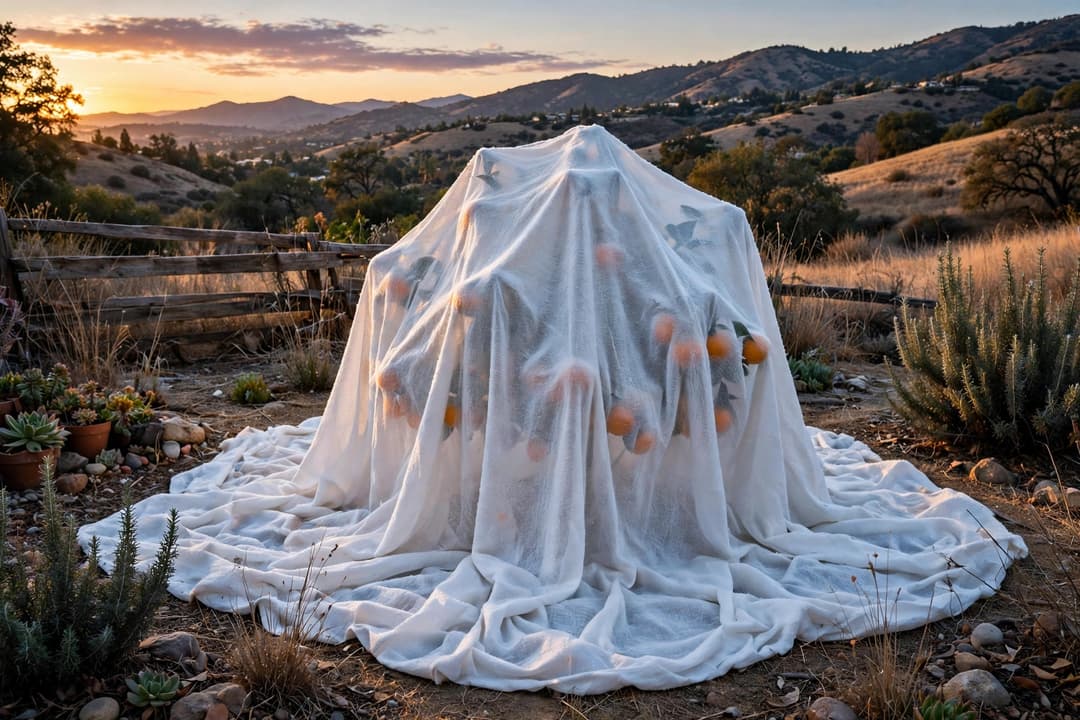
Water the soil in the late afternoon, cover the tree before sunset with the cover reaching all the way to the ground, add old-fashioned incandescent lights under the cover if the forecast drops below 32 degrees, and pick ripe fruit before the freeze. That is the short answer — and the details matter, because citrus does not have one single freezing point: fruit, leaves, green wood, and mature wood all fail at different temperatures, and how long the cold lasts matters as much as how cold it gets. UC ANR's Butte County Master Gardeners explain the mechanism plainly: freezing temperatures form ice crystals inside plant cells, frost-damaged growth withers and turns dark brown or black, and ice crystals in fruit rupture juice vesicles so the fruit dries out.
Sophie: "It is only supposed to dip to 30 tonight. Do we really need the cover out?"
Sprouty: "Thirty is usually when citrus starts getting hurt — and the cover has to go on before sunset, while the soil is still warm. After dark, there is nothing left to trap."
Know Your Number Before Sunset
Citrus trees (Citrus spp., in the rue family, Rutaceae) keep their leaves through winter, so their leaves, green wood, and fruit stay vulnerable all winter — citrus are broadleaf evergreens with no true deep dormancy, only a temperature-driven pause in growth. UC Master Gardeners in Sacramento put the general line this way: frost is generally any temperature at 32 degrees Fahrenheit or lower, and for citrus, damage usually occurs at 30 degrees or lower depending on variety. Kumquats and Satsuma mandarins tolerate frost best; lemons and limes tolerate it least. For vocabulary, Contra Costa County's UC Master Gardeners define the terms used in this article: frost can start below 36 degrees and is sure at 32 degrees, a freeze is below 32 degrees, and a hard freeze is below 28 degrees.
Fruit damage is one rule with two variables — ripeness and duration — not two competing numbers. Sacramento's guide states both formulations: citrus fruit is generally damaged below 30 degrees, and, depending on ripeness, fruit can be damaged below 27 degrees. UC ANR's Butte County guide shows why duration resolves part of the tension: mandarin fruit will tolerate a brief exposure to 24 degrees, but several hours at 26 degrees will begin to freeze the fruit. Read the numbers together: a brief dip near 30 degrees is not the same event as hours in the mid-20s, and green fruit is less cold-tolerant than ripe fruit, because sugars in ripe juice act like antifreeze — but a tree carrying fruit is still less cold-tolerant overall than a tree without fruit, which is why picking ripe fruit before a freeze protects both the fruit and the tree.
Wood damage sits at colder numbers than fruit damage, and the UC tables do not agree with each other, so do not build your night around a single wood threshold. UC ANR's Butte County guide gives the four-hour duration explicitly only for a mature mandarin (20 degrees) and an orange (24 degrees); Meyer lemon (22 degrees) and grapefruit (26 degrees) are given as critical temperatures with no duration stated, and the guide stresses that longer cold causes greater damage. Sacramento's own variety table gives different numbers — limes 29 degrees, lemons and grapefruit 26 degrees, Meyer lemon 22 degrees, oranges and mandarins 21 degrees, kumquat 19 degrees — which contradicts Butte's orange at 24 degrees and mandarin at 20 degrees. Act on the Fair Oaks action ladder below, not on any one wood-damage number.
For that practical ladder, use the one UC's Fair Oaks Horticulture Center uses for its own citrus trees when temperatures are predicted to drop below: 32 degrees, turn on the lights; 29 degrees, also cover young trees (1 to 4 years old) and older sensitive varieties such as limes and lemons; 27 degrees, also cover the remaining trees; and 26 degrees, add a layer of plastic sheeting over the frost cloth if a prolonged arctic freeze is expected. The young-tree ages in this article look inconsistent until you separate what each one measures: Butte's "one to three years old" is the group to cover entirely; Fair Oaks' "1 to 4 years old" is the cover-first group in its ladder; and Sacramento's "first four or five years" is the span over which some protection is needed. If your tree is young, it is in the cover-first group, not the wait-and-see group.
Before Sunset: Water, Bare Soil, Pots, and Picking
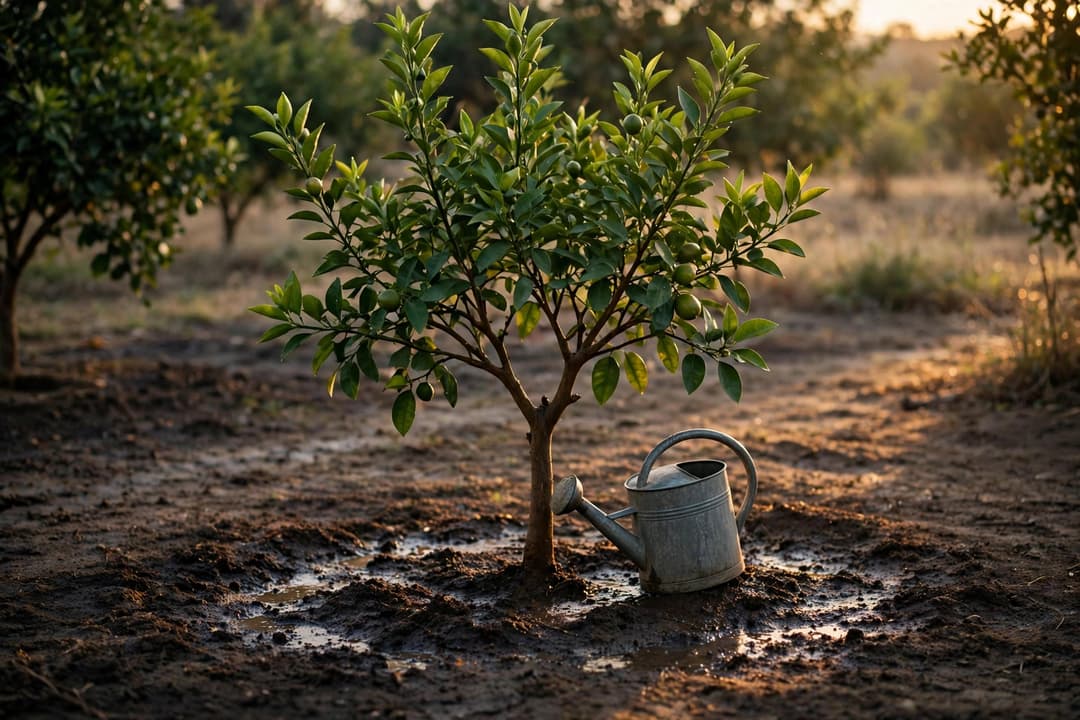
Do this work in the late afternoon, not after dark. UC Master Gardeners of Contra Costa County advise watering the ground around plants lightly in the late afternoon or early evening when the forecast calls for 32 degrees or below at night: wet soil holds more heat than dry soil, and when dry soil freezes it pulls moisture from the roots. UC ANR adds the soil-surface point: moist soil retains heat better than dry soil and can warm the air near the surface, and bare, moist soil absorbs and reradiates heat better than soil insulated with mulch, weeds, or other ground covers. The Sacramento page makes the same pre-frost move explicit: rake mulch away so the soil can warm up during the day and radiate heat into the plant at night. Butte says the same thing as a season posture — keep the ground around trees bare during the winter months — and neither source tells you to re-mulch in the morning, so treat bare soil as the frost-season posture, not a one-night trick. Before any warning arrives, stage the supplies Sacramento lists — sheets, blankets or frost cloth, lights, trunk wraps, thermometers, and stakes or a frame to hold covers off foliage — and identify the cold spots in your landscape with a thermometer, so a forecast does not find you shopping for cloth at dusk.
Move what you can move. The Sacramento page advises moving potted plants to a warmer spot next to the house or under a patio cover, especially on the south side, and Contra Costa County adds that moving potted plants indoors or into a greenhouse, or grouping them under eaves or a tree, also helps conserve heat. A potted lemon is a move-it-first plant, not a leave-it-out plant. And pick what is ripe: the Sacramento page's rule is to harvest ripe citrus fruit before a freeze, since fruit is generally damaged below 30 degrees, and the Butte County guide notes that picking fruit before a predicted freeze helps protect the entire tree as well as saving the fruit.
Cover It Right: To the Ground, and Off the Leaves — Except Frost Cloth
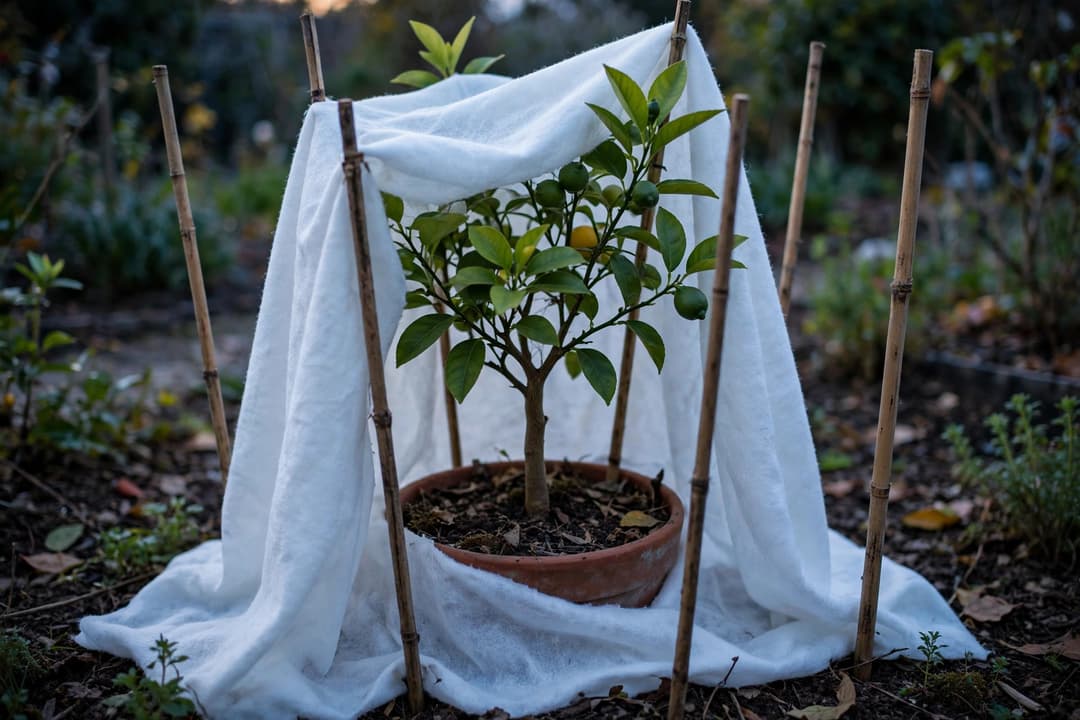
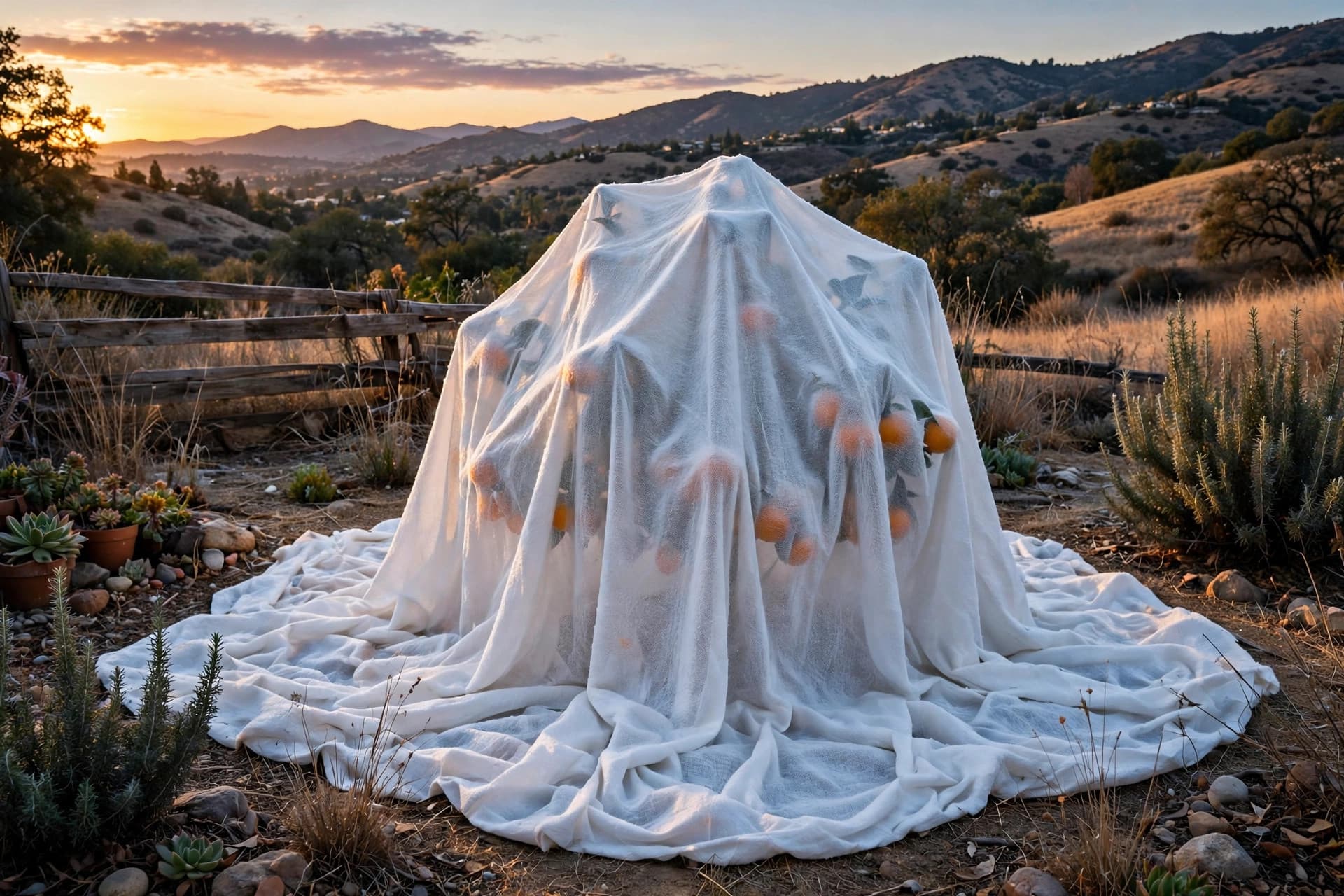
The cover's job is to trap heat rising from the soil, so the details are the whole job. UC ANR advises covering young trees from the ground up to the main branches with insulating material, and covering trees one to three years old entirely with a light material to trap heat radiated by the ground; use a frame or stakes to minimize contact between cover and leaves, because ice may form where the cover touches leaves; and extend the cover as close to the ground as possible, removing it the next morning after the temperature rises. That stakes rule is for sheets, blankets, tarps, and plastic. Frost cloth is the exception: Sacramento's guide says frost cloth can lay directly on plant foliage and can float over the top of plants, and Contra Costa County likewise says it can float over the top. Sheets, burlap, or tarps are a better choice than plastic, the Butte guide says, because plastic transfers more heat and leaves that touch it are more likely to freeze — plastic alone, touching leaves is the problem, which is why the Fair Oaks ladder's plastic step is different: plastic as an outer layer over frost cloth, not touching leaves, when a prolonged arctic freeze is expected.
Contra Costa County's version of the same routine adds two practical points: sheets, blankets, tarps, or burlap need to be propped up above the leaves and removed in the morning, because materials that get wet with dew can damage sensitive leaves; and commercial frost cloth comes in several weights, can float over plants, and can be left on for several days since light passes through it. The Sacramento page puts frost cloth's protection at 4 to 8 degrees depending on weight, while Contra Costa County lists up to 4 degrees — the honest reading is that a cover buys a few degrees, and the exact gain depends on the cloth's weight, so do not buy a thin cloth expecting eight degrees. For very sensitive plants, Contra Costa County says to make sure the cover goes all the way to the ground, and if very cold temperatures are forecast, wrap the trunk of a young citrus tree with cardboard to protect the bud union and above. Sacramento adds trunk wraps of towels, blankets, rags, or pipe insulation when a hard freeze is expected.
If you add heat, add the right kind. Sacramento's guide specifies old-style C7 or C9 holiday lights or a 100-watt drop light hung inside the plant — old bulbs that give off heat can provide up to 4 degrees of protection — and explicitly warns that new LED lights do not give off heat. The Butte County guide says the same: a 100-watt bulb designed for outdoor use, or old-fashioned incandescent Christmas lights hung in the middle of the tree, provide protection only because they release significant heat. Use lights, extension cords, and multi-outlets rated for outdoor use and grounded, Sacramento adds, and avoid connecting more than three light strings in a line. And skip the all-night sprinkler idea at home: Butte County notes that watering all night can protect trees only if applied continuously — if the water supply is interrupted, more damage may result than would have occurred otherwise — and that the practice uses a lot of water.
What Not to Do Tonight
Do not fertilize or prune now. UC ANR explains why: fertilizing and pruning both encourage new growth, and delicate new growth is far more frost-sensitive than mature foliage, so pruning and fertilizing should happen in spring and early summer to give new vegetation time to mature and harden off before cold weather. Sacramento's version is blunter: avoid fertilizing and pruning after August to minimize tender new growth. A late feed tonight does not "toughen" the tree; it pushes exactly the soft growth a frost night punishes. Likewise, do not leave a sheet or blanket cover on through a sunny day: Contra Costa County says to remove covers in the morning after frost has thawed so air can circulate and soil can warm in the sun, and Sacramento says to remove sheets and blankets daily if it is sunny and above freezing for the same reason. Frost cloth is the exception — it can stay on for a few days because light and air pass through it.
Northern California, Honestly: The Foothill Window Is Already Open
This is not a "someday in winter" job for inland Northern California — and the dates below are Northern California county evidence, not a statewide rule: Southern California and coastal timing differs sharply, so check your own county's frost dates rather than importing these. Contra Costa County's UC Master Gardeners note that a first frost may arrive as early as Halloween in their county, with November 15 often thought of as a first frost date in much of the county — and they advise starting frost protection early, before you need it, precisely because significant climate variation makes any single date unreliable. The Sacramento page's neighboring-area list makes the foothill point sharper: it lists Placerville's frost window as October 22 to May 18, Auburn's as November 14 to April 13, and Davis's and Lodi's as November 2, against Sacramento's own December 10 average first frost. A foothill garden near Placerville is therefore already inside its frost window on November 1, while a Sacramento garden may not see its average first frost for another month — same state, different urgency, and your own yard's low spots matter too, since UC ANR notes cold air collects in low areas while trees near walls benefit from reflected and reradiated heat. Check tonight's forecast for your own microclimate, not a statewide average, and stage the cloth, stakes, and lights before the first warning — not during it.
After the Frost: Wait, Then Judge in Spring
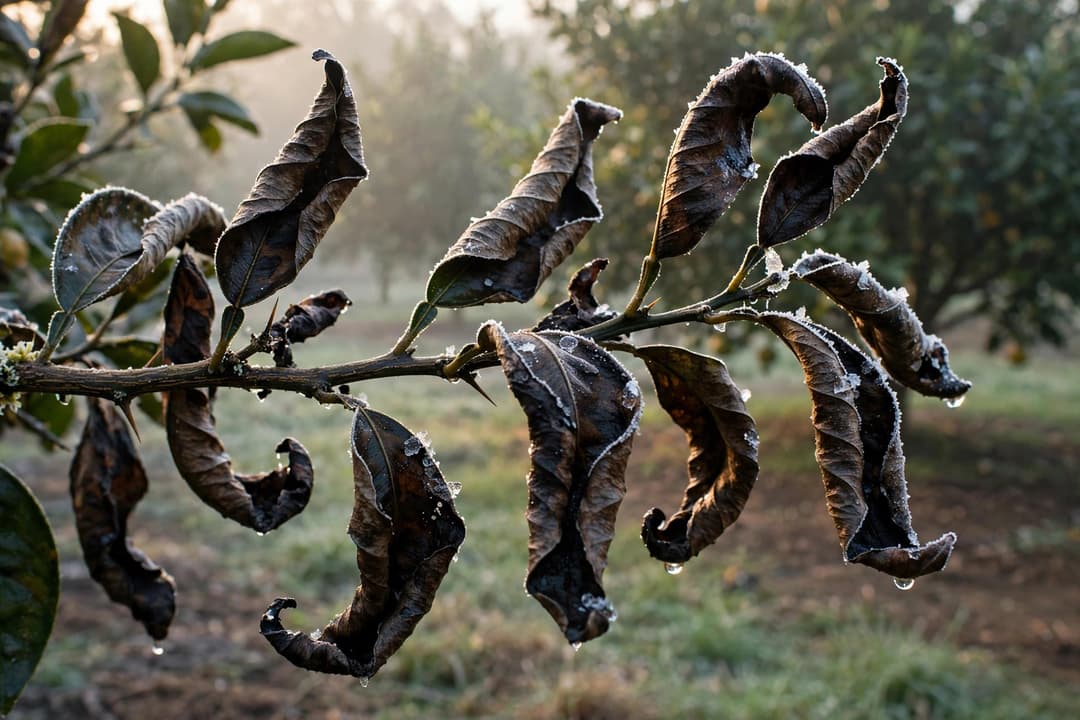
Frost-damaged leaves curl and turn brown or black within a few days, UC ANR says — and the hardest advice to follow is to leave them alone. Both UC guides agree: resist the urge to prune out "dead" wood in early spring, allow a few months for recovery with warm weather, and only once new growth appears will the actual extent of the damage be apparent, so frost-killed branches can be removed without accidentally pruning living material. Sacramento adds the reason damaged growth is worth keeping through winter: damaged leaves and branches help protect the crown and roots, and pruning too early can stimulate tender new growth that the next frost will damage. Frost-damaged fruit is a different call: UC ANR notes it is edible after a freeze but susceptible to decay and often becomes unusable soon after damage — so use it promptly rather than storing it and hoping.
Frequently Asked Questions
Can I leave the cover on all week?
Only if it is frost cloth: light and air pass through it, so Sacramento's guide says it can stay on for a few days at a time. Sheets, blankets, and tarps must come off in the morning after frost thaws, per Contra Costa County, so the soil can warm in the sun and air can circulate.
My lemon is in a pot. Is covering enough?
Move it first, cover second. Sacramento's guide advises moving potted plants next to the house or under a patio cover, especially on the south side. A cover on a pot sitting alone in the open is the weakest version of this routine.
Do I need to cover a mature mandarin?
Probably last, not never. Mandarins and kumquats are the most cold-hardy citrus in UC ANR's guide, with a mature mandarin tolerating four hours at 20 degrees before serious wood damage — but fruit on that same tree is damaged well above 20 degrees, and Fair Oaks still covers remaining trees below 27 degrees. Cover for the fruit, even when the wood could take it.
What if I missed the night and the leaves are black?
Wait until spring growth shows what is actually dead, then prune only the dead wood. UC ANR advises resisting the urge to prune in early spring and waiting until new growth appears, so frost-killed branches can be removed without accidentally pruning living material.