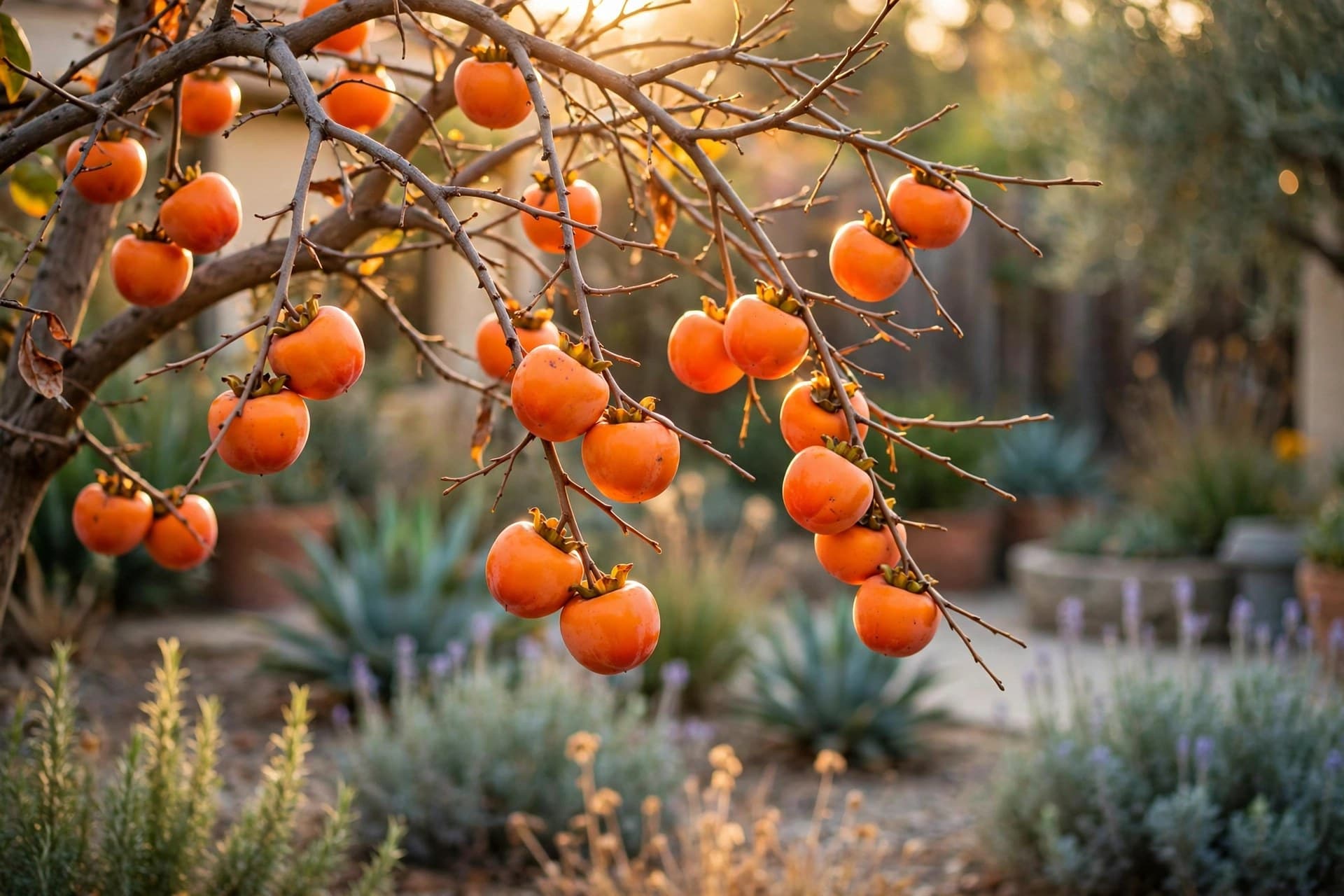

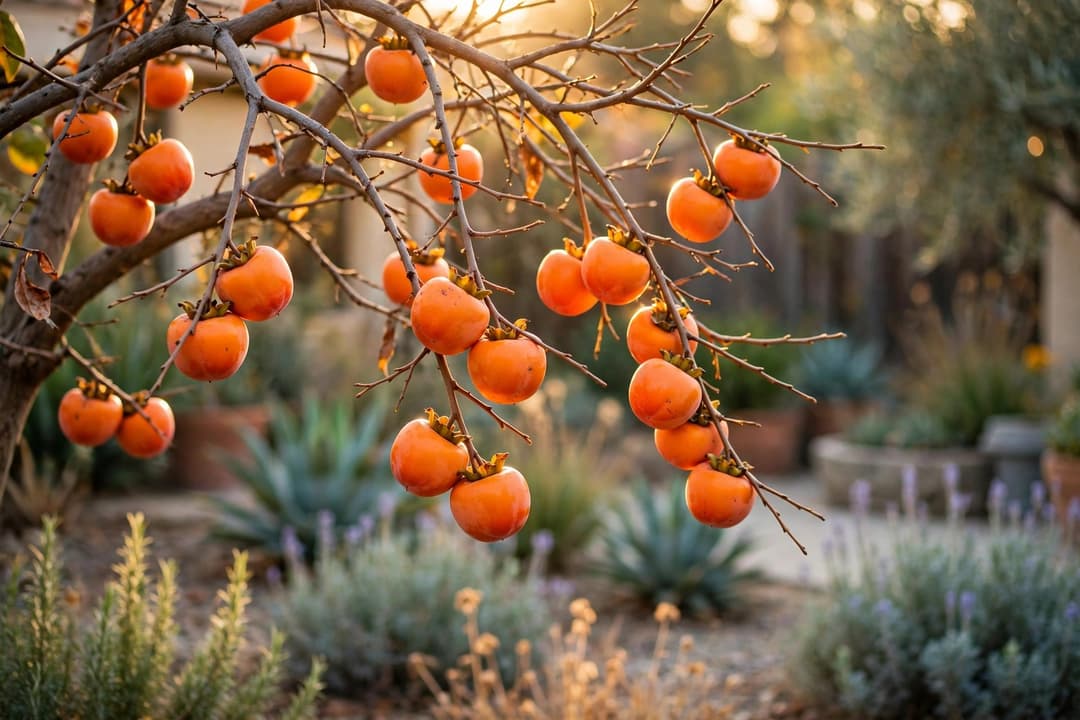
Persimmons are ripe right now — late September through November, per University of California Master Gardeners — but “ripe” means two opposite things depending on which persimmon you hold. If it is a flat, squat Fuyu, eat it when it turns fully orange and is still firm, like an apple: UC Marin Master Gardeners put the Fuyu harvest window at mid-October to mid-November, firm but sweet. If it is a pointed, acorn-shaped Hachiya, do not bite it yet: UC Marin says Hachiya must be completely soft before eating, and UC Shasta Master Gardeners put it even more bluntly — an astringent cultivar must be jelly-soft before it is edible. One orange fruit, two eating rules, and mixing them up is how a single bite leaves your mouth puckered and dry.
Sophie: “They're both orange, they're both soft-ish. Why does one taste like honey and the other like my mouth turned inside out?”
Sprouty: “Because orange is a color, not a ripeness test. The flat one lost its tannins while it was still firm. The pointy one is still carrying all of its — until it goes jelly.”
Two persimmons, two opposite rules
Both of the persimmons most home gardeners grow are the same species — Japanese persimmon, Diospyros kaki, in the ebony family (Ebenaceae), per North Carolina State Extension, which also notes the genus name comes from the Greek for “divine fruit” — the “fruit of the Gods” line UC Marin uses too. Same species, but the two common types split on one chemical question: tannins.
Fuyu (non-astringent). Flat, squat, tomato-shaped fruit. UC Master Gardeners of Calaveras County explain that Fuyu loses its astringency at maturity while still firm and crunchy, so it is eaten crisp, like an apple, or sliced into salads — UC Marin agrees it is good eaten out of hand. Harvest cue: full orange color, mid-October to mid-November, per UC Marin.
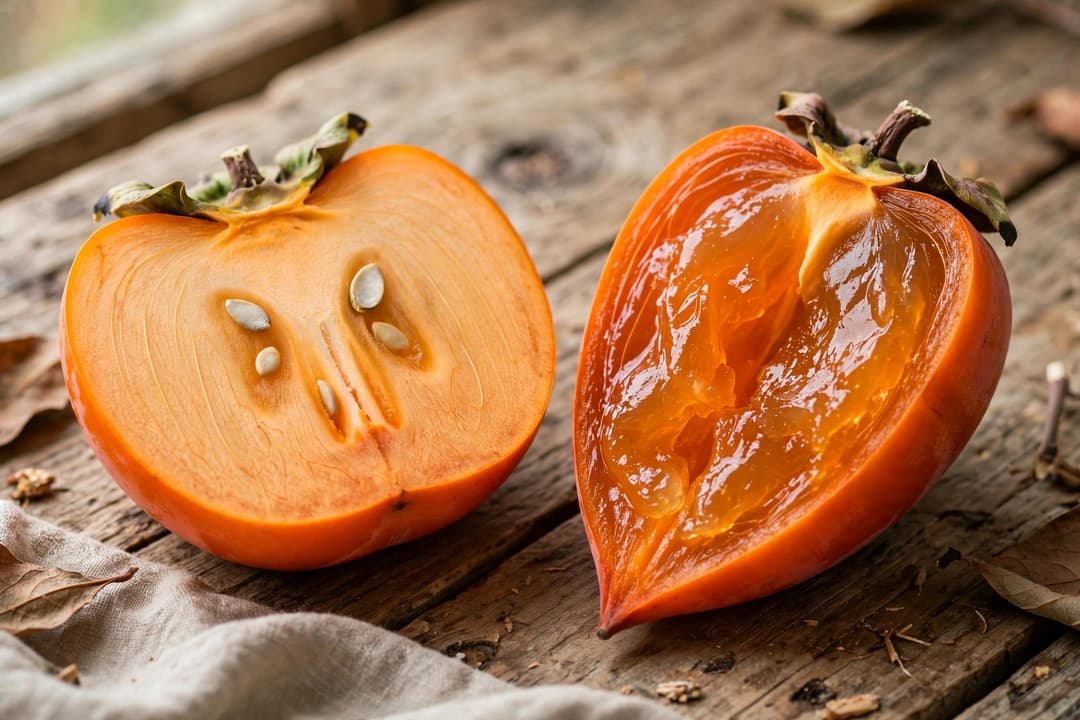
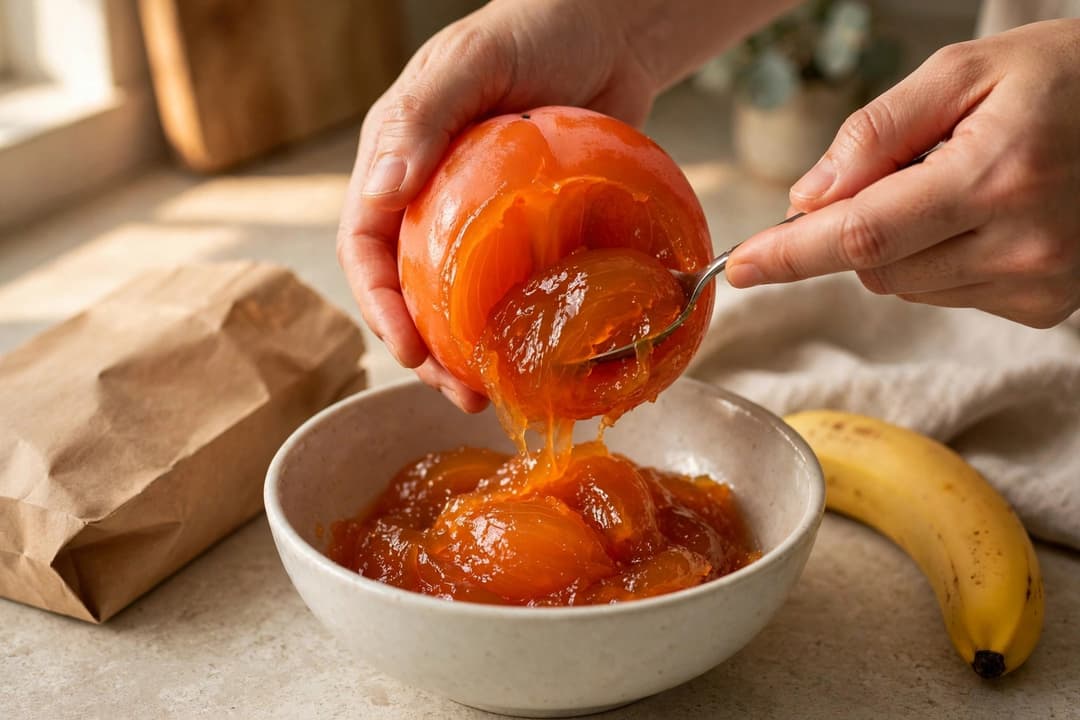
Hachiya (astringent). Large, deep orange-red, acorn-shaped fruit with a pointed end. UC Calaveras warns it is very astringent until very ripe and soft — wait until the flesh is quite soft before eating. UC Marin gives the Hachiya window as October to January, harvested on color change as it begins softening, and ripened off the tree. Fully ripened Hachiya is a baking fruit: scoop the jelly pulp for puddings, smoothies, and baking, per UC Marin.
Why an unripe Hachiya hijacks your mouth
The pucker is not sourness and it is not bitterness exactly — it is chemistry on your tongue. Unripe Hachiya fruit is loaded with soluble tannins, per the UC Master Food Preserver program, and UF/IFAS Extension notes that unripe astringent varieties are known for their mouth-puckering taste, which can numb the tongue and tighten the throat, due to the presence of tannins. One way to think of it: the tannins are the fruit's way of saying “not yet” — the drying, furry, mouth-puckering sensation is what those tannins do before the fruit is ready.
Ripening disarms it. As a Hachiya softens toward jelly, the soluble tannins polymerize into insoluble forms, so the astringency fades and the honeyed sweetness underneath finally shows. UF/IFAS Extension's postharvest guide states the rule plainly: before becoming sweet and edible, astringent persimmons must fully ripen and soften to eliminate their astringency, while non-astringent types are edible while still firm because they naturally lose their astringency before full ripeness. That is why “wait one more day” is genuinely good advice for a Hachiya: if you think it is ripe, it probably needs another day.
How to pick them
Both types begin to ripen in late September through November, per UC Calaveras — so if your tree is loaded now, you are in the window, not past it. Pick with clean pruning shears or scissors, cutting the stem above the calyx (the green collar), and leave the calyx intact until you eat or process the fruit, per UC Marin — pulling tears the skin and invites rot. Hachiya are usually harvested firm-ripe and softened at room temperature, per UC Calaveras, rather than left to go fully soft on the tree — partly because, as UC Marin notes, if Hachiya are left on the tree to fully ripen you will be competing with birds for the harvest.
Three ways to ripen a firm Hachiya
1. The bowl on the counter (simplest). The UC Master Food Preserver program calls this the simplest way to ripen a Hachiya to its best flavor: wash it, leave it in a bowl at room temperature for days or weeks until it gets soft and the skin goes nearly translucent. When it feels like a soft gel inside, it is time to eat.
2. The paper bag (fastest). UF/IFAS Extension describes accelerating ripening at home by placing the fruit in a paper bag with ethylene-producing fruits like apples or bananas — ethylene is the plant hormone that promotes ripening, and the bag traps it around the fruit. Check daily so they do not over-ripen.
3. The freezer (for a glut). Freezing also reduces astringency. The UC Master Food Preserver program says freezing, then thawing, a plastic-wrapped Hachiya at −4°F for 15–60 days softens it and reduces astringency — and for frozen whole Hachiya they say allow at least 15 days in the freezer to “ripen” and ideally consume within three months.
Hoshigaki: the patient person's persimmon
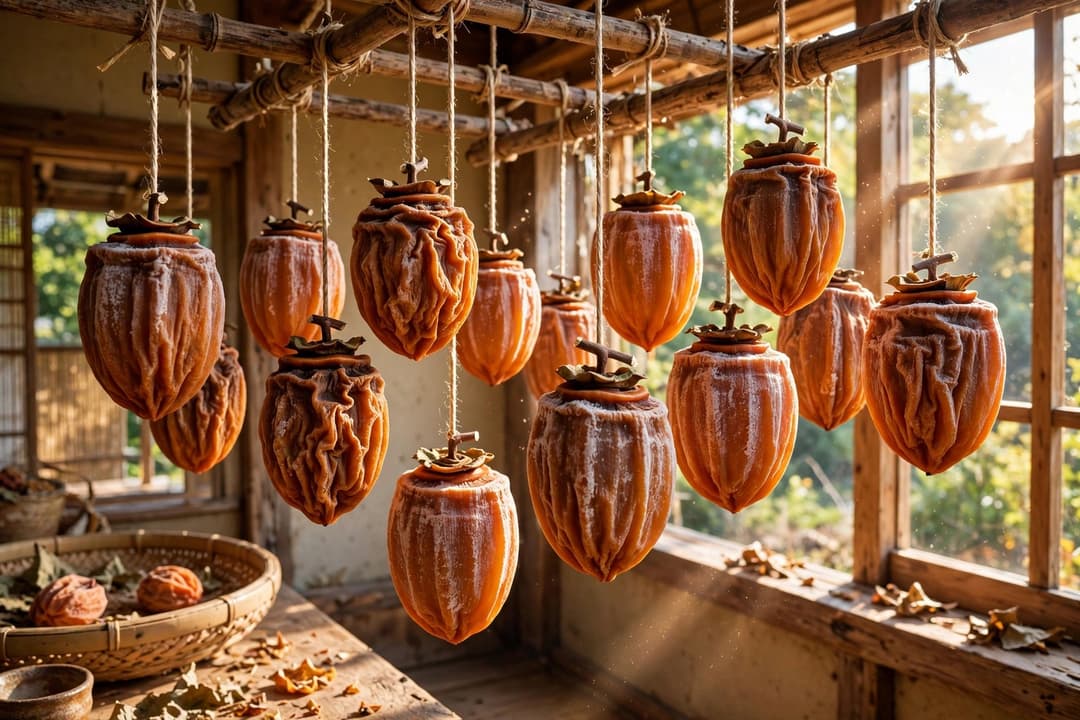
There is a centuries-old answer to the Hachiya problem that does not involve waiting for jelly at all: dry it. Hoshigaki is the Japanese art of air-drying whole Hachiya persimmons, and UC Master Gardeners of Fresno County publish a protocol adapted from UC Master Food Preserver instructions: pick Hachiya when orange but still firm, leaving the stem on; peel; dip the peeled fruit in boiling water for 15 seconds; hang by the stem in a ventilated spot. After the first 7–10 days, when the skin begins to wrinkle, begin gentle daily massaging — squeezing and rolling each fruit to redistribute sugars and break down the pulp — and continue for 3–6 weeks until the interior is soft and jelly-like and the outside develops a white sugar bloom. UC Master Food Preservers of Sonoma County give the same shape of the process — harvest only orange, firm persimmons with about an inch and a half of stem, peel, tie with cotton string, hang in a well-ventilated area for one to two months until leathery but still pliable. Drying also removes the astringency, and concentrates the sugar. It is slow food in the most literal sense — and it starts with exactly the firm, orange, inedible Hachiya you already have.
Storing the harvest
Fuyu: eat soon after picking if ripe. UC Marin says Fuyu store in the refrigerator or a cool location for one week to one month depending on ripeness, and freeze for up to six months for longer storage. They bruise easily once they soften, so handle them like the crisp fruit they are.
Hachiya: once fully ripened to jelly, eat promptly or puree. UC Marin says fully ripened Hachiya puree can be frozen for up to one year; the UC Master Food Preserver program puts frozen puree at up to six months. Two UC sources, two numbers — freeze puree in portions, label the date, and treat six months as the conservative end and a year as the outer end, not a promise. Either way, puree is the move: it turns a fruit too soft to slice into baking, smoothies, and yogurt for months after the tree is bare.
Quick answers
When are persimmons ripe?
In California, both types begin ripening late September through November, per UC Master Gardeners — Fuyu from mid-October to mid-November at full orange color while firm; Hachiya October through January, edible only once jelly-soft.
How do I tell Fuyu from Hachiya?
Shape: Fuyu is flat, squat, and tomato-shaped; Hachiya is large, acorn- or heart-shaped with a pointed end. When in doubt, press: if it is firm and fully orange and you do not know the variety, it is only pleasant to eat if it is a non-astringent type — a firm Hachiya will do the same to you.
Can I eat a firm Hachiya if I just don't mind the pucker?
UF/IFAS Extension is clear that astringent persimmons must fully ripen and soften before becoming sweet and edible, and the UC Master Food Preserver program describes unripe Hachiya as extremely tannic and difficult to digest — but there is no reason to endure it: a bowl or a paper bag fixes it in days or weeks, and the freezer handles a glut.
Why does my Hachiya never soften in the fridge?
Cold slows ripening — UF/IFAS Extension notes persimmons continue to ripen at room temperature, while cold storage slows their metabolism. Keep unripe Hachiya at room temperature until jelly-soft, then refrigerate the ripe fruit or freeze the puree.
What do I do with a tree-load of firm Hachiya?
Ripen some in a bowl, bag a few with a banana for the weekend, freeze the rest whole for later — or peel, hang, and massage your way to hoshigaki over the next month or two.