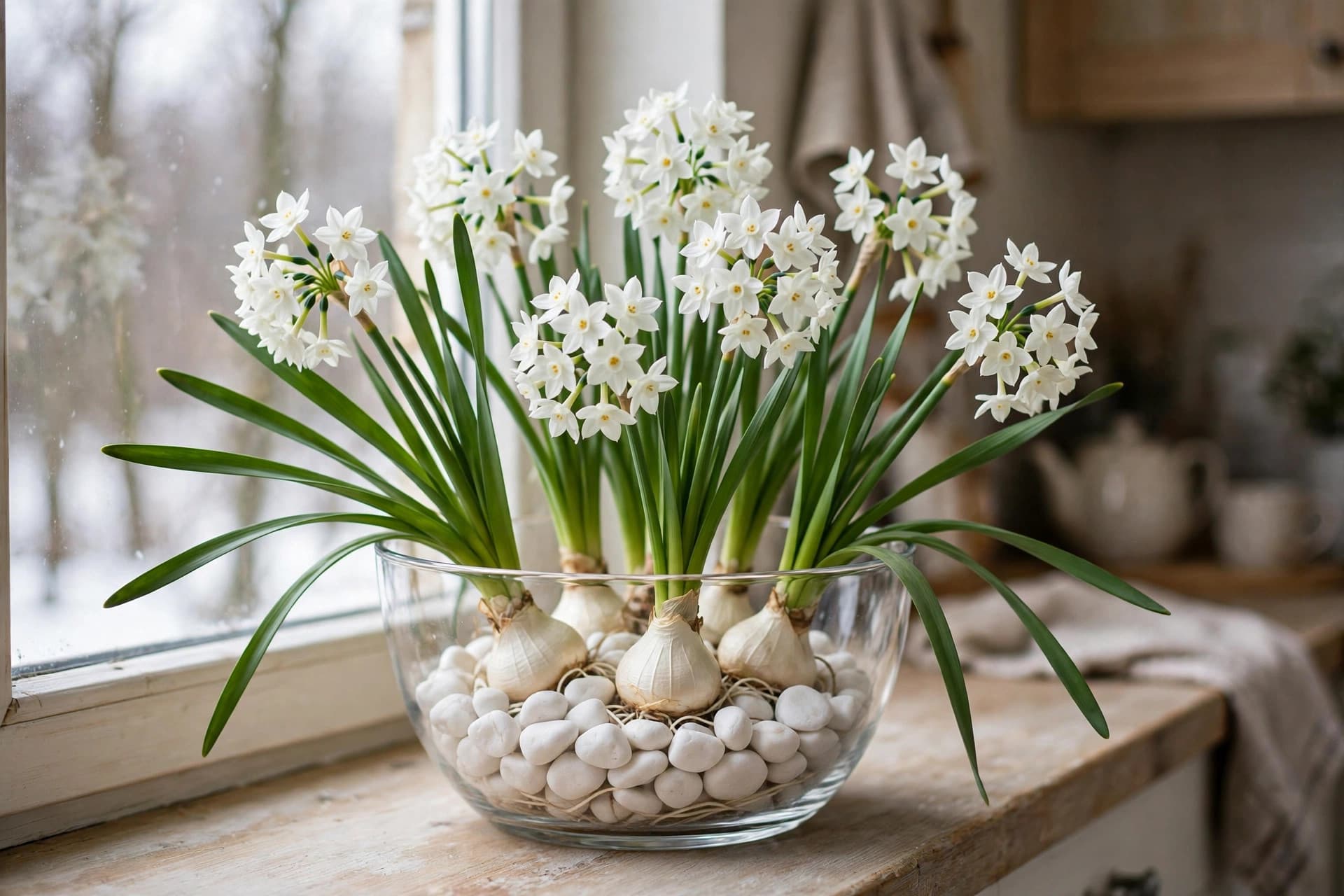

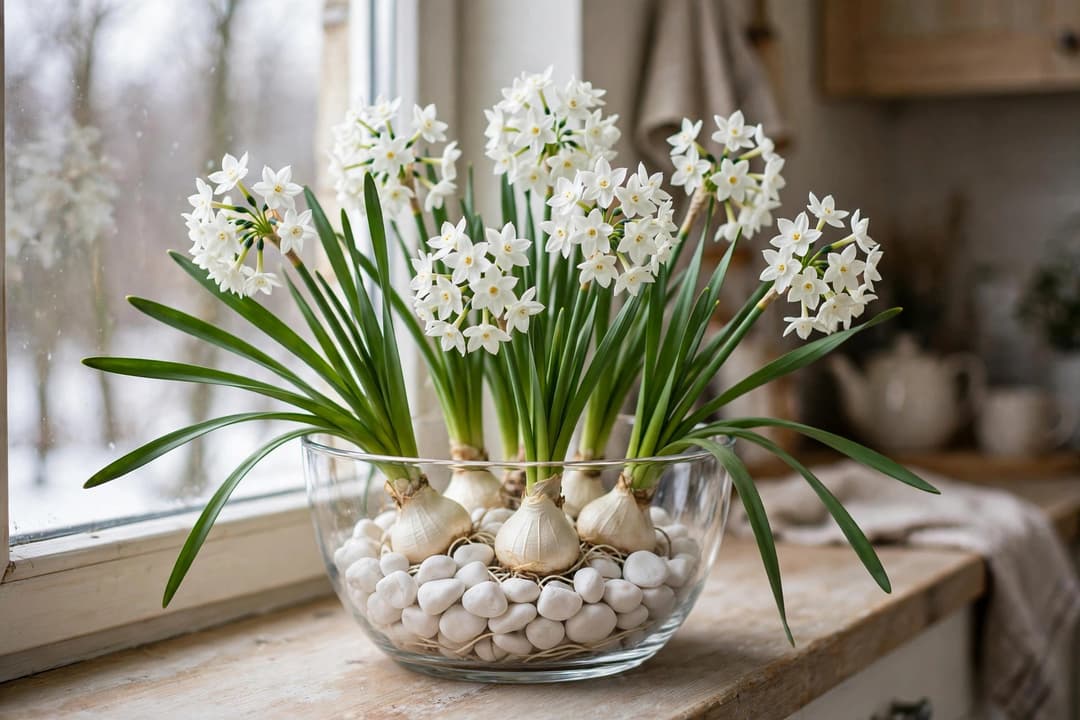
For Christmas blooms, plant in mid-November — about six weeks before December 25. Paperwhite narcissus needs no soil and no cold-chilling period: set the bulbs in pebbles and water (or potting mix), give them a short cool start for roots, and the bowl does the rest. How fast, exactly, is a range, not a date: University of Missouri Extension says bulbs normally need four to six weeks to come into flower, while Cornell University says the white, fragrant flowers usually open within 2 to 3 weeks of planting. Treat mid-November as the middle of that window, not a deadline — and plant a second bowl a week or two later as insurance. Unlike tulips and daffodils, which demand weeks of cold storage before they will flower, paperwhites skip that step entirely, per Iowa State University Extension.
Sophie: "A bowl of rocks and water becomes Christmas flowers? That sounds like a trick."
Sprouty: "No trick — just a Mediterranean bulb that never learned to wait for winter. Plant it this week, and it does the rest."
Why paperwhites skip the cold
Most spring bulbs will not bloom indoors without a long cold period first: tulips, daffodils, hyacinths, and crocuses need weeks of cold storage, while paperwhite narcissus does not require one at all, per Iowa State University Extension. Botanically the plant is Narcissus tazetta — genus Narcissus, family Amaryllidaceae — listed by North Carolina State Extension at about 18 inches tall with fragrant white blossoms. The same bulbs are often sold labeled Narcissus papyraceus; the name on the bag varies, the plant and the care do not. It comes from the mild Mediterranean, where winters never demanded a deep chill, so the bulb arrives ready to grow the moment it gets water and warmth.
One honest nuance: "no chilling" does not mean "no cool start." Iowa State still recommends a short cool, dark rooting phase after planting — 45 to 50°F for 2 to 3 weeks — before the shoots move to a sunny window. That is a rooting head start, not the months of cold storage tulips demand. What actually makes stems leggy is warmth and low light afterwards: Missouri Extension advises keeping bulbs cool after planting precisely to prevent foliage and stems from becoming too leggy.
Plant them in ten minutes
Buy large, firm bulbs — withered or soft ones bloom poorly. Then follow the Iowa State method:
- Pick a shallow bowl or pot. A clear bowl with no drainage holes works fine and lets you watch the water level; a pot with potting mix works just as well.
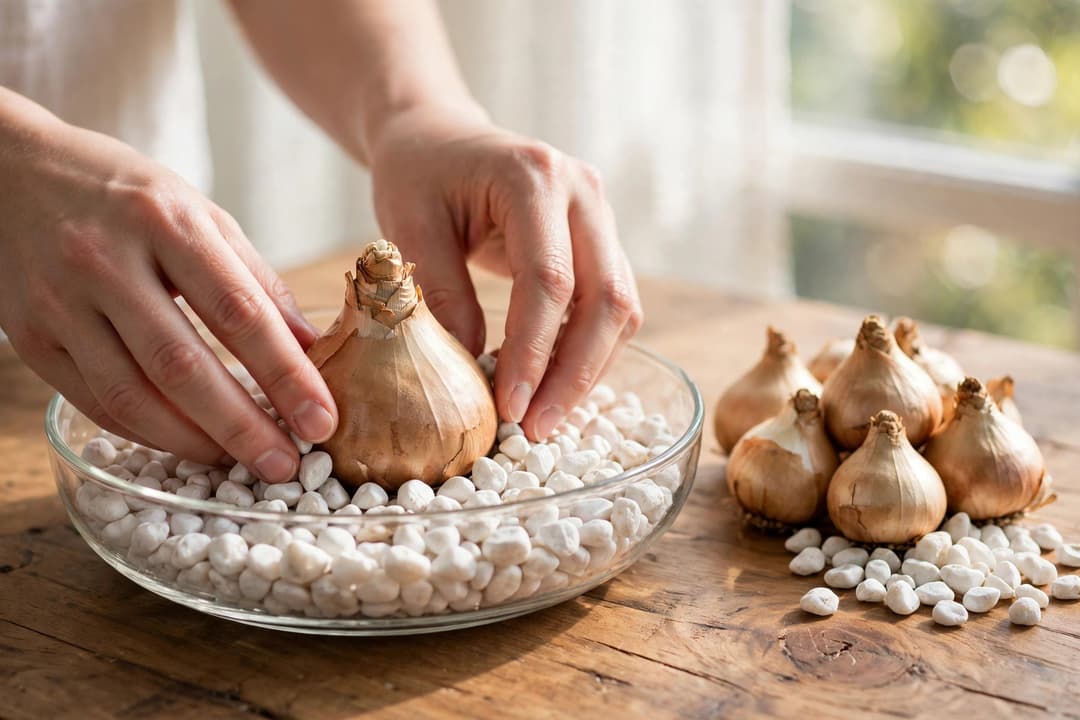
- Anchor the bulbs. In a bowl, partly fill it with washed gravel or stones, set the bulbs on top, and add more gravel around them, leaving the tips (noses) exposed. In a pot, set the bulbs on potting soil and add soil until only the tips stick out above it.
- Water to the base only. Add water until it just touches the bottom of the bulbs, and hold it at that level throughout forcing. Bulbs sitting submerged in water rot; bulbs with dry bases stall.
- Root them cool and dark. Park the bowl somewhere 45 to 50°F and dark for 2 to 3 weeks while roots form.
- Move to light at 3 inches. When the shoots reach about 3 inches, move the bowl to a sunny window at 60 to 70°F. Once flowers open, move it out of direct sunlight — that single move prolongs the bloom.
Two shopping notes from Iowa State's variety list: common paperwhites include the classic 'Ziva' — the cultivar in Cornell's alcohol trials — plus 'Bethlehem' (creamy white petals, yellow cup) and 'Galilee' (pure white), while 'Grand Soleil d'Or' (yellow petals, orange cup) takes 1 to 2 weeks longer to force — so if Christmas is the target, buy the white ones this month and save the yellow for a January bowl. And know the fragrance before you commit: most paperwhites carry a noticeable musky fragrance, which some people love and others find overpowering in a small space.
The Christmas calendar: stagger, don't gamble
Because the guides disagree on speed — Cornell says 2 to 3 weeks, Missouri says 4 to 6 — betting Christmas on a single bowl is a gamble. The fix costs nothing: stagger, as Missouri Extension recommends with succession planting at two-week intervals in November.
- Bowl 1 — early November (now): your early bowl, opening from mid-November into early December.
- Bowl 2 — mid-November, the week of November 13: your Christmas candidate. On Cornell's fast end it opens in early December; on Missouri's slow end it opens in Christmas week — either way it is the bowl most likely flowering at Christmas.
- Bowl 3 — late November: your New Year's bowl, opening into early January.
Note what the stagger actually insures: bowl 2 covers bowl 1 peaking early and fading before Christmas. It does not cover bowl 1 running late — a later bowl cannot rescue an earlier bowl that is behind. If a bowl looks slow, move it to a warmer, brighter spot (warmer conditions accelerate growth, per Missouri Extension, at the cost of taller stems).
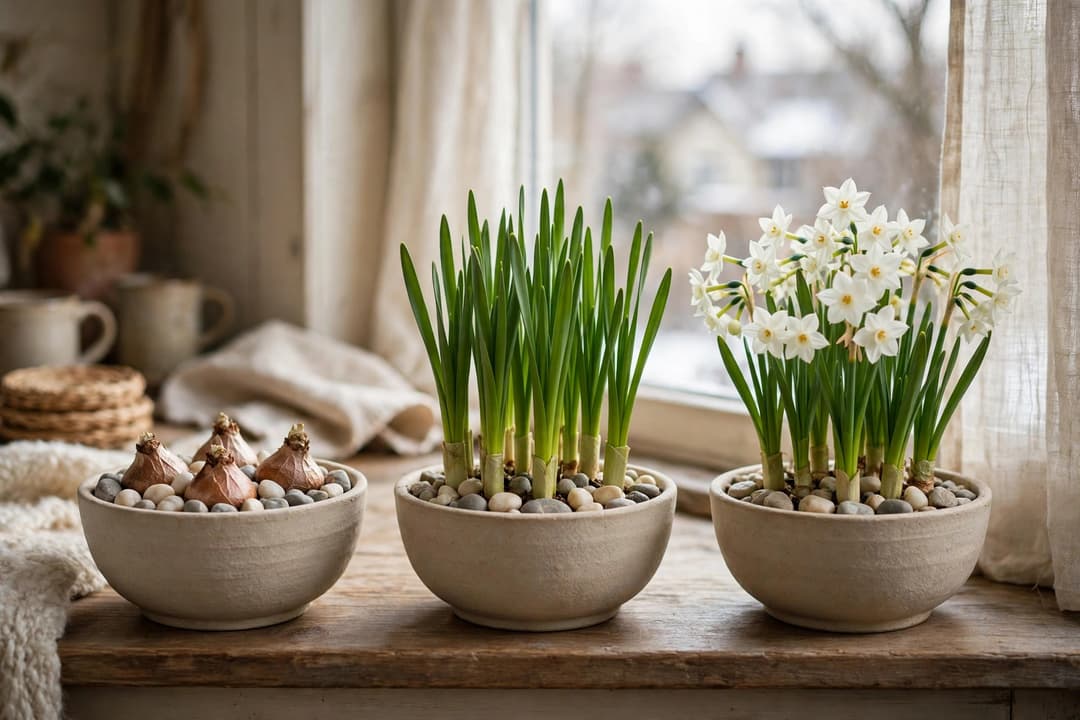
Temperature is your throttle, and Missouri Extension states the direction plainly: keep bulbs cool after planting to prevent leggy growth — temperatures in the 50s allow good development without becoming excessively leggy, while warmer conditions accelerate growth but make plants taller. That sits alongside Iowa State's sanctioned range of a 60 to 70°F sunny window once shoots reach 3 inches: bright and cool, not hot and dim. If your house runs warm, the alcohol trick below matters more, not less.
The Cornell trick: a splash of alcohol keeps them upright
Paperwhites grow 18 to 20 inches tall and flop — it is their most famous flaw, and Iowa State warns they often require staking. Cornell University found a stranger fix. Its Flower Bulb Research Program, directed by William B. Miller, tested the idea after New York Times garden writer Leslie Land asked whether gin affects paperwhites, and the results held: watering with a dilute alcohol solution makes the plants one-third to one-half shorter, with flowers just as large, fragrant, and long-lasting as usual, per Cornell's "Pickling your Paperwhites" write-up.
The recipe:
- Start the bulbs in plain water as usual. Wait about a week, until roots are growing and the shoot is green and 1 to 2 inches above the bulb.
- Pour off the water and replace it with a 4 to 6 percent alcohol solution. For a 40 percent spirit (gin, vodka, whiskey, rum, tequila), mix 1 part spirit to 7 parts water — a 5 percent solution. For 70 percent rubbing alcohol, mix 1 part to 10 or 11 parts water.
- Use that solution for all further watering.
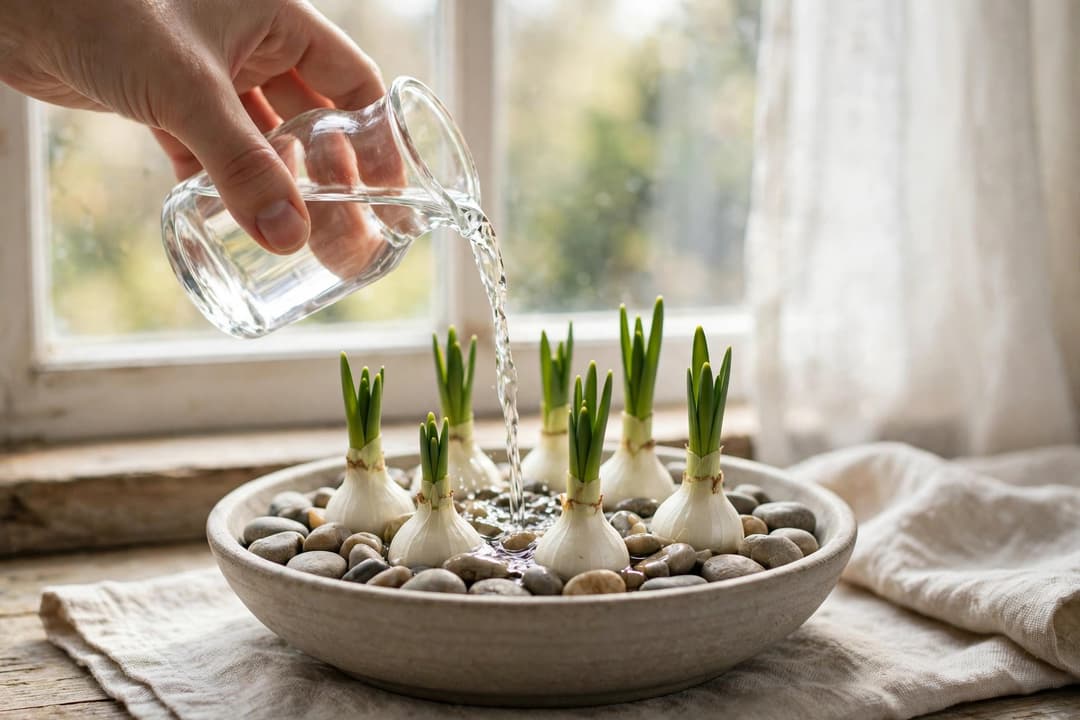
One scope note: this trick is for bowls of pebbles and water, where you can pour the water off and replace it — you cannot do that with a soil pot, so soil-grown bowls rely on a cool room and a stake instead.
The cautions matter as much as the recipe. Stay well below 10 percent alcohol — above that, growth problems start, and 25 percent is dramatically toxic to the plant. Do not use beer or wine: the sugars cause problems. And Cornell's own guess at the mechanism is mild water stress — the alcohol makes it slightly harder for the plant to absorb water, enough to slow leaves and stems but not enough to touch the flowers. If you would rather not use alcohol at all, the low-tech alternatives still work: a cool room, bright light, and a stake or a tall straight-sided vase.
After the show — and the pet warning
Enjoy the bloom, then let it go. Iowa State advises discarding paperwhite bulbs after flowering: they cannot be forced again, and they are not winter-hardy outdoors. Missouri Extension agrees — forced paperwhites are normally discarded after blooms fade.
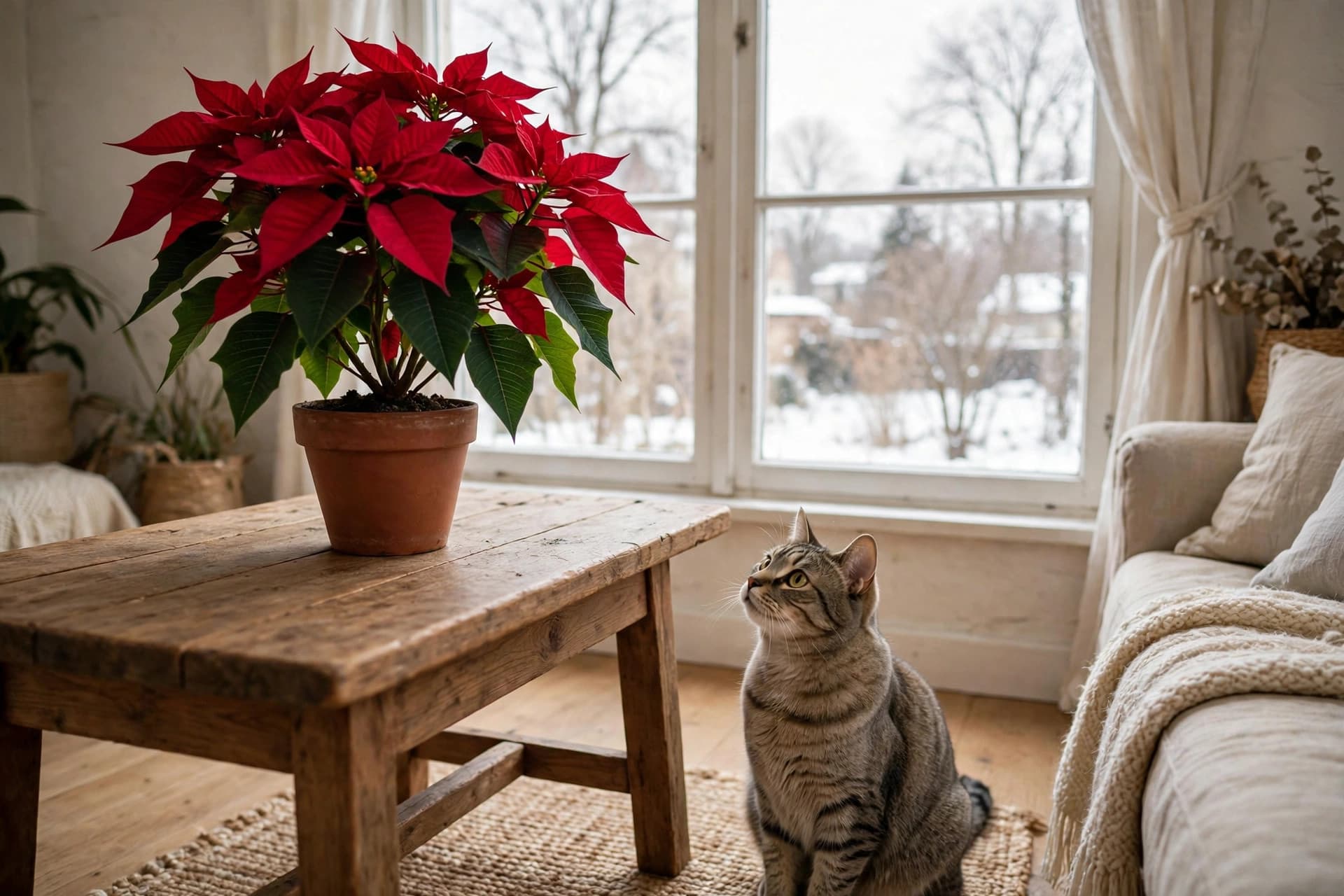
One safety note belongs in every paperwhite article, because the bowl sits at coffee-table height. Narcissus is toxic, and the bulb is the most poisonous part: Penn State Extension notes that eating parts of daffodils (Narcissus spp.) causes gastrointestinal symptoms in cats and dogs, and high amounts can cause seizures. Keep bulbs, dishes, and blooming plants where pets cannot reach them, and if a pet eats any part, call your veterinarian or the ASPCA Animal Poison Control Center at 888-426-4435.
Quick answers
Do paperwhites need chilling?
No cold storage period at all, unlike tulips and daffodils — but give them 2 to 3 weeks cool and dark after planting so roots form before shoots take off, per Iowa State.
When should I plant for Christmas?
Mid-November — about six weeks before December 25 — with a second bowl a week or two later as insurance, since guides disagree on speed (Cornell: 2 to 3 weeks; Missouri Extension: 4 to 6).
Why did my paperwhites fall over?
They grow 18 to 20 inches and go leggy, especially in warm rooms. Next time, try the Cornell alcohol method (4 to 6 percent solution, started once shoots are 1 to 2 inches tall), a cooler room, or a stake.
Will they bloom again next year?
No — forced paperwhites are spent after one show. Discard them and buy fresh bulbs next fall.
Are paperwhites safe around pets?
No. Narcissus is toxic to cats and dogs, with the bulb the most poisonous part — keep the bowl out of reach.