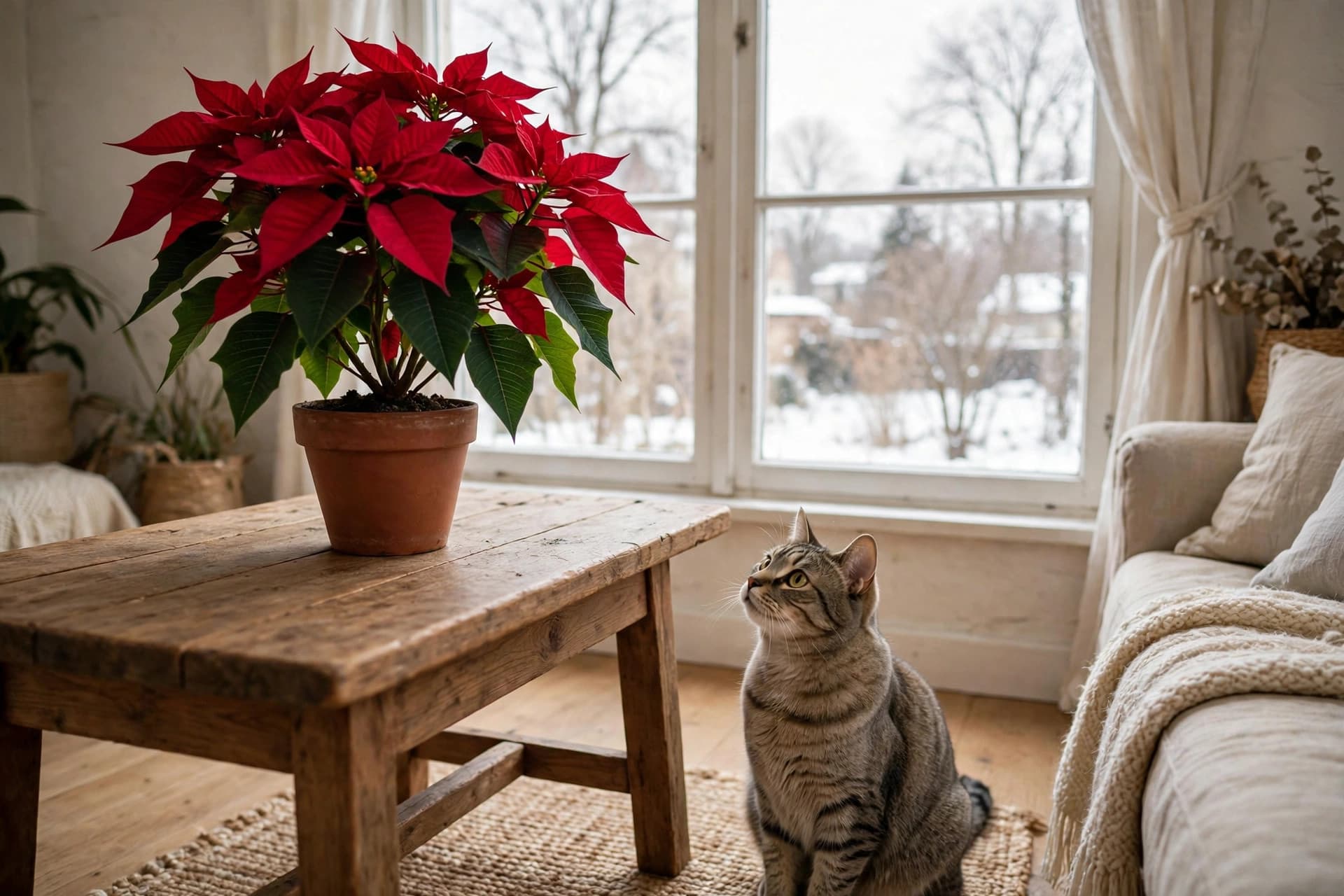

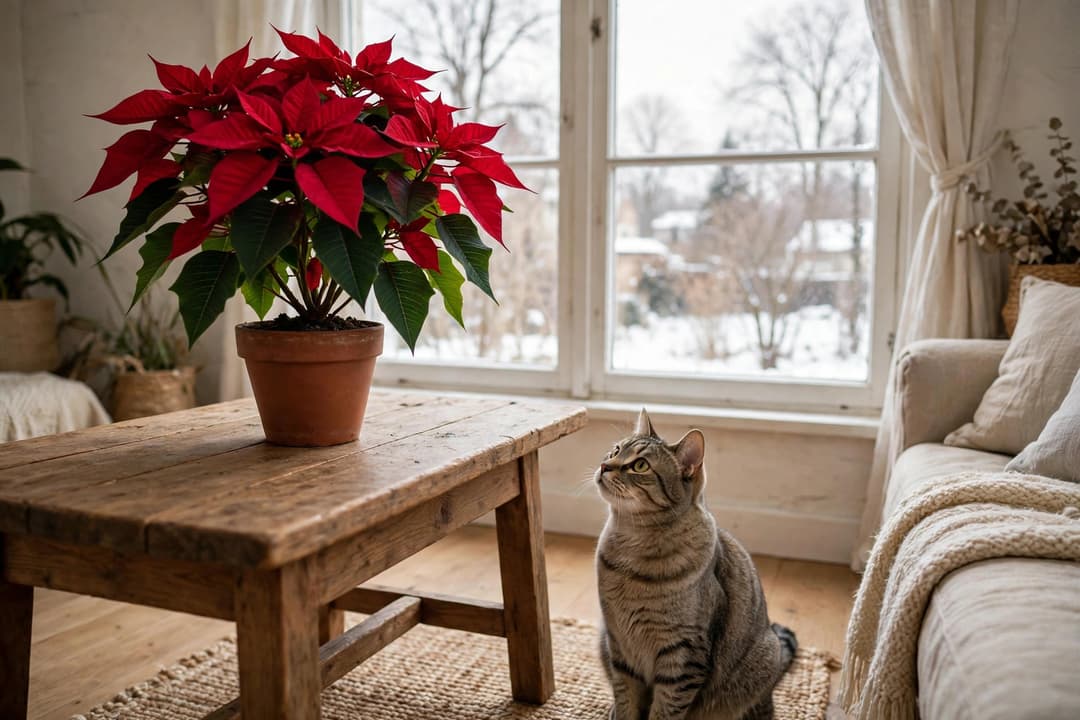
No — poinsettias are not poisonous to dogs, cats, or children. The pet evidence is veterinary: Washington State University's veterinary college, cited by Purdue Extension, says signs if any are usually mild — drooling or vomiting after a nibble — and the plant's milky sap can irritate skin. The human evidence is unusually strong too: rats fed extraordinarily high doses showed no ill effects at all, and in a study of 22,793 reported human exposures, no one died and fewer than 5 percent needed treatment at a medical facility. Illinois Extension puts it plainly: poinsettias are not poisonous, and the overwhelming evidence shows little risk in bringing one home. The one thing the evidence does not say is that the plant is a chew toy — keep it out of reach anyway, because a nibble can still mean an upset stomach and irritating sap on skin.
Sophie: "The internet says this plant could kill the cat. Should it even be in the house?"
Sprouty: "The internet is repeating a story from 1919 that was never proved. The plant can upset a stomach, but it is not classified as poisonous. Put it where the cat can't reach it, and enjoy it."
Where the Poison Story Comes From
The entire reputation rests on one unproved story. University of Missouri Extension traces the myth to a 1919 incident in Hawaii in which a two-year-old child died, presumably after eating poinsettia leaves; it was later revealed that the child died from other causes and the poinsettia was not involved. Illinois Extension calls the story hearsay, never proved by medical or scientific fact — but it took on a life of its own, repeated in a 1920 academic article about poisonous plants in Hawaii and then enshrined in a 1944 textbook, until "poinsettias are poisonous" felt like settled science. As Missouri horticulturist David Trinklein put it: "You cannot un-ring a bell. Once a myth gains traction, dispelling it becomes quite a challenge." Modern lists of toxic holiday plants keep repeating it, which is why the question still tops every November search.
What the Evidence Actually Shows
The myth has been tested more thoroughly than almost any other houseplant. In a 1971 study funded by the Society of American Florists, scientists at Ohio State University fed lab rats extraordinarily high doses of various parts of the poinsettia — a human would have to devour several pounds to get an equivalent dose — and observed no mortality, no symptoms of toxicity, and no changes in dietary intake or behavior, according to Missouri Extension. Iowa State University Extension reports a separate exposure study in detail — 22,793 exposures, 98.9 percent accidental, 93.1 percent involving children, no fatalities, fewer than 5 percent requiring treatment at a medical facility, and gastric upset, vomiting, or diarrhea in fewer than 8 percent of exposures. After reviewing all available information, the U.S. Consumer Product Safety Commission denied a 1975 petition to require warning labels on poinsettias, according to Illinois Extension. Purdue Extension, citing the College of Veterinary Medicine at Washington State University, adds the pet-specific version: the milky sap can irritate the mouth, but if signs develop they are usually mild, and some cats that chew leaves may salivate or vomit if leaves are swallowed.
Two real cautions survive the debunking. First, the sap: poinsettia stems and leaves ooze a milky latex when cut or broken, and that sap shares several proteins with natural latex rubber, so it can cause allergic skin reactions — Illinois Extension flags latex allergy specifically, and Missouri Extension notes the same latex-protein link. Wear gloves if you prune, and wash sap off skin. Second, a determined chewer can still earn an upset stomach. The practical rule, stated by both Illinois Extension and Iowa State Extension, is the same: not poisonous, not food, keep it out of reach of small children and pets, and call your veterinarian if a pet eats a large amount or vomits repeatedly.
The Red Parts Aren't Flowers
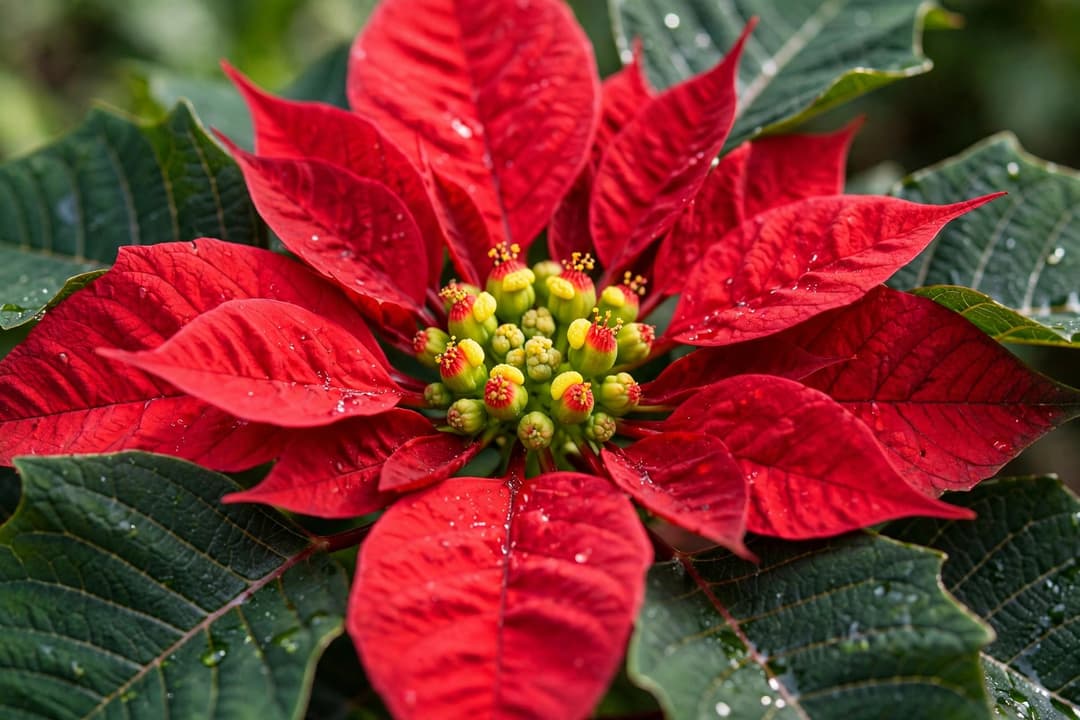
The poinsettia (Euphorbia pulcherrima, in the spurge family, Euphorbiaceae) is native to Mexico, where it grows as a large shrub or small tree reaching 10 to 15 feet, according to Iowa State Extension. The showy red parts are not petals at all: they are bracts, specialized leaves that color up around the true flowers — the small yellow-green button-like structures in the center called cyathia, from the Greek for "cup," as Missouri Extension explains. That distinction is also your freshness test when shopping (below): cyathia still tight and shedding little or no pollen mean a young plant; missing cyathia mean the plant is past its prime.
The plant's older story is a cultural one, and it predates Christmas by centuries. The Aztecs cultivated it as cuetlaxochitl — Nahuatl, in Illinois Extension's history of the plant, for a flower that perishes and withers like all that is pure — and used its red bracts to make a reddish-purple dye for textiles and cosmetics, while its milky sap was traditionally used to treat fevers. That fever use is traditional medicine, not a modern recommendation — nobody should dose a fever with poinsettia sap today. After the Spanish conquest, Franciscan priests used the plant in nativity processions, and in 1825 Joel Roberts Poinsett, the first U.S. minister to Mexico, sent plants from Taxco to his home in South Carolina; the plant took his name, and Congress later declared December 12 — the anniversary of Poinsett's death — National Poinsettia Day, all per Illinois Extension's history. Today it is America's number-one selling potted flowering plant, according to Iowa State Extension — which is why it floods stores every November.
Buying One in November: The Five-Minute Check
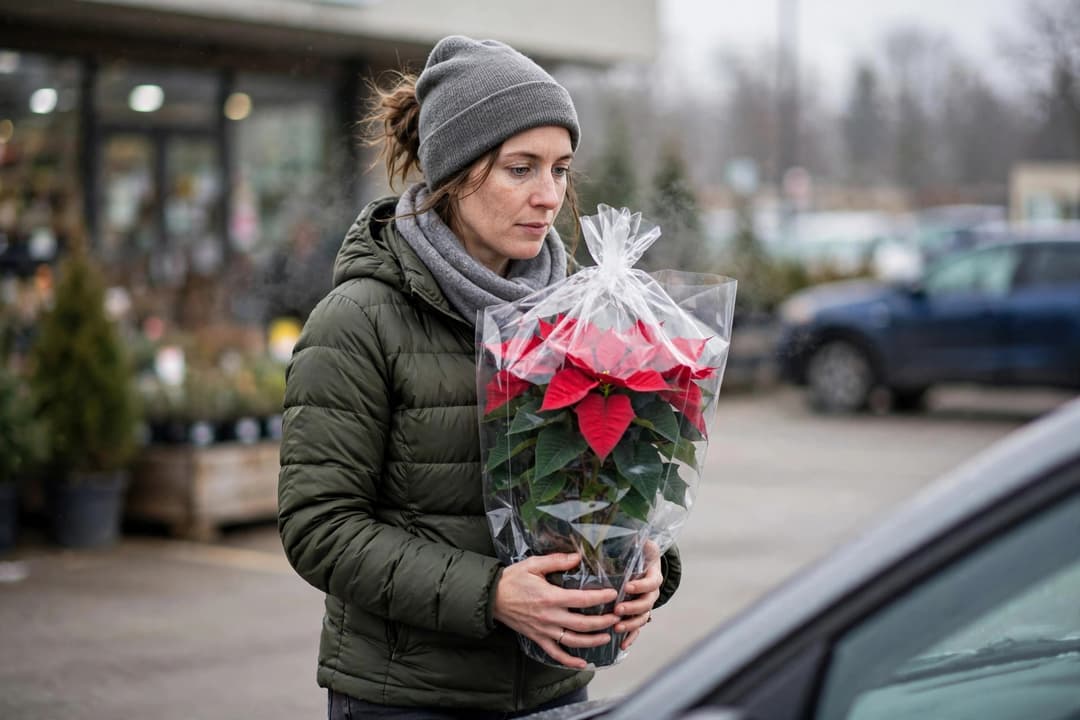
November is the start of the buying window, and the plant you pick now should still look good at New Year's. Iowa State Extension's checklist: dark green foliage covering the stem all the way to the soil line; brightly colored, unfaded bracts with no yellow or brown spots or edges; true flowers (the cyathia) shedding little or no pollen; no wilted foliage and no missing lower leaves; no broken or partially broken stems; and no insects on the undersides of the leaves — whiteflies are the usual hitchhiker, and they flutter up when the plant is disturbed. Mississippi State University Extension adds two more: skip plants that have sat in plastic sleeves for days, and avoid any plant showing signs of stress below 50 degrees.
The trip home is where most November poinsettias are damaged. Iowa State advises buying the poinsettia at the end of your shopping trip, wrapping it in a sleeve before going outdoors, and setting it in a heated vehicle — even a brief exposure to freezing temperatures can blacken leaves and make them drop, and there is no cure once cold damage happens. Never leave it in a cold car while you finish other errands. At home, Iowa State advises cutting the sleeve off rather than sliding it down and off, since the branches break easily — then place the plant near a bright window, not touching the cold window pane.
Keeping It Alive Through the Holidays
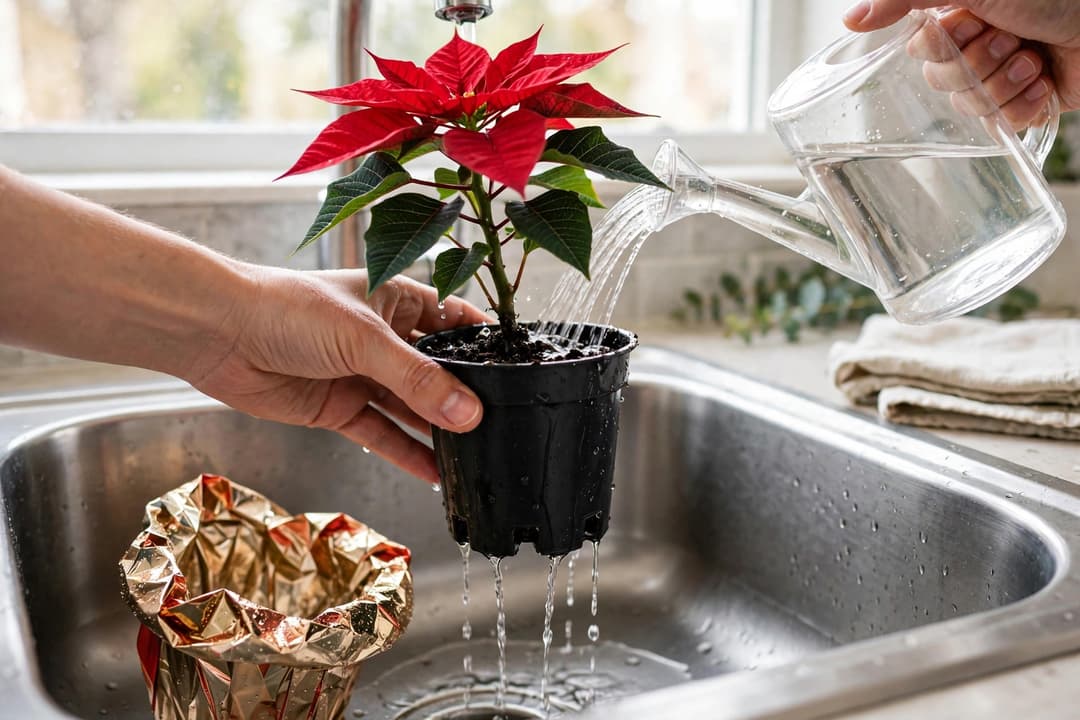
Two things matter most, per Missouri Extension: bright, indirect light and not overwatering. Iowa State's full routine: temperatures between 60 and 70°F (never below 50°F); away from cold drafts and heat sources such as exterior doors that open and shut and heat registers; water by feel — check the soil daily, and when the surface is dry to the touch, water until it flows out the bottom of the pot; and when watering, lift the plant out of its decorative foil cover, water in the sink, and set it back only after draining. Improper watering is the primary cause of most poinsettia problems at home: too wet, and the lower leaves yellow and drop, and root rot can make the whole plant wilt and collapse, sometimes rapidly; too dry, and leaves curl and drop. If the foil has no drainage hole, poke holes in it or remove it — Missouri notes that a pot sitting in standing water is the classic killer, and fertilizer or plant food is unnecessary during the holidays. Leaf drop after the holidays is a different story: Purdue Extension notes a well-cared-for plant starts dropping leaves in February as it enters dormancy, which is normal, not failure.
Can You Make It Turn Red Again?
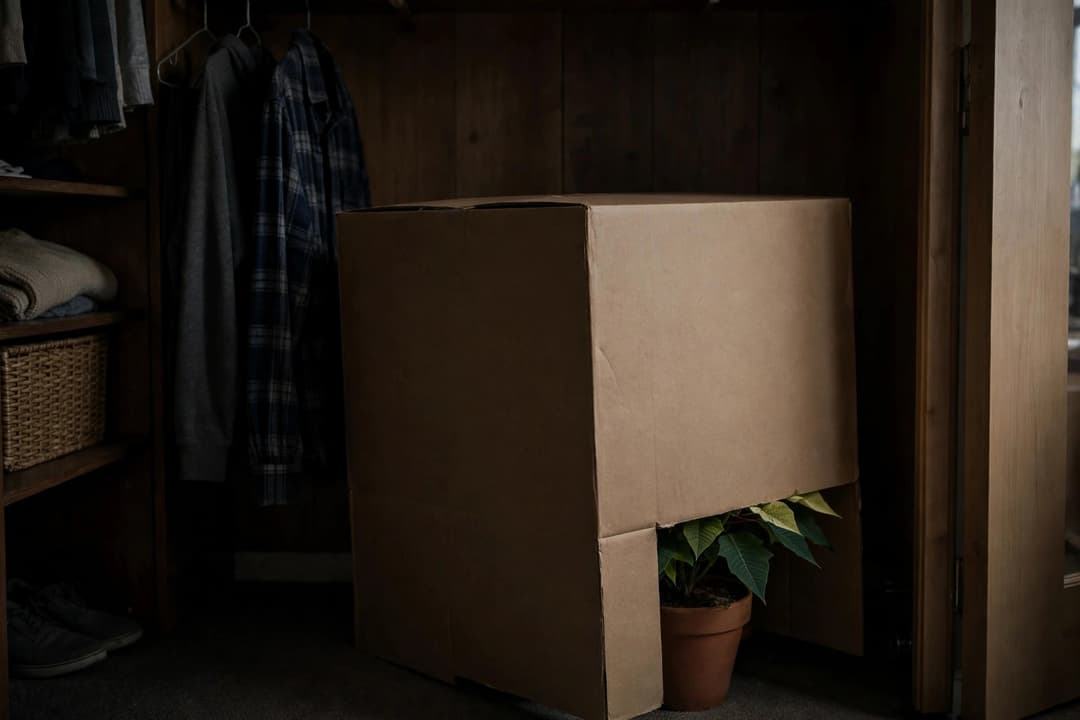
Yes, with patience and one strict rule. Poinsettias are short-day plants: they flower when nights get long, and indoors you have to manufacture those nights. Iowa State Extension's rebloom schedule: cut stems back to 4 to 6 inches in March, grow it on through summer (outdoors after late May, hardened off gradually, pinched once or twice for bushiness), bring it indoors in mid-September, and then give it complete darkness from 5:00 p.m. to 8:00 a.m. daily from early October until the bracts color up, usually in early December — a closet or a box over the plant, with a sunny window during the day. Any stray light during the dark period can delay or prevent coloring; University of Georgia Extension warns that a plant that misses its long nights will simply stay green all winter.
Be honest with yourself about the payoff. Iowa State calls home reblooming "challenging," and home-grown plants commonly come back taller, less compact, and less densely colored than the greenhouse-grown plants on store shelves each November. That is not failure — it is the difference between a controlled greenhouse and a windowsill. If the project sounds like a chore, compost the plant after the holidays and buy a fresh one next November; that is what most gardeners do.
Frequently Asked Questions
My cat nibbled a leaf. What do I do?
Don't panic. Purdue Extension notes that signs, if any, are usually mild — drooling, or vomiting if leaves were swallowed. Remove the plant from reach, watch the cat, and call your veterinarian if vomiting repeats or the cat seems unwell.
My dog ate several leaves. Is that an emergency?
Usually not — but it is worth a call. The pet-specific evidence is Purdue Extension's, citing Washington State University's veterinary college: signs, if any, are usually mild mouth irritation, drooling, or vomiting. (The large 22,793-case exposure study is human data, mostly children — it does not by itself prove dog safety, which is why the pet answer rests on the veterinary source, not the headcount.) A large amount, repeated vomiting, or a pet that seems lethargic deserves a veterinarian's advice — not because poinsettia is deadly, but because any repeated vomiting in a pet should be checked.
Is the sap dangerous to touch?
For most people, no — but if you have a latex allergy, take care. The milky sap shares proteins with natural latex rubber and can cause allergic skin reactions, according to Missouri Extension, and Illinois Extension flags latex allergy specifically. Wear gloves when pruning and wash sap off skin.
Why do so many lists still call poinsettias toxic?
Because the 1919 story never died. Illinois Extension notes the rumor has circulated for decades despite never being proved — more than a century, counting from the 1919 story — and once a plant lands on a "toxic" list, every list after it copies the last one. The extension sources, the rat study, and the 22,793-case exposure study all point the other way.
Can a poinsettia live outside in California?
Only where it never freezes. Poinsettias show stress below 50°F, per Mississippi State Extension, and even brief freezing exposure blackens leaves, per Iowa State. Those two facts are the whole answer: treat it as an indoor winter plant unless your yard never freezes — it is a large outdoor shrub only in its native Mexican climate and other truly frost-free places.