
Brown edges and curling leaves on a calathea can come from several stresses, including uneven moisture, dry air, water-quality issues, and pests. Start by checking the mix and inspecting leaf undersides, then change the likely cause rather than buying several fixes at once. Damaged edges will remain brown; healthy new growth is the better measure of progress.
Sophie: “So the brown edges could be the water, the air, the soil, or bugs? How is anyone supposed to know which one?”
Sprouty: “That’s exactly why we diagnose before we shop. Run through the four checks in the table below first — your wallet will thank you.”
Let’s be honest with each other.
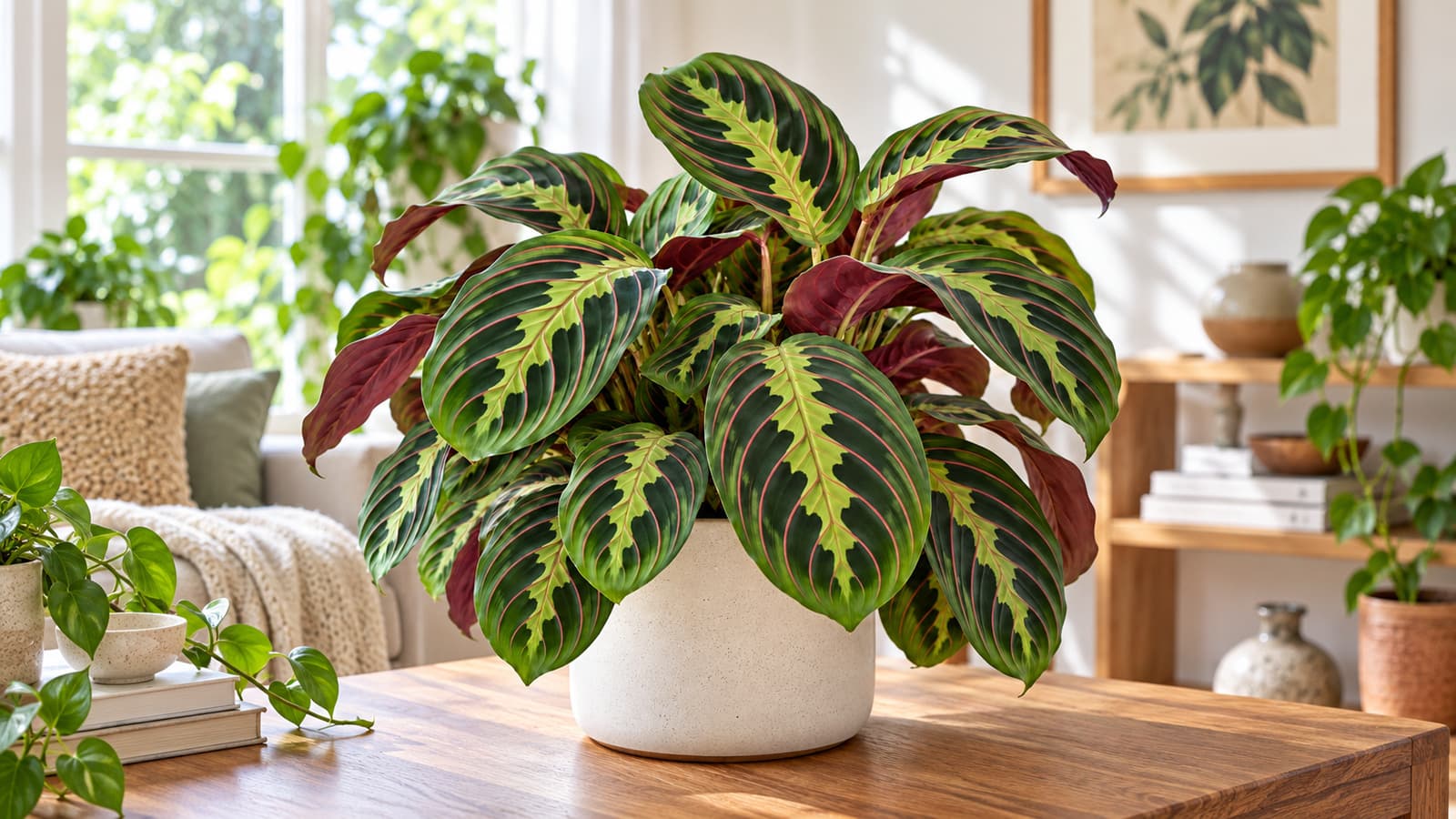
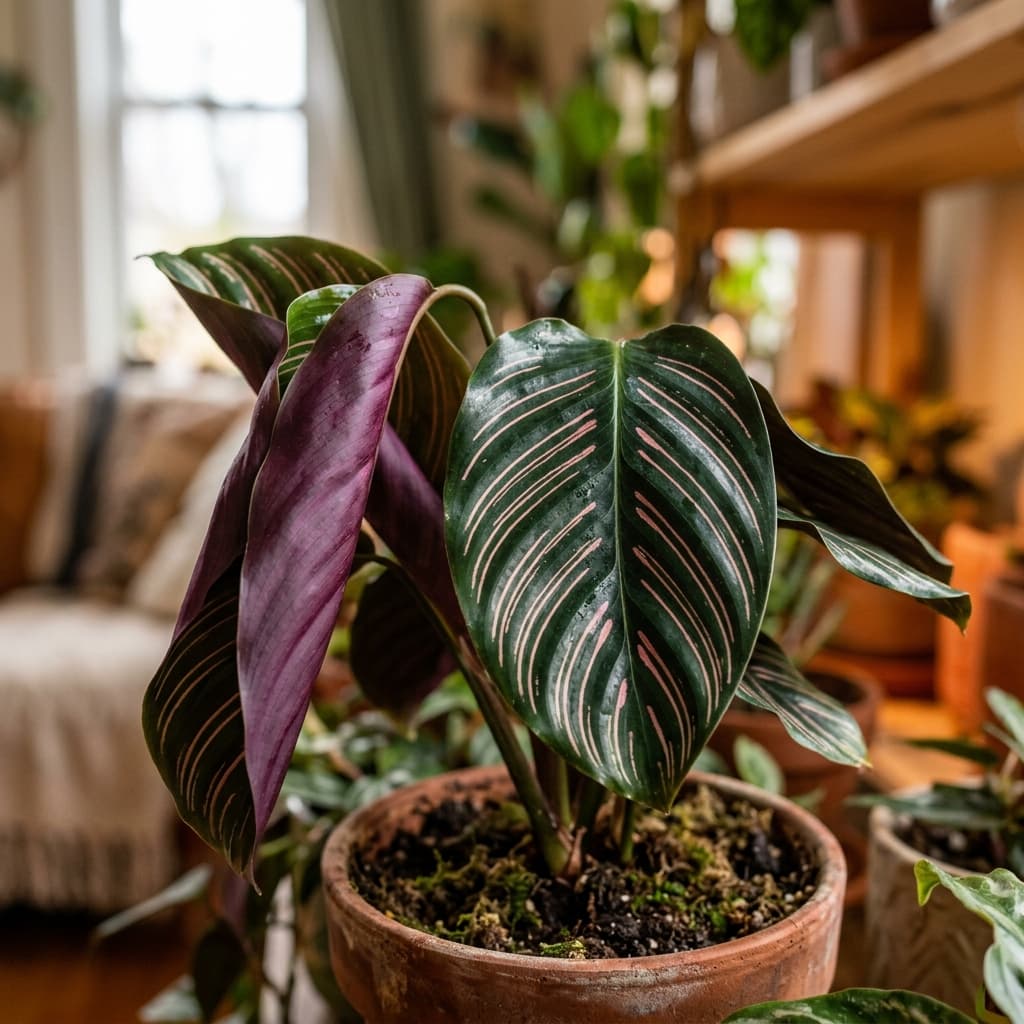
You bought the Calathea because the leaves looked like someone had painted them by hand — dark green velvet with rose-pink pinstripes, deep purple undersides, patterns that seem almost too deliberate to be real. You brought it home, put it in a nice spot, watered it reasonably, and within three weeks it looked like it was staged for a funeral.
Crispy edges. Curling leaves. Possibly some dusty webbing if things really went sideways.
Here’s the thing: it is not your fault. Calatheas and their close cousins, Marantas (prayer plants), have one of the highest “Distress Indexes” in the houseplant world. They sulk over dry air. They crisp up when watering goes uneven. They invite spider mites to dinner when stressed. Plant influencers will tell you they’re “rewarding” — and they are, eventually — but only once you’ve learned to read what the leaves are actually telling you.
That’s what this guide does: diagnose first, then fix.
First: Read the Symptoms Before Buying Supplies
Your calathea’s brown edge is a symptom — not a tap-water verdict. Run this four-point check before you change anything:
| What you see | Check first | What it often means |
|---|---|---|
| Crisp brown edges or tips | Water quality, humidity, soil moisture | Fluoride or salts in water, dry air, or uneven watering — check all three before treating just one |
| Leaves curling inward | Soil moisture, then humidity | Underwatering or dry air; leaves can curl from lack of water or low humidity |
| Stippling, dusty look, fine webbing | Leaf undersides, with light or a hand lens | Spider mites — confirm they’re actually there before treating |
| Yellowing, wilting lower leaves | Soil moisture and root condition | Overwatering or root rot in a dense, airless mix |
Know Which Plant You Actually Have
Quick taxonomy note, because it matters for care advice: many plants sold as “calathea” were reclassified into the genus Goeppertia — so your Calathea orbifolia may be labeled Goeppertia orbifolia at a good nursery. Same plant, same needs, updated name. Marantas (true prayer plants, Maranta leuconeura and relatives) are a separate genus in the same family, with very similar requirements. When you read care guidance, check which genus it was written for — advice for one usually suits the other, but don’t assume.
Both come from the shaded floor of South American rainforests: filtered light, steady warmth, high humidity, and loose, humus-rich soil that stays evenly moist but never waterlogged. Every fix below is just recreating some version of that.
Step 1: Check Root Moisture and Drainage
Here is the paradox that breaks most Calathea owners: let the soil dry out completely and the leaves crisp up and curl inward defensively. Keep the soil constantly wet in dense nursery peat and the roots can rot fast in the airless mix. Both failures feel like the same problem — a dying plant — which makes the diagnosis confusing.
The answer isn’t a magic watering schedule. It’s your soil structure.
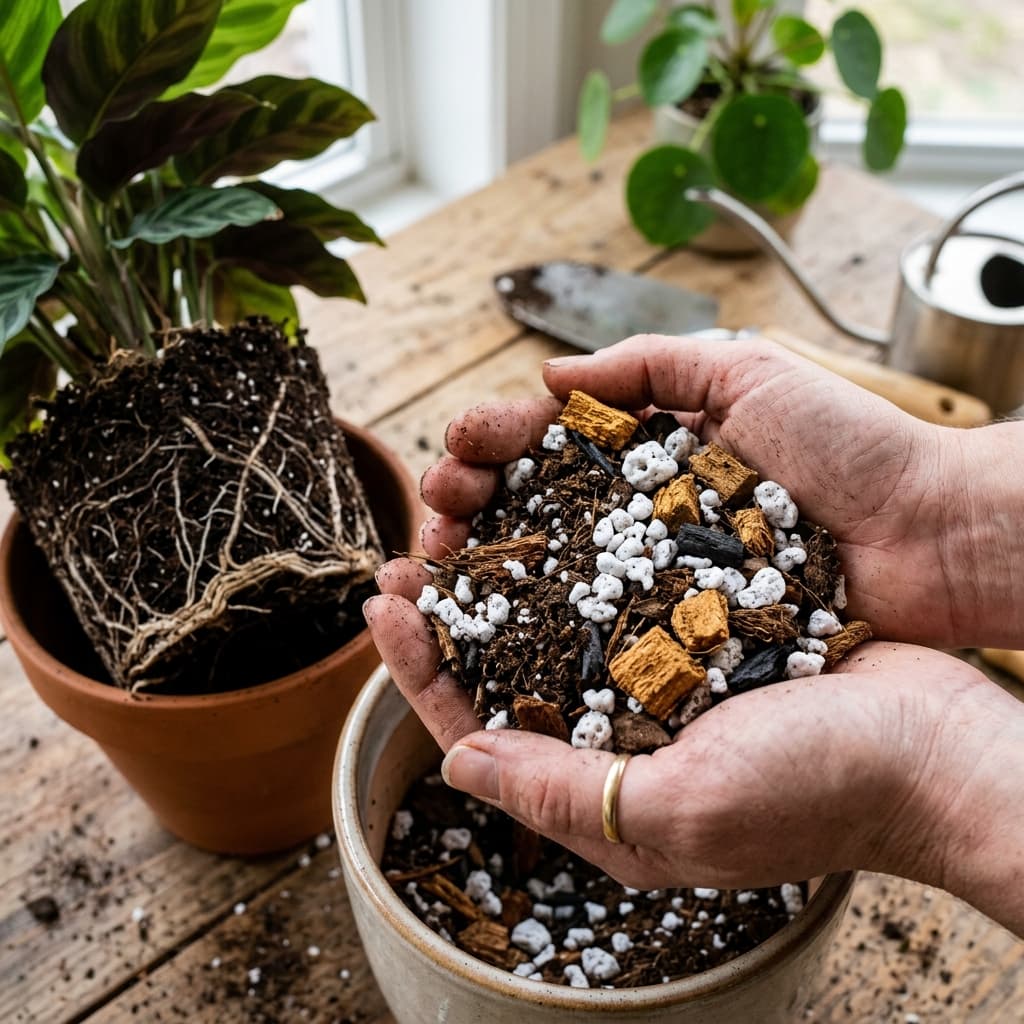
The problem with standard nursery peat mix is that it compacts when wet, eliminating air space around the roots. Calathea roots need both moisture and oxygen simultaneously — the same way they’d get it in the loose, litter-rich floor of a rainforest. Compacted peat gives them moisture but suffocates the roots.
Sprouty’s Calathea Soil Recipe:
- 50% quality indoor potting mix
- 30% perlite (creates drainage channels and air pockets)
- 20% orchid bark or coco coir (adds structure, retains slight moisture without compacting)
With this mix, you can water thoroughly — until water runs freely from the drainage hole — and the chunky structure keeps roots oxygenated even when the mix is moist. Water again when the top inch of soil feels dry. That’s it. No guessing, no paranoia. For a deeper dive on how soil composition affects root oxygen and uptake, see Sprouty’s guide on how stagnant root zones destroy plant collections.
Step 2: Water Quality — When Switching Actually Helps
Brown edges are a differential diagnosis, not a single-cause verdict. NC State’s plant profile notes that brown leaf edges and tips in Goeppertia orbifolia result from low humidity or from tap water containing fluoride — and uneven soil moisture belongs on the same suspect list. So before you overhaul your water supply, rule out the other two checks above.
When does switching water help? If your tap water is high in fluoride or dissolved mineral salts, the plant can accumulate those salts at the leaf margins — the crispy tips you hate are the plant pushing minerals to the outer edges to protect core tissue. Signs water quality is your culprit: edges brown even though humidity and watering are reasonable, and your local water report shows notable fluoride or hardness.
🚫 Myth-Bust: Letting Tap Water Sit Out Overnight
Leaving tap water out for 24 hours does allow chlorine gas to dissipate — but it does nothing to remove fluoride or dissolved mineral salts. If you’re doing this and still seeing crispy tips, you now know why. The fluoride is still there.
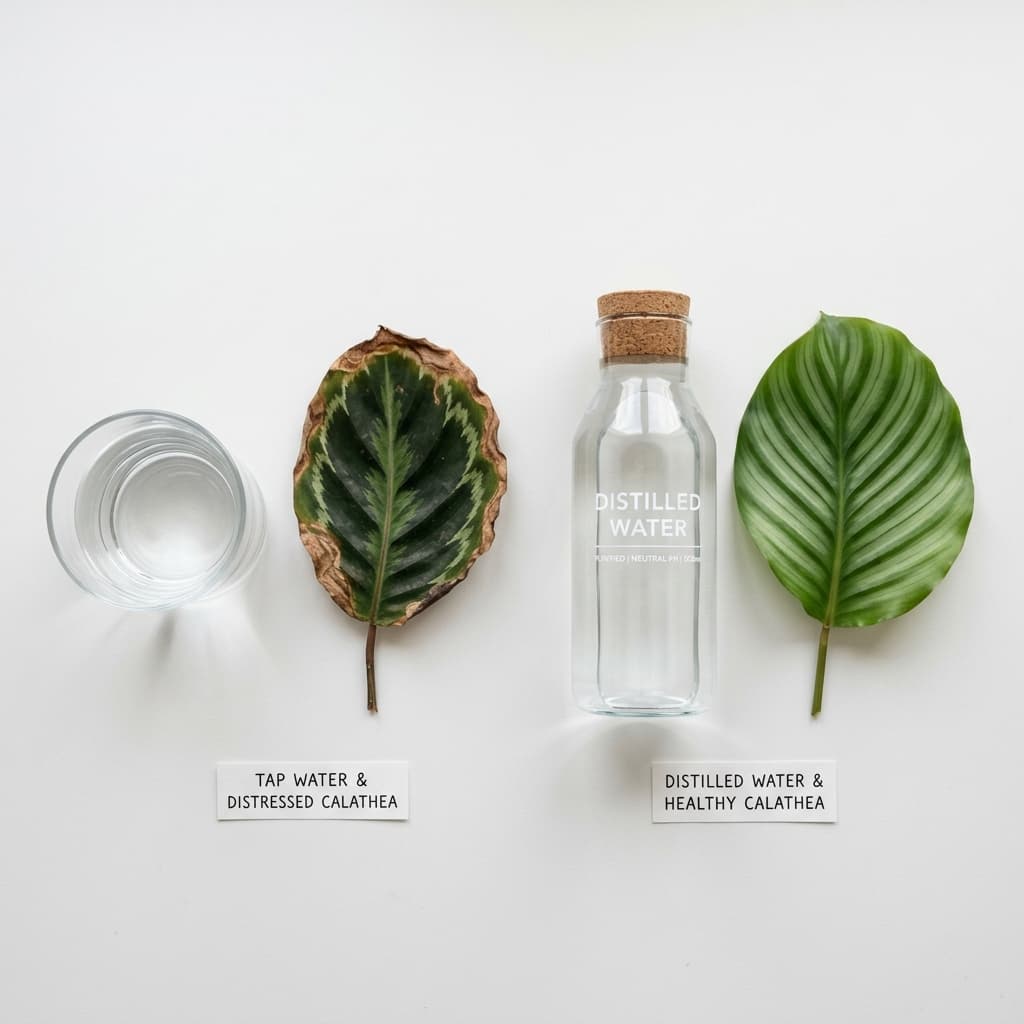
If water quality is your likely cause, switch to one of these:
- Distilled water — available cheaply at any grocery store
- Reverse osmosis (RO) water — if you have an RO system at home
- Collected rainwater — free and closest to what they evolved with
One honest note: existing crispy edges won’t reverse — that tissue is gone. New growth coming in clean-edged is your sign the change worked.
Step 3: Measure Humidity, Then Evaluate Light
Start with a cheap hygrometer near the plant. Guessing humidity is how people buy three gadgets before discovering the room was at 65% all along.
Calatheas want sustained ambient humidity around 60% or higher (NC State lists at least 60% for Goeppertia orbifolia). Here’s what each common method actually does — no inflated promises:
| Method | What it actually does | Verdict |
|---|---|---|
| Misting daily | Lifts humidity for a matter of minutes, then evaporates; wet leaves can invite fungal leaf spot | ❌ Don’t bother as a humidity strategy |
| Grouping plants together | Small local lift in the air pocket between leaves; free | ⚠️ Helps a little |
| Pebble tray with water | Slight lift right above the tray; effect fades with distance | ⚠️ Marginal |
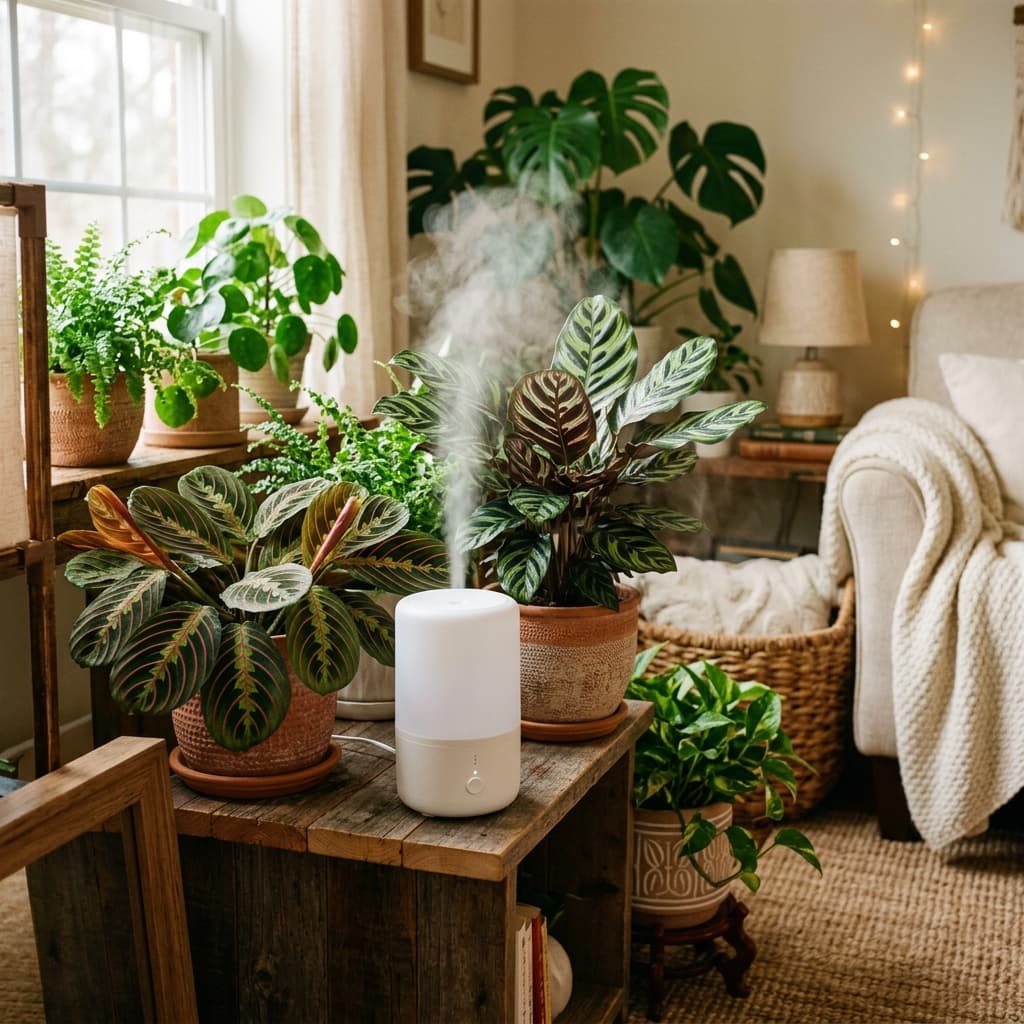
| Dedicated room humidifier | The only common method that holds elevated humidity across a whole room; verify with your hygrometer | ✅ The real MVP |
| Greenhouse cabinet / terrarium | High, controlled humidity in an enclosed space | ✅ End-game for collectors |
On light: in the wild these plants grow under a multi-layered rainforest canopy — filtered, diffused, gentle light from all directions. In your home, think in terms of orientation rather than fixed distances, because what “three feet from a window” means depends on which way the window faces, your latitude, the season, and the glass itself:
- ✅ East-facing window — gentle morning light; usually fine close to the glass.
- ✅ North-facing window — lower but stable light; calatheas tolerate this better than most patterned plants.
- ⚠️ South- or west-facing window — pull the plant back or filter with a sheer curtain; direct afternoon sun risks bleaching patterns and scorching tissue.
Let the leaves be your light meter: bleached, faded patterns mean too much direct sun; slow, leggy, dull growth means it wants a brighter spot. When in doubt between “a bit dim” and “direct sun,” choose dim — low light slows growth, but direct sun damages tissue.
Step 4: Spider Mites — Inspect, Isolate, and Treat
The classic mite setup: dry indoor air plus an already-stressed plant. Mites prefer warm, dry conditions and find weakened plants fast. Early warning signs:
- Leaves losing vibrancy, looking dull or dusty
- Tiny pale stippling on the leaf surface (mites puncture and suck individual cells)
- Fine webbing where the leaf stem meets the stalk, or on leaf undersides
- Undersides looking bronzed or silvery
Stippling with no mites in sight? Other tiny pests cause similar marks — see Sprouty’s thrips treatment guide before you assume.
🌿 Inspect, Isolate, Treat
Inspect: check leaf undersides with a hand lens or shake leaves over white paper — moving dots confirm mites. UC IPM advises confirming mites are present before treating, since damage sometimes outlasts the mites themselves.
Isolate: move the affected plant away from your collection immediately; inspect neighbors too.
Treat: start with a forceful water spray on leaf undersides. If more is needed, use an insecticidal soap or horticultural oil per the product label — test on a few leaves first, don’t treat water-stressed plants or in heat above 90°F, and expect repeat applications, since eggs survive most treatments and you’re targeting each newly hatched round. Humidity makes conditions less mite-friendly, but it is not a barrier — inspection and quarantine do the real prevention work.
Trimming Brown Edges (Optional, and Only Cosmetic)
Even well-kept calatheas get an occasional brown tip — older leaves adapting to indoor life will show small edges. One or two on an otherwise thriving plant is a win, not a failure.
If a brown edge genuinely bothers you:
- Use sterilized scissors (wipe blades with rubbing alcohol)
- Follow the natural curve of the leaf — don’t snip straight across
- Leave a thin sliver of brown at the edge — do not cut into green tissue. Cutting into healthy tissue just creates a new brown edge at the cut
- That’s it. One trim, done, move on
The Survival Protocol: At a Glance
| Problem | Check first | The fix |
|---|---|---|
| Brown crispy leaf edges | Humidity, water quality, soil moisture | Raise humidity toward 60%+, consider distilled/rainwater if tap is high in fluoride, even out watering |
| Leaves curling inward | Soil moisture, then humidity | Water thoroughly when the top inch is dry; add humidity if the air is dry |
| Yellowing / wilting leaves | Soil moisture and roots | Repot into chunky airy mix (perlite + orchid bark); see the yellow-leaf diagnosis guide for the full workup |
| Bleached, faded patterns | Light exposure | Move out of direct sun or filter with a sheer curtain |
| Dusty look, stippling or webbing | Leaf undersides — confirm mites | Isolate; water spray, then insecticidal soap/oil per label with repeat rounds |
| Fuzzy white/grey spots on leaves | Recent misting | Stop misting — see Sprouty’s powdery mildew guide |
🌿 Sprouty’s Bottom Line
You now have the actual blueprint. Diagnose first — moisture, water quality, light, humidity, pests — then fix the likely cause instead of buying every solution at once. Chunky soil, steady moisture, humidity toward 60%, filtered light, and regular leaf inspections will carry a Calathea or Maranta further than any single magic product. A plant getting all of those things will reward you with movement — literally. Watch it raise and lower its leaves through the day as the light changes. That’s the prayer plant prayer. That’s the payoff. It is 100% worth the effort.
Now — drop a comment below with the name you’ve given your most dramatic Calathea. We know you’ve named it. Tag us in your recovery progress photos on social media @SproutySpeaks — include your water type and humidity when you post, so others can learn from what worked.
Ready to go deeper on indoor plant care? Start with Sprouty’s guide on why your rarest plants actually want you to back off, or if you’re new to tropical houseplants, see our honest take on which plants are actually beginner-friendly (spoiler: not succulents).