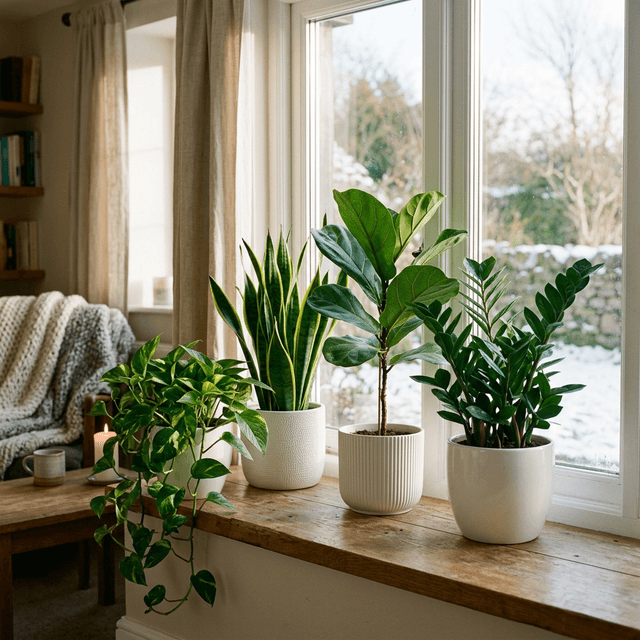
Most houseplants don’t die from neglect. They die from too much love — mostly too much water, given on a schedule instead of when the plant actually needs it. The good news is that houseplant care comes down to a handful of habits that work for almost every plant you’ll bring home.
This guide covers the basics: light, watering, feeding, repotting, winter care, and how to read the signs your plant is giving you.
🌱 The short version: Match the plant to your light. Water only when the soil is dry an inch down, and never let a pot sit in water. Feed only while the plant is growing, spring through fall. Repot in spring, one pot size up, in a soilless mix.
1) Start With Light
Light is the one thing you can’t fix with care, so it comes first. Choose plants that suit the light you have, rather than trying to make a plant fit a spot.
- Too little light: faded leaves and flowers, stunted growth, no flowers on flowering plants, and stretched, leggy stems reaching toward the window.
- Too much light: wilting, burned patches, and a washed-out look to the leaves.
Change a plant’s light gradually. Moving it straight from a dim corner into strong sun — or outdoors for the summer — can scorch the leaves. When you move houseplants outside after frost, start them in the shade.
Give plants that lean toward the glass a quarter turn now and then so they grow evenly.
2) Watering: The Number One Skill
Check before you water
Push a finger about an inch into the soil. Water only if it feels dry. This one habit prevents most houseplant deaths. A plant’s needs change with the season, the light, the pot, and the room, so a fixed weekly schedule will be wrong most of the year.
Water thoroughly, then let it drain
When you do water, water until it runs out of the drainage holes, then let the pot drain. Make sure every pot has drainage holes, and don’t let a plant stand in water in its saucer or cachepot unless that particular plant needs it.
Why overwatering kills
Roots need air as well as water. Too much water suffocates them and leads to root rot, which shows up as yellowing leaves, then wilting — even though the soil is wet. If a plant wilts in wet soil, don’t water it again; check the roots.
Tap water tip
University of Wisconsin Extension suggests letting tap water sit for at least 24 hours before use. Chlorine and fluoride can cause brown tips on many houseplants.
3) Temperature and Humidity
Most common houseplants are happy at normal room temperatures, but watch for cold drafts near doors and windows, and blasts of hot, dry air from heater vents. Both stress plants.
Indoor humidity drops in winter when the heat is on. Humidity-loving plants like ferns and calatheas do better grouped together, away from vents, or near a small humidifier.
4) Feeding Without Burning
- When: fertilize only while the plant is actively growing — for most plants, spring through fall. Plants that bloom in winter should be fed before they flower.
- How often: as a general rule, once every one to two months.
- How much: dilute liquid fertilizer exactly as the label directs. Plants in lower light need less than plants in bright light.
Too much fertilizer burns leaves and roots and can kill a plant. If you see a white crust on the soil or pot, run lukewarm water through the pot in the sink or shower to rinse out excess salts.
Skip the kitchen-scrap “fertilizer” hacks — see why fruit-peel fertilizer invites roaches.
5) Repotting: When and How
Signs it’s time
- Roots coming out of the drainage holes or showing on the soil surface.
- Soil that dries out much faster than it used to.
- Growth that has slowed or stopped in spring and summer even with regular feeding.
- A root ball so dense you can hardly see any mix in the bottom third.
When
Repot at the start of active growth — spring for most plants.
How
- Water the plant in its old pot and let it rest for about an hour.
- Choose a pot one size larger. An oversized pot holds extra wet mix around the roots, which invites rot. Clean a used pot first — Penn State Extension uses one part bleach to nine parts water.
- Use a soilless potting mix made for container plants, moistened before you start. Avoid mixes with garden soil.
- Gently tease apart roots that are matted or circling the root ball.
- Set the plant so the top of the root ball sits about an inch below the rim, fill around it, and firm gently.
- Water thoroughly and let it drain.
6) Winter Care
Short, dim days slow most houseplants down. Adjust with them:
- Water less. Keep using the finger test; the soil will stay moist longer.
- Reduce or stop feeding unless the plant grows under bright supplemental light.
- Move plants closer to your brightest window, or add a grow light. University of Minnesota Extension suggests running supplemental lights in the evening so plants get around 12–14 hours of light a day.
- Hold off repotting until spring growth starts.
As days lengthen in late winter, new growth is your signal to start feeding again. More seasonal care in the winter guide’s houseplant section.
7) Keep Leaves Clean
Dust blocks light. Every so often, rinse plants under lukewarm water in the sink or shower, or wipe large leaves with a damp cloth. Rinsing also flushes excess fertilizer salts out of the soil.
8) Reading the Signs
| What you see | Likely causes | First thing to check |
|---|---|---|
| Yellow leaves, leaf drop | Overwatering, often with too little light; sometimes spider mites or low nutrients | Is the soil wet an inch down? Is the plant in a dim spot? |
| Wilting in wet soil | Root rot from overwatering | Slide the plant out and look for dark, mushy roots |
| Brown leaf tips | Chlorine or fluoride in tap water, fertilizer salt buildup | Let tap water sit 24 hours; flush the soil |
| Pale, stretched growth | Too little light | Move closer to a window or add a grow light |
| Scorched, bleached patches | Too much direct sun, often after a sudden move | Move back to bright, indirect light |
| Fine webbing, speckled leaves | Spider mites, especially in dry winter air | Check leaf undersides |
For a deeper dive, see Why Houseplant Leaves Turn Yellow, Snake Plant Drooping?, and Calathea Brown Edges.
9) Common Pests
- Fungus gnats — tiny flies around the soil; a sign the mix stays too wet. See how to stop fungus gnats.
- Spider mites — fine stippling and webbing, worst in dry air.
- Mealybugs — white cottony tufts in leaf joints.
- Scale — brown bumps on stems and sticky leaves.
Check new plants carefully and keep them apart for a couple of weeks before they join the rest. The Natural Pest Control Guide has a houseplant pest section.
10) Common Mistakes
- Watering on a schedule instead of checking the soil.
- Pots without drainage, or saucers left full of water.
- Feeding in winter or at full strength.
- Repotting into a pot that is far too big.
- Sudden moves into strong sun.
11) Frequently Asked Questions
How often should I water my houseplants?
There’s no fixed schedule. Check the soil about an inch down and water only when it feels dry. Plants need more water while actively growing and less in winter.
Why are my houseplant’s leaves turning yellow?
The most common cause is overwatering, often combined with too little light. Check whether the soil is wet an inch down and whether the plant is in a dim spot. Spider mites and low nutrients are other possibilities.
When should I repot a houseplant?
In spring, when roots are coming out of the drainage holes or the soil dries out much faster than it used to. Move up just one pot size.
Should I fertilize houseplants in winter?
Usually not. Feed during active growth, spring through fall, about once every one to two months. Plants growing under bright supplemental light, and winter bloomers before they flower, are the exceptions.
Is tap water bad for houseplants?
It’s fine for most, but chlorine and fluoride can cause brown tips on sensitive plants. Letting tap water sit for at least 24 hours before use helps.
What potting mix should I use?
A soilless potting mix made for container plants. Avoid mixes that contain garden soil.
12) Sprouty’s Houseplant Checklist
- ☐ Plant matched to the light you have
- ☐ Every pot has drainage holes; saucers emptied
- ☐ Finger test before every watering
- ☐ Tap water left to sit for 24 hours
- ☐ Fed only spring through fall, diluted per the label
- ☐ Repotted in spring, one size up, in soilless mix
- ☐ Away from cold drafts and heater vents
- ☐ Leaves rinsed or wiped now and then
- ☐ New plants checked for pests before joining the others
- ☐ Watering and feeding cut back in winter
Sources
- University of Wisconsin–Madison Extension · Houseplant care
- Penn State Extension · Repotting houseplants
- University of Minnesota Extension · Winter houseplant tips
- University of Maryland Extension · January gardening tips
- University of Maryland Extension · May gardening tips
Keep Growing With Sprouty
Get this month’s indoor tasks for your ZIP in the Garden Calendar (choose “Houseplants”), read the winter houseplant guide, and browse all our Houseplant articles.