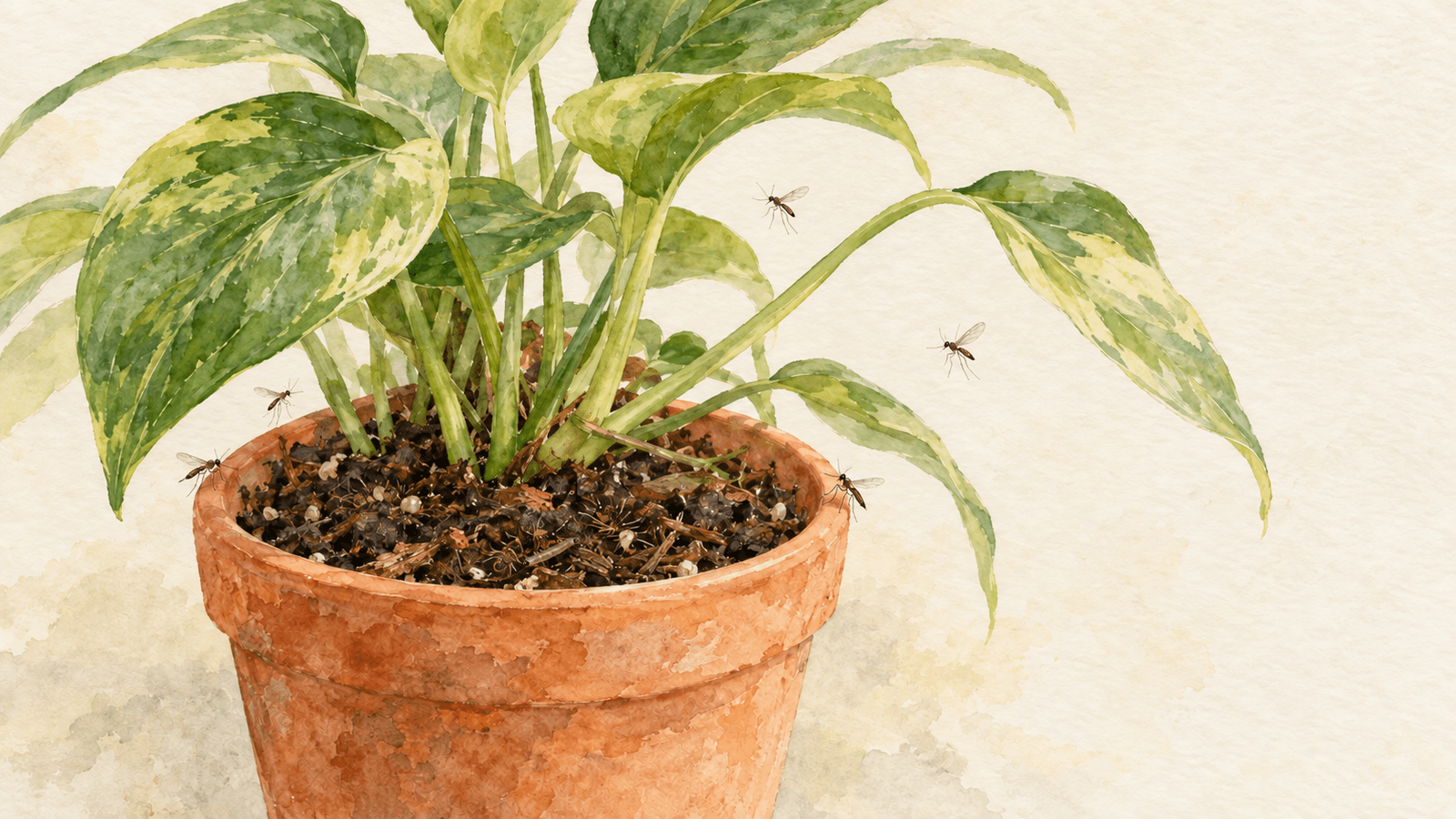

To get rid of fungus gnats, deal with both the flies you see and the larvae you don't. Put yellow sticky traps in the soil to catch and count adults, cut back on excess moisture so the top inch of potting mix dries between waterings — without drought-stressing the plant — and consider a labeled larval treatment such as Bti if the problem persists. Then keep watching: catching today's flies does nothing to the next generation already developing in the soil. UC IPM notes that a fungus gnat generation takes about 17 days at 75°F, with generations overlapping — so plan on steady monitoring, not a one-weekend cure.
First: make sure it's actually a fungus gnat
Not every tiny indoor fly is a soil pest, and soil treatments won't help if your flies are breeding somewhere else. Match what you're seeing before you treat:
| Fungus gnat | Fruit fly | Drain fly | |
|---|---|---|---|
| Looks like | Tiny (2–3 mm), dark, mosquito-like, with delicate wings | Tan to brown with a rounder body, often red eyes | Small and moth-like, with fuzzy wings held like a tiny tent |
| Where you see it | Hovering around potting soil and the plant's lower leaves | Around fruit bowls, trash, compost, or drink residue | Near sinks, showers, and drains |
| Where it breeds | Moist potting mix | Fermenting food and liquids | The slimy film inside drains |
Only the first column means a pot problem. If your flies match the fruit fly or drain fly column, skip the soil treatments below and deal with the real breeding site first. If you're unsure, UC IPM's fungus gnat page has identification details.
📋 Sprouty's 3-move plan
Catch adults. Target larvae. Reduce excess moisture. Everything below is a variation on these three moves — screenshot this card and you've got the whole strategy.
The adults are the symptom — the larvae are the problem
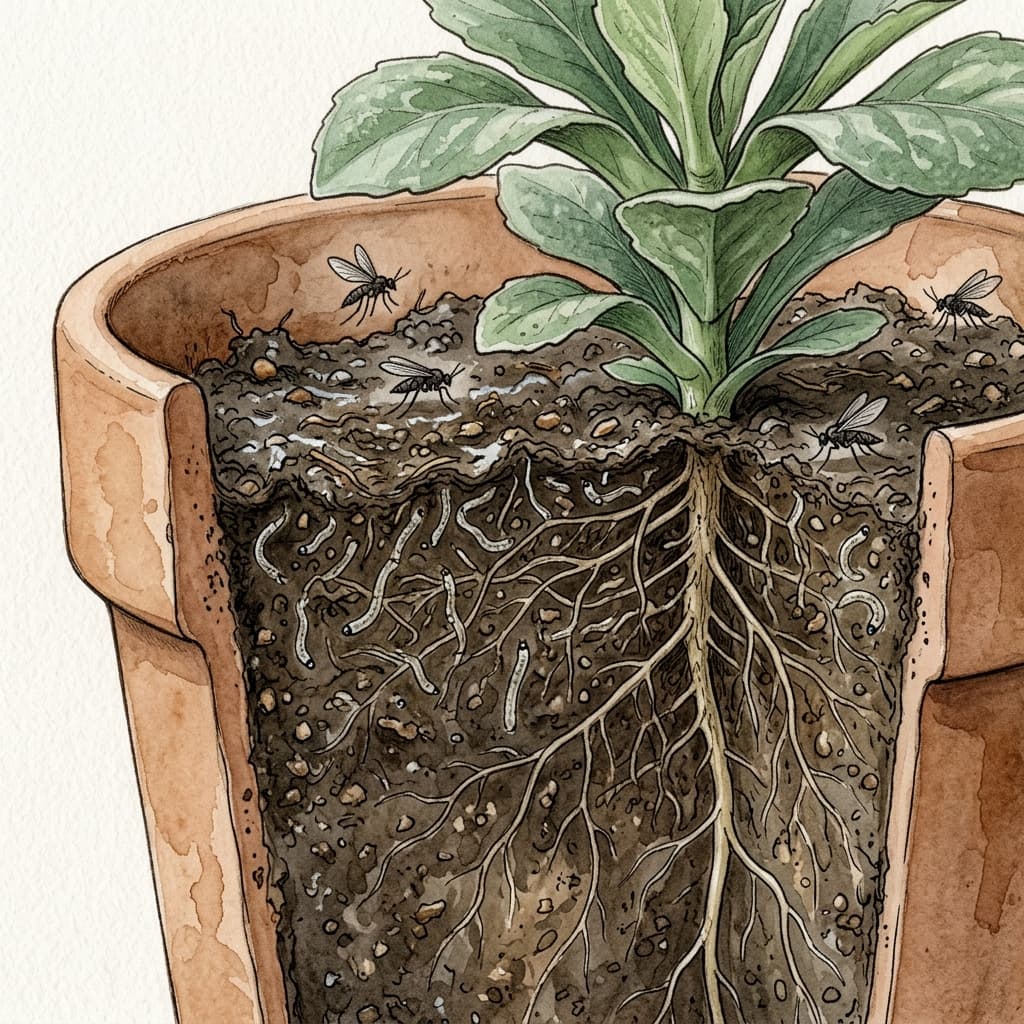
Adult fungus gnats live for about a week. They don't bite, they don't eat your plant, and they can't survive without moist soil to lay eggs in. A single female lays up to 200 eggs in the top inch of damp growing medium. Those eggs hatch into larvae in 4–6 days. The larvae — not the adults — are the real threat: they feed on organic matter in the soil and, when populations are high, on fine root hairs and seedlings. A repeat infestation means larvae are completing their cycle uninterrupted.
Here's the part that defeats most one-weekend fixes: UC IPM describes a full generation taking about 17 days at 75°F, with generations overlapping. Eggs, larvae, pupae, and adults are all present at once — so killing this week's flies never touches next week's.
🪲 Why killing adults alone doesn't fix it
Swatting, trapping, or spraying adults feels productive. But if the top layer of your soil stays consistently moist and organic-dense, every remaining egg in that soil will hatch and replace the adults within days. The cycle only breaks when the larvae have nowhere comfortable to develop.
Choose a treatment that fits your plant and infestation
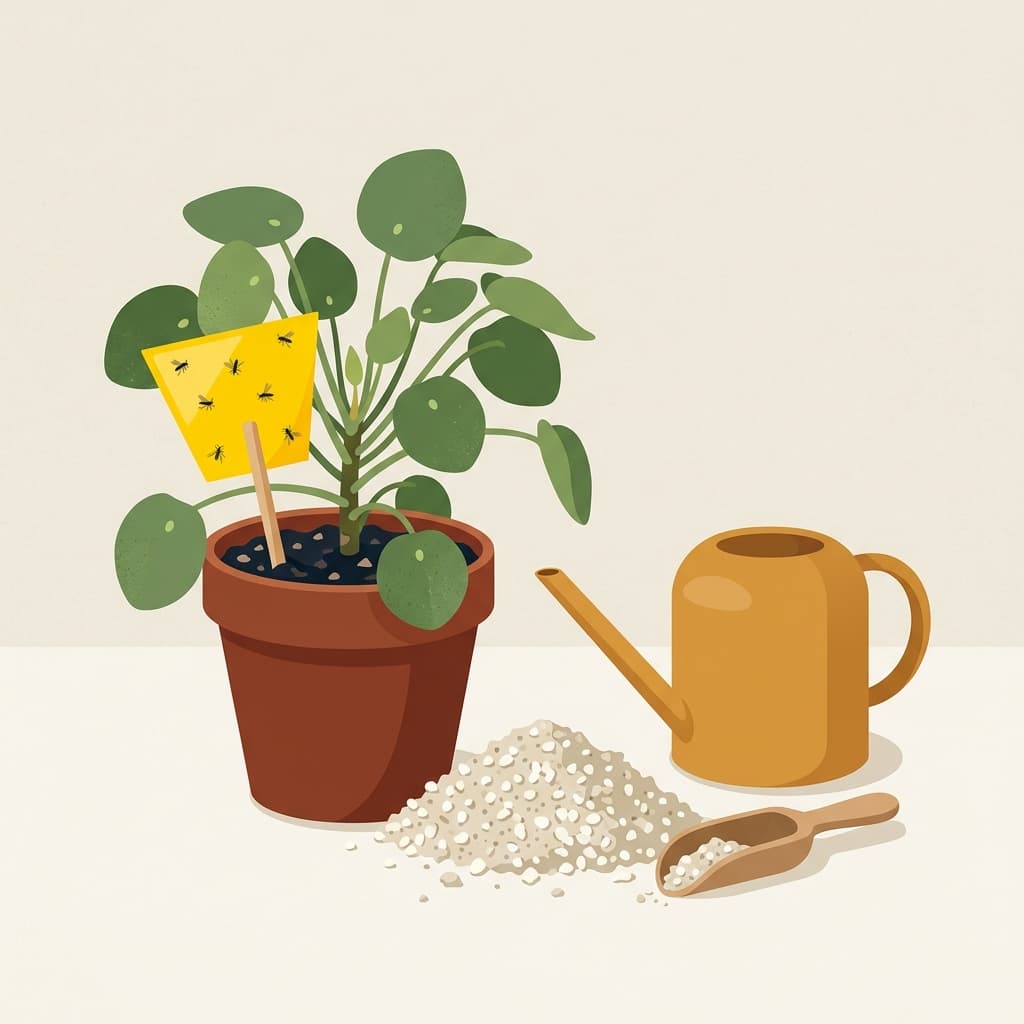
No single product finishes the job on its own — the approaches below work in combination. Pick the ones that suit your plant, and always follow product labels for rates, timing, and repeat applications.
| Approach | What it does | Evidence & caveats |
|---|---|---|
| Yellow sticky traps | Catch and count flying adults; no effect on larvae | Supported by UC IPM for monitoring. Replace as they fill — a full trap stops catching. |
| Letting the top inch dry between waterings | Removes the damp habitat larvae need to develop | Core cultural control per UC IPM. Don't drought-stress the plant to get there — match drying to what the plant tolerates. |
| Bti (Bacillus thuringiensis israelensis) | Biological larvicide — targets larvae in the soil; the same bacteria used in organic mosquito control | Supported by UC IPM. Follow the product label for rate and timing; repeat applications are usually needed because generations overlap. |
| Beneficial nematodes (Steinernema feltiae) | Microscopic worms that attack larvae in the soil | An option per UC IPM. Follow label directions; they need moist (not waterlogged) soil to move and survive. |
| Bottom watering | Waters from below via a tray, which can keep the surface drier; also encourages deeper roots | Moisture wicks upward, so don't assume the top stays dry — check the actual surface. Judge by the soil, not the method. |
| Inorganic topdress (perlite, sand, gravel) | A dry mineral layer over the soil surface | Optional helper, not a guaranteed egg barrier. It can make the surface less inviting, but don't rely on it alone. |
| Neem oil soil drench | May disrupt larval development | Slow-acting — expect a multi-week commitment. Follow the product label. |
| Cinnamon and other folk remedies | Mild antifungal at best | May reduce the fungi larvae feed on, but rarely enough on its own. Supplementary only. |
Your first two weeks: a monitoring plan, not a countdown
Think of the next two weeks as your first checkpoint — not a guaranteed finish line. With overlapping generations, progress shows up as a trend, not a sudden zero.
- Day 1 — Set traps and take a baseline: Push a yellow sticky trap into the soil of each affected pot and note roughly how many adults it catches in the first day or two. That count is your "before" — you'll compare everything against it.
- Days 1–14 — Water for drier tops: Let the top inch of mix dry between waterings, watering to the plant's needs rather than on a fixed schedule. If you bottom-water, still check the surface — moisture wicks up.
- Days 1–14 — Treat the larvae if needed: If you're using Bti or nematodes, apply per the product label and note your repeat dates. Labels, not calendars, set the timing.
- Every few days — Check and log: Glance at the traps and jot down the counts. A downward trend over two to three weeks means the plan is working, even if a few flies still show up. Flat or rising counts mean something below — in the "why they return" section — needs fixing first.
💡 A note on trap-count honesty
If you keep a simple log — date, trap count, what you changed — you'll see real progress instead of guessing. Don't expect a dramatic before-and-after in a week; with a ~17-day generation cycle, honest improvement looks like a slow downward slope.
Why they keep coming back — and when repotting actually helps
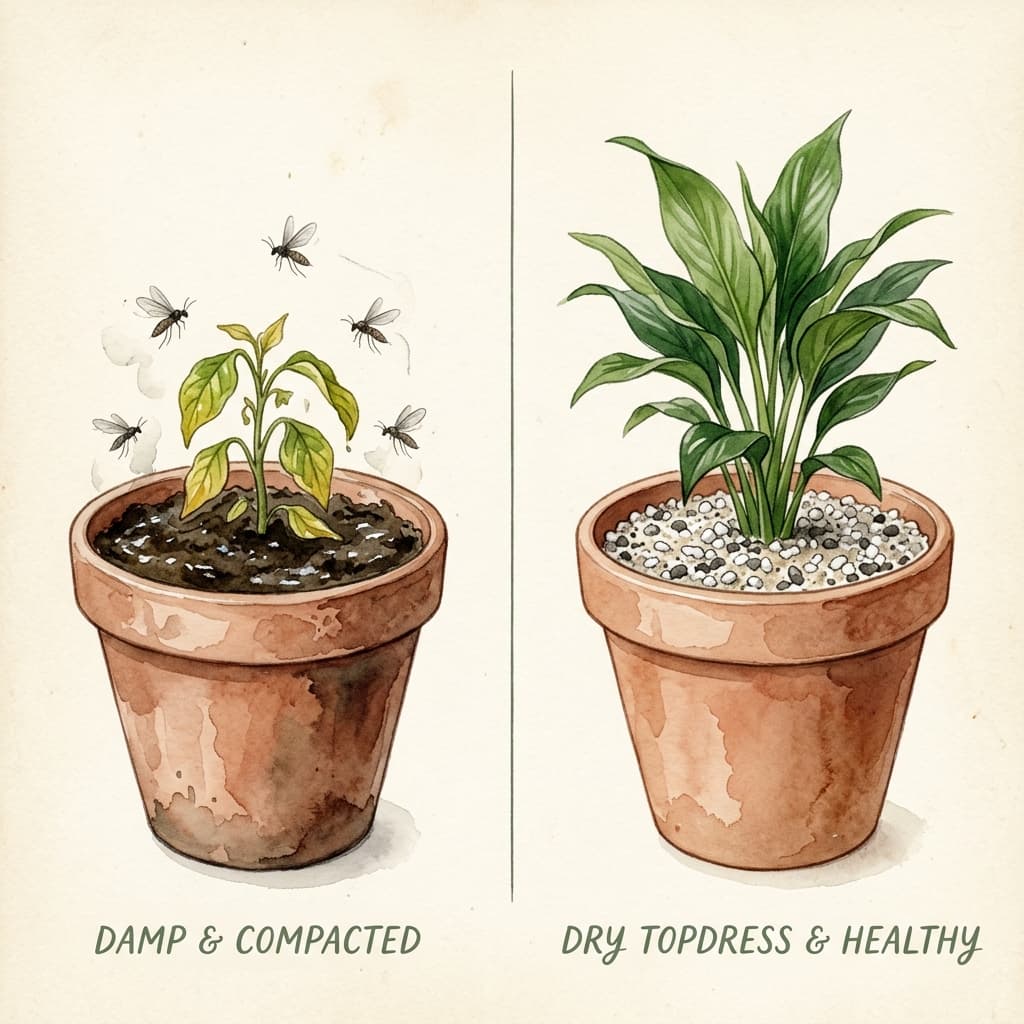
If gnats return after treatment, run through this list honestly before treating again:
- 🔍 Is there a second plant you haven't treated? Gnats fly. One untreated pot across the room is enough to repopulate everything you've cleared.
- 🔍 Are you top-watering between treatments? Even one thorough top-watering re-wets the layer you're trying to dry. Stay consistent through the monitoring period.
- 🔍 Are you misting regularly? Mist settles on the top inch of soil and keeps it damp — a problem for calatheas, ferns, and other humidity-lovers. Switch to a pebble tray with water kept below the pot level instead.
- 🔍 Is the soil genuinely draining fast enough? If water sits on the surface for more than a minute after watering, the mix is too dense. No treatment fully compensates for soil that stays wet for a week.
- 🔍 Is there decaying matter in or near the pot? Dead leaves on the surface, old roots from a rootbound plant, or gunky buildup in a saucer are all larval food. Clear them out and empty saucers after watering.
Repotting is often suggested as the nuclear option — dump the infested soil, start fresh. Sometimes it's the right call. Often it isn't. Base the decision on drainage and root condition, not on peat content alone:
| Scenario | Should you repot? |
|---|---|
| New plant whose soil stays wet for days after watering and drains poorly | ✅ Consider it — swap to a chunkier, well-draining mix. It's the drainage that's the problem, not peat by itself. |
| Plant has been in the same compacted mix for 2+ years and it stays wet for days | ✅ Yes — degraded soil compacts, holds more moisture, and becomes a better larval habitat over time |
| Gnat problem is moderate, plant is healthy, soil drains well — just keeps getting reinfested | ❌ No — use the monitoring plan above. Repotting stresses roots and introduces fresh organic matter that gnats can exploit |
| Plant is currently stressed — dropping leaves, recovering from overwatering, recently moved | ❌ Not now — repotting a stressed plant compounds the problem. Stabilize first, repot later. Our guide on reading plant stress signals can help you assess where the plant is before deciding. |
If you do repot, the new mix matters as much as ditching the old: a chunkier blend with added perlite that dries faster between waterings removes the foundational condition gnats need.
Prevention: new plants, new soil, seasonal flare-ups
- 🪴 New plants: Quarantine for about 2 weeks before placing near your collection. Inspect the soil surface for tiny moving specks or hovering adults before integrating.
- 🌱 New potting soil: Fresh bags of mix can harbor eggs. Store opened bags sealed and dry. A topdress on freshly potted plants makes the surface less inviting from day one.
- 🍂 Seasonal flare-ups (autumn/winter): Less light means slower growth and slower soil drying. A pot that dries in 5 days in summer may stay damp for 10+ in winter — prime gnat conditions. Reduce watering frequency with the season, and check soil moisture below the surface rather than trusting the top. UC IPM's houseplant problem guide is useful context for seasonal watering adjustments.
- 🌊 Watering habits: Whatever method you use, the goal stays the same — a top inch that dries between waterings. Bottom-watering can help, but verify the surface rather than assuming.
FAQs
How long until the gnats are gone?
There's no fixed timeline — anyone promising eradication in a set number of days is guessing. With a generation of about 17 days at 75°F and overlapping generations (UC IPM), expect a downward trend in trap counts over two to three weeks of consistent treatment, and keep monitoring after that.
Do fungus gnats actually hurt my plants?
The adults don't bite and don't feed on plants — they're just annoying. The larvae feed on organic matter in the soil and can damage fine root hairs and seedlings when populations are high. Healthy, established plants usually tolerate moderate numbers; seedlings and cuttings are more vulnerable.
Will bottom-watering keep the top inch dry?
Not necessarily. Moisture wicks upward through the mix, so the surface can still end up damp. Bottom-watering is a useful habit, but judge the actual surface moisture rather than trusting the method.
What about the hydrogen peroxide drench I see recommended online?
It's a popular folk remedy, but it isn't an established control for fungus gnats — and it can damage the very roots and soil biology you're trying to protect. Skip it as a default treatment and stick with cultural controls plus labeled larval treatments like Bti.
Should I just throw out all the soil and start over?
Only if the soil itself is the problem — poor drainage, compacted old mix, roots in bad shape. If the mix drains well and the plant is healthy, repotting adds stress without fixing the reinfestation source. Check the "why they return" list first.
Could my gnats be coming from the kitchen or bathroom instead?
Possibly — which is why identification comes first. Fruit flies breed in fermenting food; drain flies breed in drain slime. If your flies match those instead of the soil-hovering fungus gnat, soil treatments won't help. See the identification panel at the top.
✅ Fungus gnat checklist — save for watering day
- Confirmed they're fungus gnats (soil hoverers — not fruit flies or drain flies)
- Sticky trap in each affected pot; today's count noted
- Top inch of soil dry before watering; watered to the plant's needs
- All infested pots treated — not just the worst one
- If using Bti or nematodes: applied per label, repeat date noted
- No misting onto soil; saucers emptied after watering
- Recheck traps in 3–4 days and compare counts
Save this checklist for your next watering day.
🌿 Sprouty's Bottom Line
Fungus gnats are a soil-moisture problem wearing an insect costume. Catch the adults, target the larvae, reduce the excess moisture — and give it a few weeks of honest monitoring. The flies annoying you today hatched from conditions you can change.
Dealing with a different pest and not sure which one? Sprouty's thrips treatment guide and the Natural Pest Control reference guide cover the full cast of common indoor plant pests with the same finish-the-job approach.
Last reviewed: October 2026.