
Thrips can cause silvery scars, black specks, and distorted new growth — but confirm you're actually looking at thrips before choosing a treatment. Isolate the affected houseplant, prune away heavily infested material where it makes sense, and choose a product labeled for houseplants and indoor use. Repeat only as the label directs, and judge your progress by live insects and new damage: old scars will not disappear, and that's normal.
Sophie: "Sprouty, I sprayed it once and they came back. The spray doesn't work."
Sprouty: "The spray worked on the ones it could reach. Thrips keep part of their family where sprays can't go — inside the leaf, and down in the soil. That's not a failed spray. That's an unfinished job."
⚡ Do this today
- Confirm the ID — silvery scraped patches plus tiny black specks (frass), or catch the insects themselves with the tap test below. Don't treat on suspicion alone.
- Isolate the plant — move it away from your other houseplants before you do anything else.
- Remove the worst of it — prune heavily infested leaves and discard them in the trash, not the compost.
- Treat with a labeled product — choose one labeled for houseplants and indoor use, and follow its directions and repeat interval exactly.
- Start your monitoring log — write down what you saw, what you used, and when the label says to check again.
Confirm It's Thrips — Not Mites, Not Old Injury
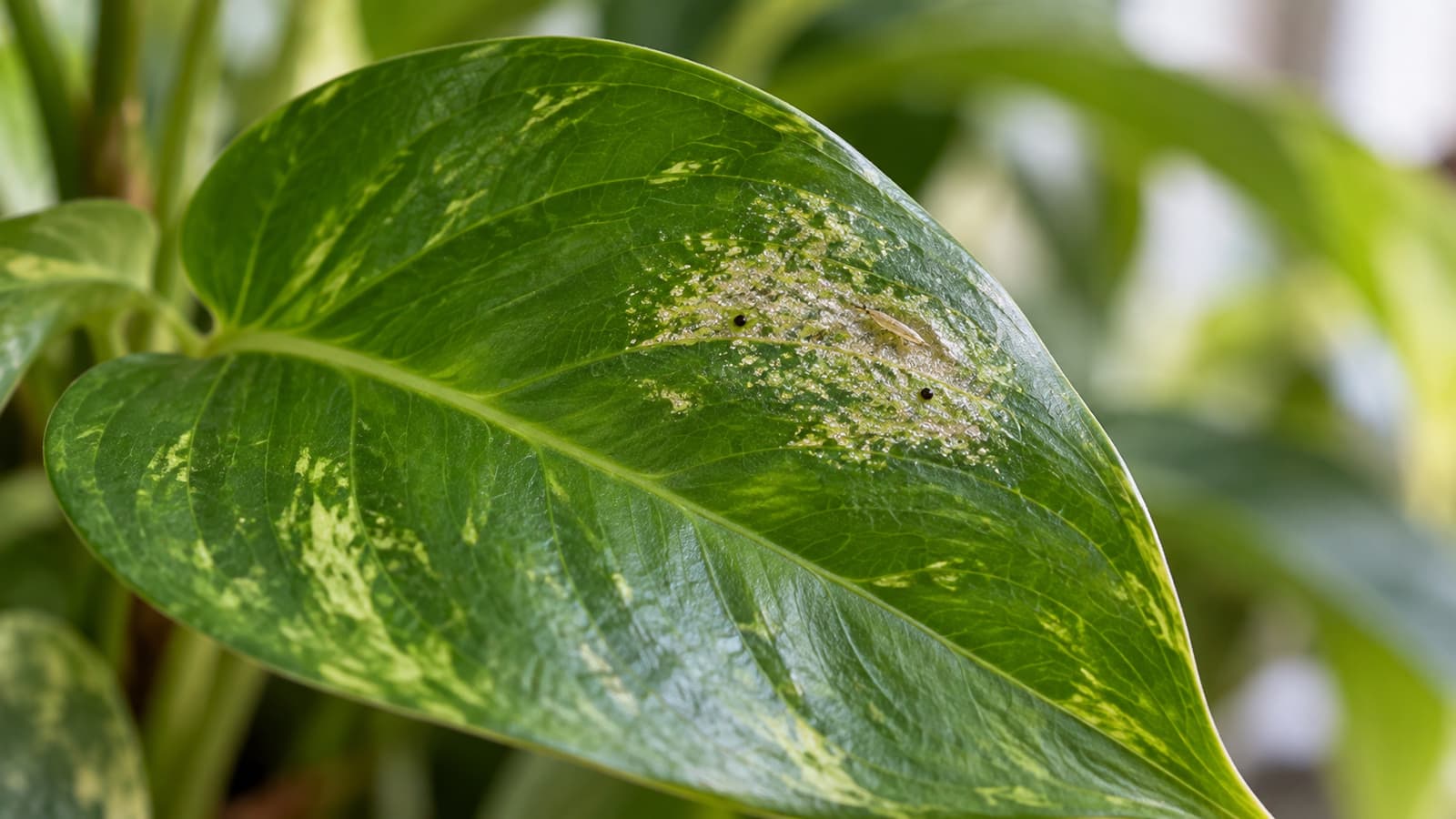
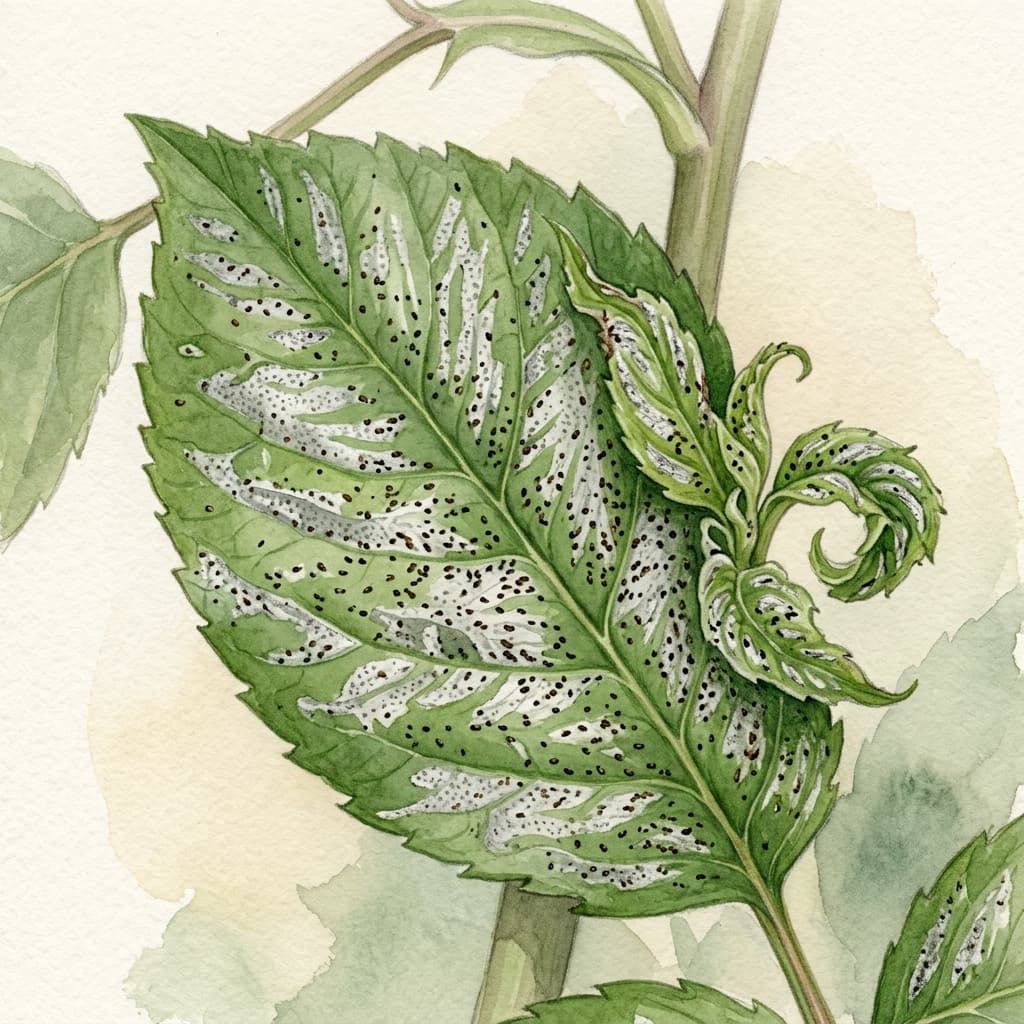
Thrips are tiny — most are under 2mm — slender, and fast. By the time you see one clearly, the infestation has usually been going for weeks. The damage gives them away first:
| Sign | What You're Seeing | What It Tells You |
|---|---|---|
| Silvery or bronze streaks | Empty plant cells where thrips scraped out the contents | Early feeding damage — investigate now |
| Tiny black specks | Thrips frass (droppings) — often misread as dirt or fungus | Strong thrips indicator |
| Distorted new growth | New leaves emerging curled, puckered, or stunted — attacked before they unfurled | Active infestation, likely weeks old |
| White papery patches | Large areas of drained cells, visible on both leaf surfaces | Heavy, prolonged feeding |
| Tiny moving specks under leaves | Actual larvae or adults — check leaf undersides and inside rolled new growth with your phone flashlight | Confirmed live infestation |
The white-paper tap test: hold a sheet of white paper under a suspect leaf and tap the foliage sharply. Thrips — pale larvae or dark, slender adults — fall onto the paper where you can actually see them move. It's the fastest way to turn suspicion into confirmation.
Thrips vs. spider mites: both cause stippled, silvery-looking damage, but spider mites leave fine webbing (especially where leaf meets stem) and no black frass specks. Thrips leave the silvery scraping plus those telltale black dots. If you see webbing, you're dealing with mites, not thrips — and the treatment differs. UC IPM's thrips identification guide has close-up photos worth comparing against.
Why early signs get missed: silvery streaks are subtle, and small specks look like soil splash or water residue. Most people notice thrips when distorted growth appears — which means the infestation is already a few weeks old. That's fine. It just means your treatment window needs to be longer.
Why One Spray Fails: The Protected Life Stages
Here's the detail that explains every "they came back" story: at any given moment, part of the thrips population is physically out of reach of a contact spray.
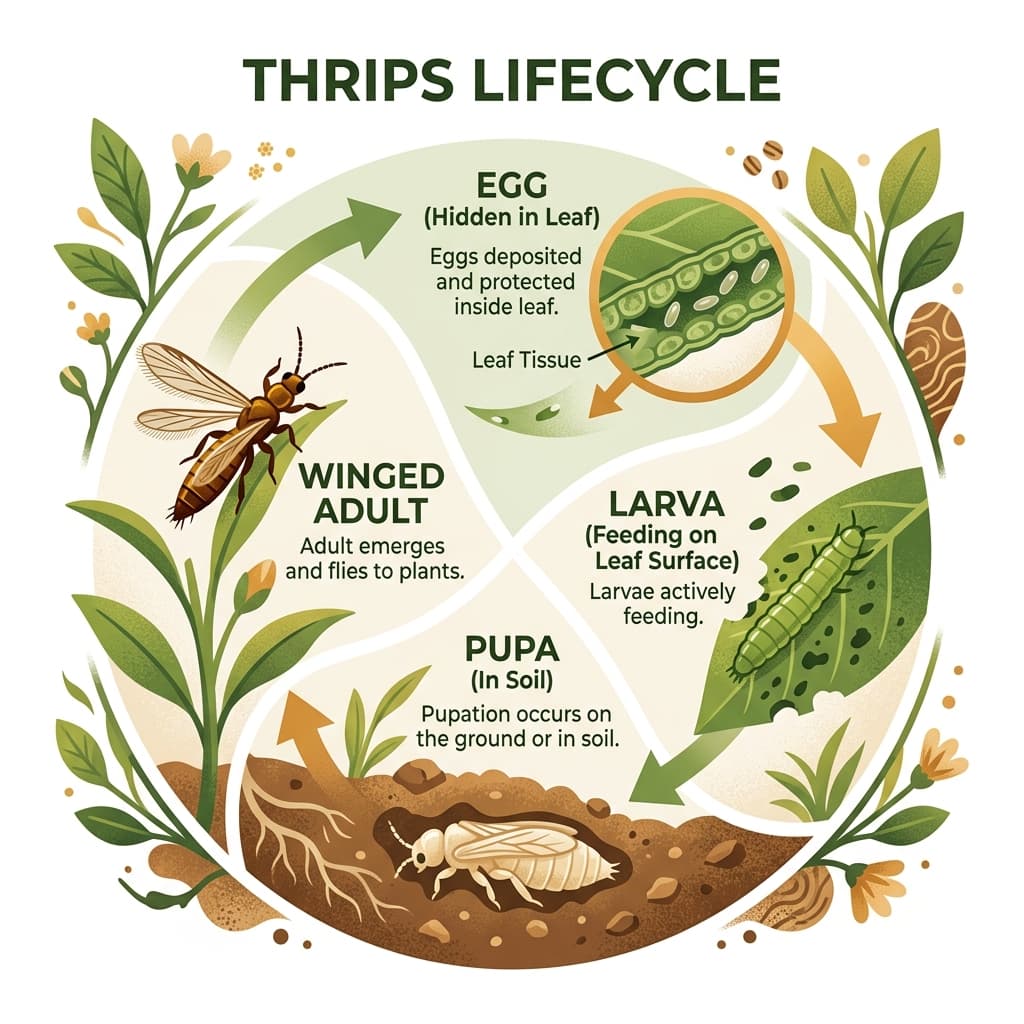
- Eggs — females insert them inside leaf tissue, where no contact spray can reach. They hatch over days to weeks depending on species and temperature.
- Larvae — feed exposed on leaf surfaces and inside unfolding growth. This is the stage a contact treatment reaches most reliably.
- Pupae — commonly drop into the top layer of the growing medium, but some species pupate on the plant itself, in bark crevices or curled leaves. Either way, they're sheltered from sprays.
- Winged adults — mobile and easily missed; a contact spray kills the ones it hits, but adults keep emerging from the protected stages behind them.
So a single spray kills the exposed feeders — then eggs hatch and pupae emerge over the following weeks, and it looks like the treatment "didn't work." It did work; it just couldn't reach the whole population at once. That's why UC IPM emphasizes repeated, correctly timed applications rather than a single heavy dose.
Isolate and Physically Remove First
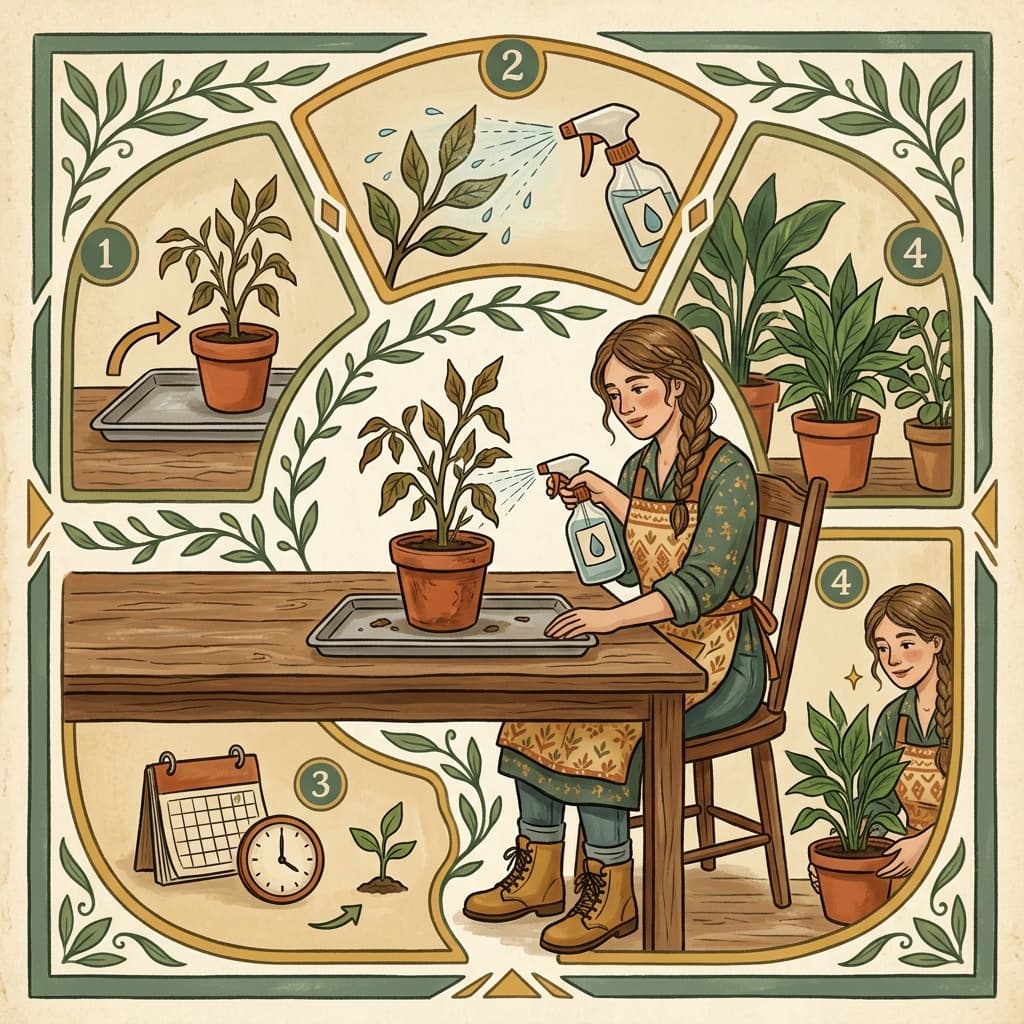
Before any product touches the plant:
- Move the plant away from the rest of your collection. Adults are winged; isolation is the single highest-value step and it costs nothing.
- Prune the worst leaves. Heavily scarred, distorted foliage holds eggs inside its tissue and rarely recovers its looks. Cut it off and put it straight in the trash — not the compost, not the sink.
- Wipe or rinse what remains. A damp cloth or a firm shower of water physically removes a surprising number of larvae and adults. Pay attention to leaf undersides and gently unfurled new growth, where larvae hide.
Choose a Labeled Treatment — Skip the Kitchen Recipes
This is the correction that matters most: homemade sprays are not interchangeable with formulated products. Dish-soap-and-neem mixes, Castile-soap solutions, and alcohol wipes get passed around as equivalent pesticides, but they aren't. Unmeasured soap concentrations can burn foliage, alcohol injures many houseplants, and none of these mixtures have been tested for safety on your plant the way a labeled product has. UC IPM's houseplant guidance stresses matching the product to the plant and following label directions — that's the standard to hold.
What to do instead:
- Buy a product labeled for thrips on houseplants and for indoor use. Insecticidal soap and horticultural oil products formulated for houseplants are the usual starting point — the key word is formulated, with a label that lists thrips and houseplants.
- Read the whole label, then follow it exactly — dilution, repeat interval, and maximum number of applications. The repeat interval on the label is your treatment cadence; don't invent your own.
- Check plant tolerance first. Some products injure sensitive foliage. Test on a small area and wait a few days if you're unsure. If your plant is a calathea or prayer plant with famously fussy leaves, skim their care guide before spraying anything.
- Cover thoroughly when you do spray — leaf tops and undersides, stems, and gently opened new growth. Contact products only work where they land.
- Spray when the plant won't sit in harsh light while wet, and let foliage dry with good air movement. Wet foliage plus intense sun or stagnant air invites its own problems.
Expect this to take several weeks of repeat treatments — that's the protected life stages, not a product failure. A realistic arc is a month or more of label-directed repeats with inspections between them.
Check the Neighbors and the Medium — Don't Blanket-Spray Them
The old advice was "spray every nearby plant and drench every pot each session." Scale that back:
- Inspect exposed plants, don't automatically treat them. Check the plants that sat near the infested one — leaf undersides, new growth, tap test. Treat only the ones where you find thrips or fresh damage. Treating clean plants "just in case" wastes product and stresses plants for no reason.
- Keep watching the neighbors for a few weeks even if they look clean today. Adults fly; an inspection schedule beats a panic spray.
- Treat the growing medium only with reason and a labeled use. Pupae shelter in the top layer of mix, but drenching soil every session with an unapproved mixture isn't the answer. If your product's label includes a soil or drench application for thrips, use it as directed. If it doesn't, don't improvise one.
- Wipe down the pot exterior and saucer — pupae and adults use nearby surfaces, and a damp cloth is free.
Keep a Monitoring Log
This is the unglamorous tool that actually finishes the job. Old scars and frass specks persist long after the insects are gone, so "it still looks damaged" is not evidence of failure. Your log tracks what matters: live insects and new damage.
📋 Saveable monitoring log
Copy this into your notes app and fill it in at every inspection:
Save this log and check new growth — not old scars — at every inspection.
When to Step Down Treatment — and Keep Watching
Old thrips scars can stay on leaves after treatment. That's cosmetic history, not an active problem. Step down from active treatment when all of these are true:
✅ The step-down checklist
- No new silvery damage has appeared for at least two weeks
- No live thrips found on tap tests or flashlight inspections of leaf undersides and new growth
- New growth is emerging normally — not distorted or puckered
- You've completed the full repeat course on your product's label
When the checklist is met, return the plant to its spot — but keep it slightly apart from its neighbors for another couple of weeks as a buffer, and keep the log going with monthly checks. Thrips can be reintroduced on a new plant or through an open window, so "done treating" and "done watching" are different things. Nobody can promise they won't come back; what you can do is catch them early next time, when the job is small.
When Letting Go Is the Right Call
Sometimes the honest decision is about the plant, not the pest. Forget percentage rules — judge these four things:
- Live insects: are you still finding active thrips after a full label-directed treatment course?
- Ongoing new damage: is fresh distortion still appearing on new growth, or has damage frozen at the old scars?
- Plant value to you: a rare, expensive, or sentimental plant justifies more effort than a common one you could replace for a few dollars.
- Risk to the collection: a heavily infested plant sitting among healthy ones is a reservoir. Quarantine only works if it's genuinely isolated.
If a plant keeps producing live thrips and fresh damage through repeated proper treatments, and it's an inexpensive, easily propagated plant like a pothos or tradescantia, the practical move is often taking clean cuttings from unaffected growth, discarding the rest (plant and soil), and sterilizing the pot before reuse. Letting go of one plant to protect ten isn't failure — it's triage.
🌿 Sprouty's Thrips Summary
Thrips aren't hard to kill — they're hard to finish. Eggs hide inside leaves and pupae shelter out of reach, so one spray only gets the exposed feeders. Isolate the plant, prune the worst leaves, treat with a product actually labeled for thrips on houseplants, repeat exactly as the label says, and track live insects — not old scars — in your log. Finish the course, keep watching, and you'll know exactly where you stand.
Seeing spots and streaks but not sure it's pests at all? Sprouty's guide to why plant leaves turn yellow helps rule out watering and nutrient causes first — and remember, old thrips scars can linger after treatment, so always check what's happening now: live insects and new growth.