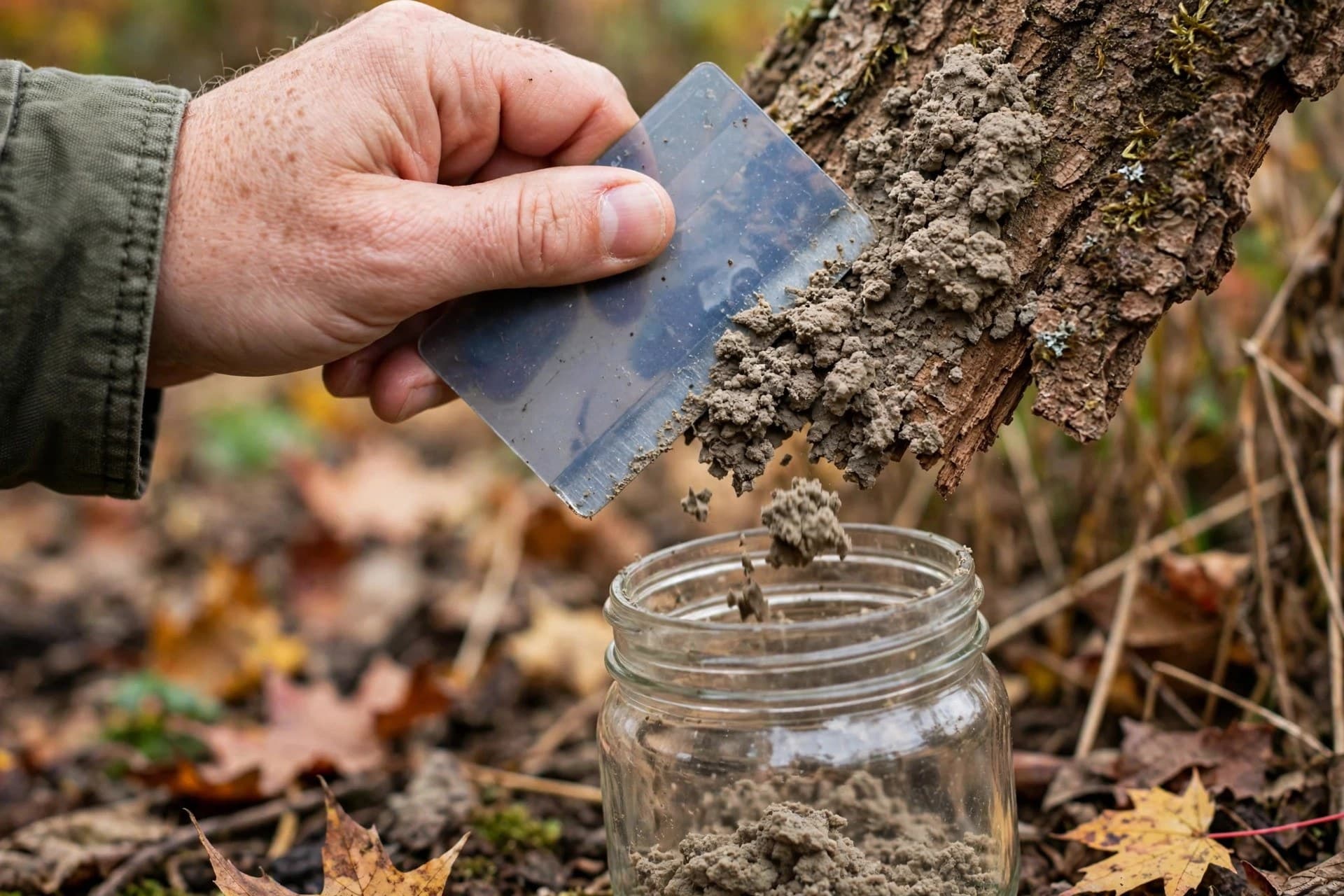

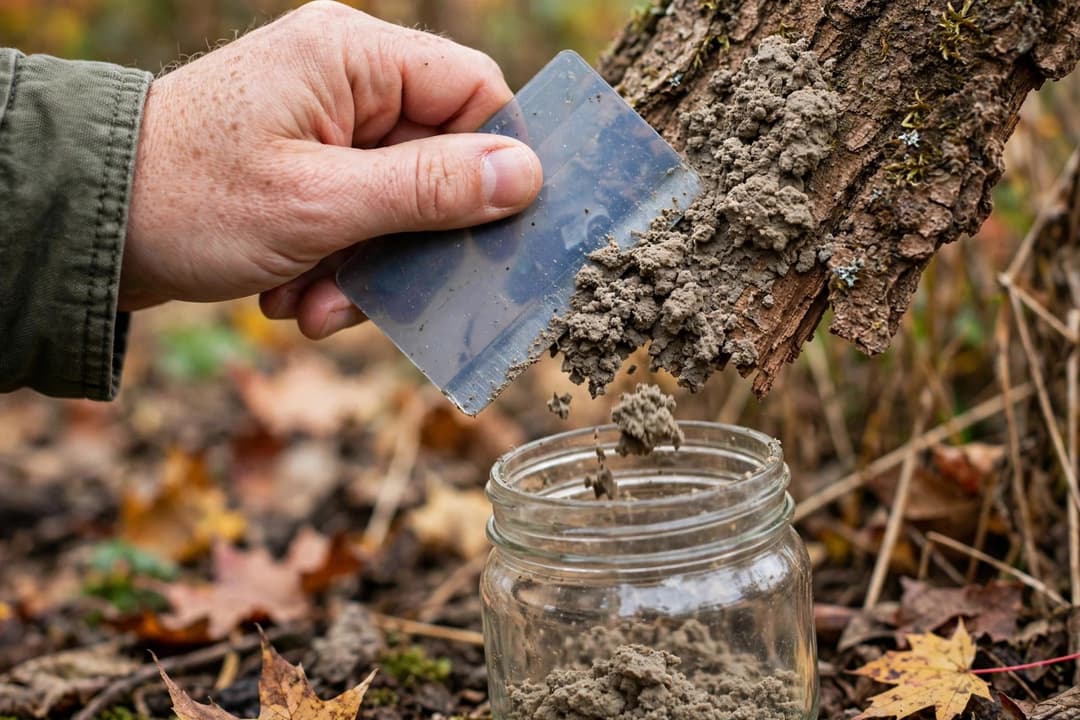
Yes — scrape them now. Penn State Extension's 2026 guidance is blunt: spotted lanternfly (SLF) egg masses are laid from late summer into early winter, and the majority of deposition happens in October — this exact week (Penn State Extension). The egg mass is the insect's only stationary stage, which makes it the one moment you can break the cycle by hand. Scrape reachable masses with a plastic card or putty knife into a bag of rubbing alcohol or hand sanitizer, and keep them in the solution permanently.
What an egg mass actually looks like
Fresh masses are about 1.5 inches long and brown or grey — like a smear of dried mud or putty (Penn State Extension). Inside, tiny eggs sit in rows, each roughly the size of a sharpened pencil point. When the female finishes laying, she covers the mass with a protective coating: it goes on white and glossy, then dries to dull grey-brown within hours. Some masses never get the cover (the female was disturbed); those hatch about 10% less, but still hatch.
Old masses from prior years can still be sitting on your trees. Check two things: a fresh mass still has its coating intact, and it has no emergence holes. After spring hatch, each egg has a small oval "hatch door" at the top — if you see those ovals, the nymphs already left.
Where to look — and what to check first
Start with the trees the adults fed on all summer. Late in the season Penn State points to red maple, silver maple, and willows, but females also lay on black cherry, pine, rocks, picnic tables, patio furniture, and the undersides of limbs — anything horizontal or angled toward the ground (Penn State Extension). They prefer to lay next to existing masses, so expect clumps, not singles.
Be honest about your reach: researchers found that on large maples, less than 2% of egg masses sit within reach (0–10 feet) (Penn State Extension). Get the ones you can touch. Do not climb trees or use ladders.
The right way to destroy them
The rule most people get wrong: do not scrape them onto the ground. Egg masses knocked loose can still hatch. Scrape them into a bag or container of rubbing alcohol or hand sanitizer and leave them in it permanently — Ohio State Extension's Mike Hogan gives the same instruction for fall 2026 (The Columbus Dispatch).
You can also smash them in place, but Penn State warns the pressure must be even and forceful across the whole mass — a properly smashed mass bursts open. For masses you can see but cannot reach, horticultural oils (paraffinic or mineral oil, at least 3% concentration) killed up to 75% of treated eggs in 2018–2019 trials (Penn State Extension). Physical removal still beats oil for anything within arm's reach.
One more job before winter
Spotted lanternflies ride to new territory on our stuff. Before you move firewood, camping gear, outdoor equipment, or vehicles, inspect them and remove any masses (Penn State Extension). USDA APHIS reports 19 states plus the District of Columbia now have some degree of infestation — the quarantine map keeps growing (USDA APHIS). If you find an egg mass outside your state's known quarantine area, photograph it, destroy it, and report it to your state agriculture department right away (Penn State Extension).
Keep expectations honest
Penn State is candid: scraping reduces next spring's nymph and adult numbers, but it will not eliminate the population from your neighborhood — neighbors' trees and unreachable masses will still hatch. Think of October egg-mass duty as the opening move, not the whole battle: plan nymph defenses like circle tree traps for spring.
Quick answers
Will scraping wipe out the lanternflies in my yard?
No — but each mass you destroy removes up to 50 lanternflies from next year's generation (Penn State Extension). With females laying at least two masses each, the math compounds fast.
Can I just knock the masses off the tree?
No. Dislodged masses can still hatch on the ground. Collect them into rubbing alcohol or hand sanitizer, or smash them thoroughly in place.
How do I know if a mass is fresh or two years old?
Fresh = coating still present, no emergence holes. Old = oval holes at the top of each egg, coating weathered or gone.