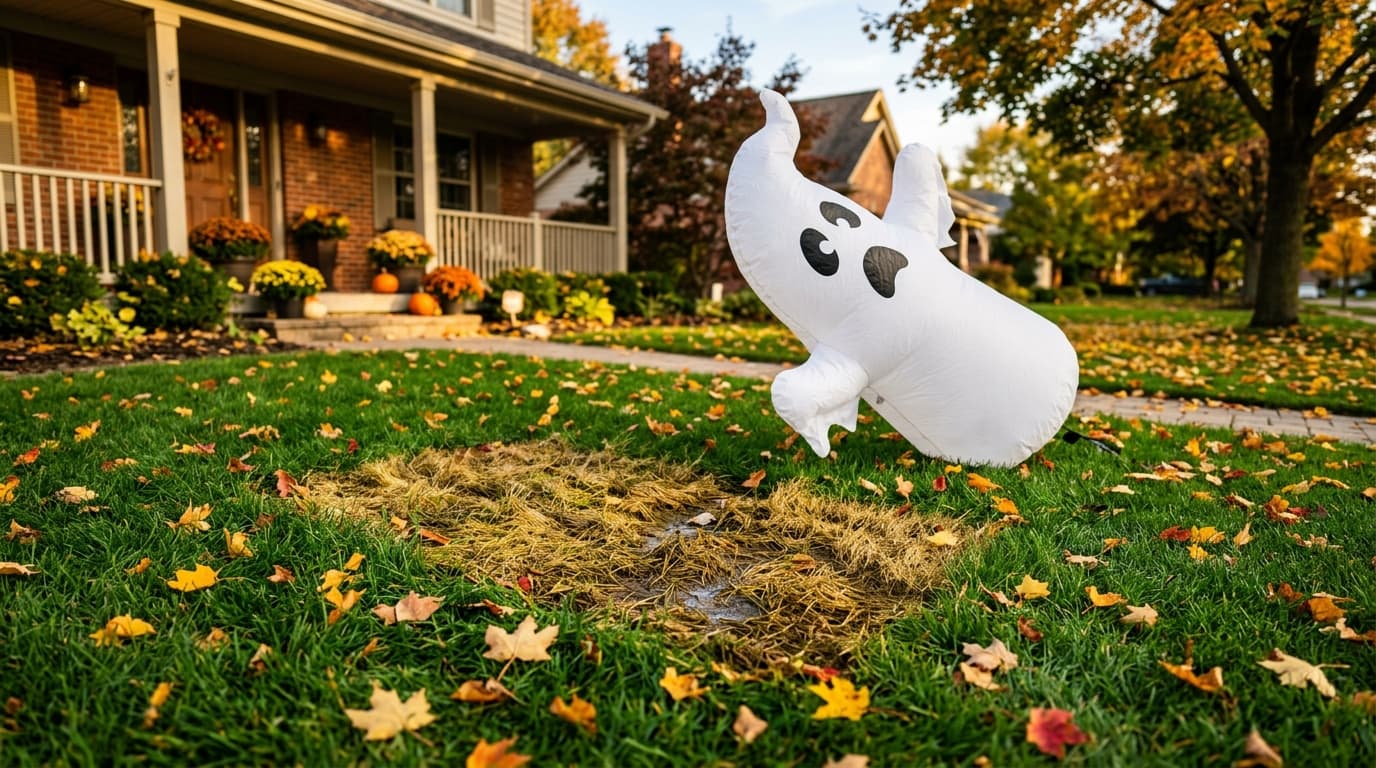

Yes — park a Halloween inflatable on the same patch of lawn for a couple of weeks, and the grass underneath can die. Louisiana State University's AgCenter warns that debris left piled on turf for several weeks kills the grass beneath it, because actively growing grass needs light and air to survive — without those two elements, it dies. A big inflatable sitting in one spot for all of October is exactly that kind of cover.
That's the bill hiding under your ghost: not the electricity, but the dead yellow rectangle waiting when the decoration finally comes down. Sprouty's rule is simple — move the inflatable every few days, or don't be surprised by the lawn-repair bill.
Sophie lifts the deflated ghost and finds the dead patch underneath. Sprouty explains the suffocation — and the two-second fix.
Why the Grass Dies Underneath
Two things happen under that vinyl shell, and both are bad news:
- Light starvation. Grass is a plant — it needs sunlight to make and store food. The University of Iowa notes that mats left on lawns over winter smother and kill grass by blocking sunlight and airflow. An inflatable is a far more complete block than any leaf mat.
- Trapped moisture and heat. University of Georgia Extension explains that when turfgrass is covered by a nonpermeable material, humidity rises and the grass can't cool itself by evaporation — which can scald the turf. It looks water-soaked at first, then turns brown.
Deprived of light and air for weeks, the grass first turns thin and yellow, then dies outright — leaving a patch shaped exactly like your decoration.
How Long Is Too Long?
LSU AgCenter's rule of thumb: debris cleared within about two weeks in warm weather may reveal yellowed shoots that can still recover — much past that, the spot is dead. Halloween decorations typically go up in early October and stay until November. That's a month or more in one spot — well past the line.
Timing makes it worse: cool-season grasses are actively growing through October, so they're hit hardest right when they're trying to store food for winter.
Check: Dead or Just Sulking?
Lift the inflatable and look closely:
- Thin, yellow shoots may revive once sunlight returns — but ease them back in, since pale grass can scorch in sudden sun (LSU AgCenter).
- Green stolons or rhizomes under the brown top mean a real chance of recovery.
- Brown, papery, no green at the base — it's dead. Time to repair, not wait.
The Fix: Move It Every Few Days
The prevention costs nothing:
- Rotate the inflatable to a fresh spot every few days. No patch of grass should spend more than a week under cover.
- Deflating between shows helps, but isn't enough alone — the fabric still blocks light while it's down. Rotation is the real fix.
- Park big decorations on non-turf surfaces when you can — a mulch bed, patio edge, or driveway apron spares the lawn entirely.
Repairing a Dead Patch (Act Fast)
Found the yellow rectangle already? The calendar is working against you: Iowa State University Extension notes that the best window for seeding cool-season grasses runs late summer through about the end of September, and the odds of success drop with each day past October 1st. Seed immediately for a slim chance — or plan the repair for spring.
Your options:
- Reseed: rake out the dead grass, loosen the soil, spread seed, and keep it consistently moist.
- Sod patch: cut a piece of sod to fit for instant coverage — the fastest fix for a decoration-shaped hole.
Don't wait for it to fill in on its own. LSU AgCenter warns that large dead spots rarely repair themselves — weeds and unwanted grasses from seed are what usually move in first.
🎃 Sprouty's Take
About that "$80 lawn bill" in the video — that's a headline number, not a quote. Your real cost depends on the patch: a small spot is a few dollars of seed and a weekend of watering; a big ghost-shaped rectangle might mean sod. Either way, the cheapest repair is prevention, and prevention is free: move the ghost every few days.
FAQs
Does deflating the inflatable every night prevent damage?
Mostly — but the fabric still blocks light and air while it's lying flat. Nightly deflating plus rotating positions every few days is the combination that actually works.
Does it matter what kind of grass I have?
Yes. Cool-season grasses (bluegrass, fescue, ryegrass) are actively growing in October, so they're the most vulnerable. Warm-season grasses heading into dormancy tolerate cover longer — but "longer" isn't "forever."
Will the dead patch fill in by itself?
Unlikely for a large spot. Expect weeds to colonize it first. Reseed or sod it — and do it soon, since the fall seeding window is closing.
What about staking the inflatable down — does that help?
Stakes stop it blowing away, but they don't solve the smothering. Only moving the footprint — or getting it off the turf — does that.
Related fall lawn reading: the fall overseeding window for patchy lawns, leaves vs. lawns — the same smothering rule, and timing your fall garden work to real frost dates.