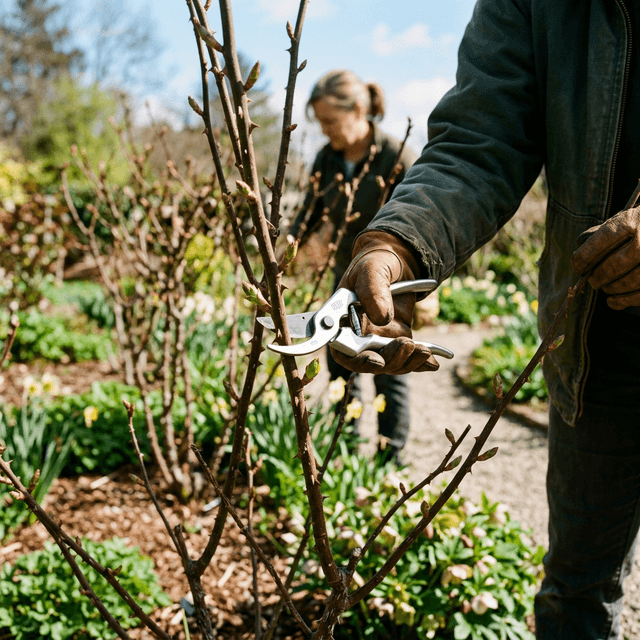
Most pruning mistakes aren’t bad cuts. They’re good cuts made at the wrong time, or too many cuts made at once. Get the timing right, cut in the right place, and pruning becomes one of the simplest ways to keep shrubs and trees healthy, shapely, and full of flowers.
This guide covers the basics every gardener needs: why to prune, which tools to use, when to cut each kind of plant, how to make a clean cut, and how to rescue an overgrown shrub without killing it.
🌱 The short version: Prune most trees and shrubs in late winter to early spring, before new growth starts. Prune spring bloomers right after they flower. Cut just outside the branch collar, leave no stub, and skip the wound paint. Not sure about a specific plant? Sprouty’s free When to Prune tool gives a prune-now, wait, or don’t answer for 21 common plants.
1) Why Prune at All?
Pruning changes how a plant grows. A few well-placed cuts can:
- Remove problems — dead, broken, or diseased branches that invite pests and decay.
- Improve structure — especially on young trees, where early training builds a strong frame for decades.
- Keep a shrub in bounds — so it fits its space without constant shearing.
- Renew tired plants — older shrubs often bloom better after their oldest stems are replaced by young ones.
University of Minnesota Extension describes pruning as preventive maintenance for insect and disease damage as well as a way to shape plants. In other words, it’s not just cosmetic.
What pruning can’t do is turn a plant that is too big for its spot into a small one. If you find yourself cutting the same shrub back hard every year, the long-term fix is usually a smaller plant.
2) The Right Tools for Each Cut
Using a tool that is too small crushes stems and leaves ragged wounds. Match the tool to the branch:
| Tool | Best for |
|---|---|
| Hand pruners | Stems up to about ¾ inch thick — most shrub and perennial work |
| Loppers | Long handles give leverage for branches up to about 1½ inches |
| Pruning saw | Branches over about 1 inch thick |
| Chainsaw | Large limbs — never above your shoulders or from a ladder; hire a certified arborist for big tree work |
Keep blades sharp and clean. A sharp blade makes a smooth cut that closes faster, and wiping blades clean between plants helps avoid carrying disease from a sick plant to a healthy one.
3) When to Prune: The Big Rule
For most woody plants, the late dormant season — late winter to early spring — is the best time to prune. The plant is leafless, so you can see its structure, and it is about to grow, so cuts close quickly.
The exception is when the plant flowers:
- Spring-flowering shrubs (lilac, forsythia, azalea, bigleaf hydrangea) bloom on buds they formed last summer. Prune them right after they finish flowering. Prune them in fall or winter and you cut off this spring’s flowers.
- Summer-flowering shrubs (panicle hydrangea, butterfly bush, crape myrtle) bloom on new growth. Prune them before spring growth begins.
| Plant | When to prune | Check it |
|---|---|---|
| Lilac, forsythia | Right after flowering | Lilac · Forsythia |
| Azalea, rhododendron | Right after flowering | Azalea |
| Hydrangea | Depends on the type — bigleaf after bloom, panicle in late winter | Hydrangea |
| Roses | Repeat bloomers in late winter; once-bloomers after flowering | Rose |
| Crape myrtle, butterfly bush | Late winter, before growth | Crape myrtle · Butterfly bush |
| Apple and pear | Late winter while dormant | Apple & pear |
| Oak | Dormant season only — never April to October in oak-wilt areas | Oak |
For the month-by-month answer in your climate, use When to Prune with your ZIP code.
4) Trees and Shrubs With Special Timing
A few plants break the general rule. Get these wrong and you can invite disease or a sappy mess:
- Oaks: University of Minnesota Extension says not to prune oaks from April to October. Fresh cuts in the growing season attract the beetles that spread oak wilt, a disease that can kill the tree.
- Maples and birches: They “bleed” sap if pruned in late winter. Prune them after their leaves are fully expanded in late spring or early summer.
- Apples, pears, and their relatives: Spring and summer pruning raises the chance of fire blight, a bacterial disease. Prune them while dormant.
- Anything in fall: Autumn or early-winter pruning is more likely to cause drying and dieback at the cut, and late-fall pruning can push tender new growth that cold weather injures.
5) Thinning vs. Heading: Two Kinds of Cut
Almost every pruning cut is one of two kinds:
- Thinning cuts remove an entire branch back to where it starts — at the trunk, a larger branch, or the ground. Thinning opens up the plant, lets light into the middle, and keeps a natural shape. This is usually the cut to reach for.
- Heading cuts shorten a branch partway along its length. They trigger a burst of new shoots just below the cut. Used everywhere, heading — including shearing — leaves a shrub stemmy and top-heavy, with leaves only on the outside.
If you do need to shorten stems, Clemson Extension suggests heading back to several different heights rather than one flat line, so the shrub stays fuller from top to bottom.
6) How to Make a Clean Cut
Small stems: cut above a bud
Cut about ¼ inch above a healthy bud, on a slight slant. Choose a bud that faces outward — the new branch will grow in the direction the bud points, which keeps the center of the plant open.
Branches: cut at the branch collar
Where a branch meets the trunk, there is a slightly swollen ring of bark called the branch collar. Cut just outside it — close, but don’t cut into the collar and don’t leave a stub. The collar is where the tree seals the wound.
Skip the wound paint
Wound dressing is not normally needed on pruning cuts. A clean cut at the collar closes on its own. Sprouty’s article on why not to seal rose pruning cuts explains why sealing can make dieback worse.
7) The Three-Cut Method for Heavy Branches
A heavy branch cut in one go tends to tear, ripping a strip of bark down the trunk. Use three cuts instead:
- Undercut: about 18 inches out from the trunk, cut upward from underneath, one-third to halfway through the branch.
- Top cut: an inch farther out, cut down from the top until the branch breaks free. The undercut stops the bark from tearing.
- Final cut: remove the remaining stub just outside the branch collar.
For limbs high in a tree or near power lines, hire an ISA-certified arborist.
8) How Much Can You Remove?
Less than you think. For established shrubs, the usual routine is to remove up to one-third of the oldest, thickest stems each year, cutting them right down to the ground. For trees, University of Minnesota Extension advises never removing more than a quarter of the live foliage at once.
Taking too much at once stresses the plant and often triggers a thicket of weak, upright shoots — the opposite of what you wanted.
9) Renewing an Overgrown Shrub
Many multi-stemmed deciduous shrubs can be brought back from overgrown and leggy. There are two approaches:
Gradual renewal (safer)
Spread the work over three years, before spring growth begins:
- Year 1: remove one-third of the old, mature stems at ground level.
- Year 2: remove half of the remaining old stems.
- Year 3: remove the rest of the old wood, and head back any long new shoots.
Hard rejuvenation (faster)
Some tough shrubs can be cut back to 6–12 inches above the ground in late winter or early spring. Within a growing season they can look like new plantings — but you will likely lose that year’s flowers, and not every shrub tolerates it. When in doubt, use the gradual method.
10) Pruning Young Trees
The first few years shape a tree for life. At planting, remove only dead, diseased, or broken branches. After that, prune lightly each dormant season to build a strong structure — and don’t cut back the central leader, the main upward stem.
Early training with small cuts prevents the large, risky cuts a neglected tree needs later.
11) Common Pruning Mistakes
- Fall “haircuts” on spring bloomers. Pruning lilacs or forsythia in September removes next spring’s flowers. See why pruning lilacs in September deletes May’s flowers.
- Topping crape myrtles. Hard heading cuts aren’t needed for flowers and leave knobby, weak regrowth.
- Leaving stubs or cutting into the collar. Both slow healing.
- Shearing everything into balls. It thickens the outside and starves the inside of light.
- Taking too much at once. Stick to the one-third rule for shrubs.
More in 7 Pruning Mistakes That Are Killing Your Plants.
12) Frequently Asked Questions
What is the best time of year to prune?
For most trees and shrubs, late winter to early spring, before new growth starts. The big exceptions are spring-flowering shrubs, which you prune right after they bloom, and oaks, maples, and birches, which have their own timing.
Can I prune in the fall?
It’s best avoided. Fall and early-winter cuts are more likely to dry out and die back, and late-season pruning can push tender growth that cold weather damages. Removing dead, broken, or diseased wood is fine any time.
Should I seal pruning cuts?
No. Wound dressing is not normally needed. A clean cut just outside the branch collar seals naturally.
How much of a shrub can I cut off at once?
For routine pruning, up to about one-third of the oldest stems a year. For badly overgrown shrubs, renew them over three years instead of cutting everything at once.
Where exactly do I cut?
On small stems, about ¼ inch above an outward-facing bud. On branches, just outside the branch collar — the slightly swollen ring where the branch joins the trunk — without leaving a stub.
How do I know when to prune a specific plant?
Use Sprouty’s free When to Prune tool. Pick the plant and your ZIP code, and it tells you whether to prune now, wait, or not prune this month, with the Extension source.
13) Sprouty’s Pruning Checklist
- ☐ Know when the plant flowers — on last year’s wood or new growth
- ☐ Prune most woody plants in late winter, before buds break
- ☐ Prune spring bloomers right after flowering
- ☐ No oak pruning from April to October
- ☐ Sharp, clean tools sized to the branch
- ☐ Thinning cuts first; heading cuts only where needed
- ☐ Cut ¼ inch above an outward bud, or just outside the branch collar
- ☐ Three cuts for any heavy branch
- ☐ No more than one-third of a shrub’s oldest stems a year
- ☐ No wound paint
Sources
- University of Minnesota Extension · Pruning trees and shrubs
- Clemson Cooperative Extension (HGIC) · Pruning shrubs
- Clemson Cooperative Extension (HGIC) · Pruning roses
- Clemson Cooperative Extension (HGIC) · Crape myrtle pruning
Keep Growing With Sprouty
Check any plant’s timing for your climate with When to Prune, see what else is due this month in the Garden Calendar, read the spring Prune, Clean Up & Divide guide, and browse all our Pruning articles.