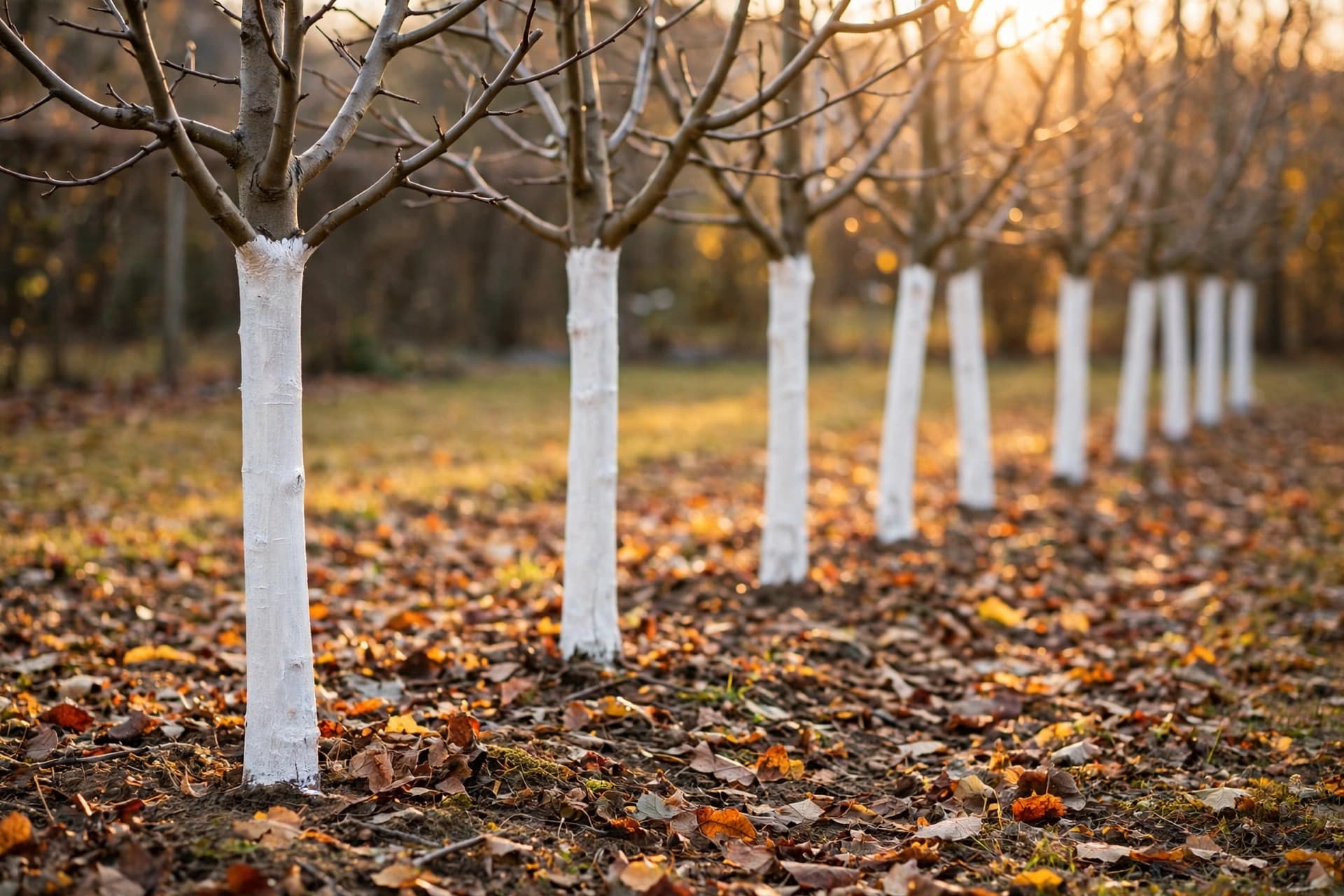

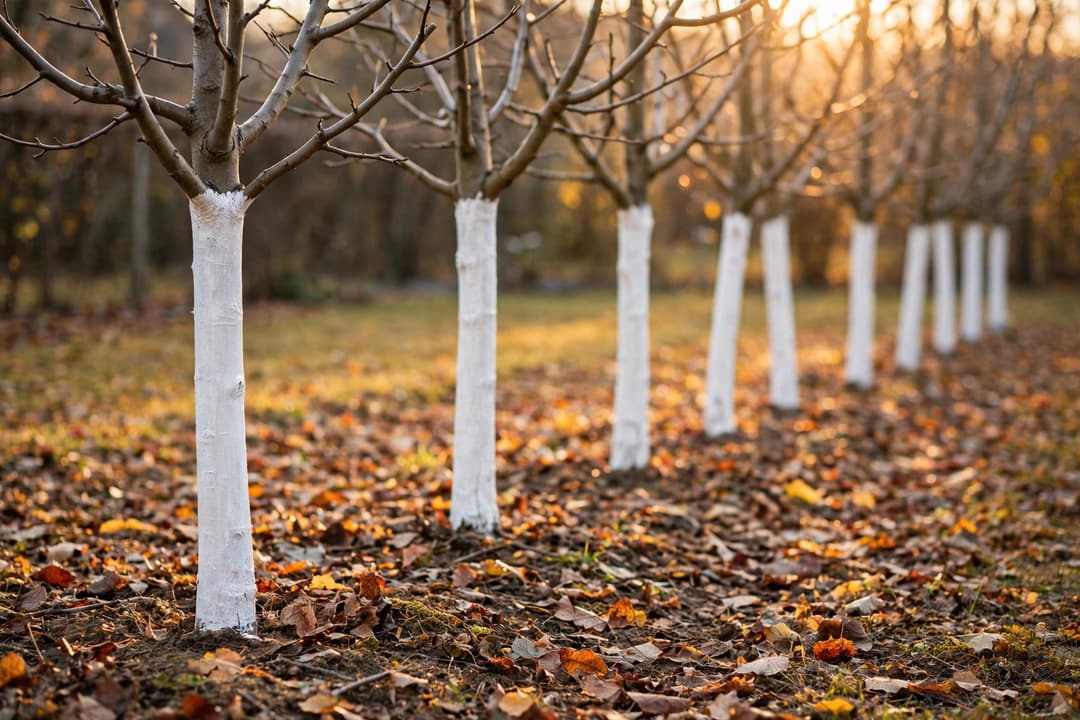
Those white tree trunks are sunscreen, and late fall is when it goes on. On a clear winter day, dark bark can heat well above freezing even while the air sits below 32°F — and when the sun drops or a cloud passes, the bark temperature plunges and ice forms in the tissue. The cells that woke up in the afternoon sun freeze and die, the bark splits, and the wound is called sunscald, or southwest injury, per the University of Idaho Extension. A coat of diluted white latex paint reflects the sun and keeps the swing small. That is the whole trick, and it costs about as much as a brush and a can of paint.
Sophie: “Wait — the sun burns trees in winter? I thought sunburn was a summer problem.”
Sprouty: “Summer has its own version. But winter is the sneakier one — the damage happens because the bark warms up and then freezes, not because it stays hot.”
What sunscald actually is
Sunscald is a temperature injury, not a disease — though it opens the door to plenty of them. The University of Idaho Extension describes it plainly: a trunk exposed to direct afternoon sun on a clear day with air temperatures below 32°F can itself be well above 32°F, depending on bark color, moisture, and wind. When the sun is hidden by clouds, buildings, or the horizon, the trunk temperature often drops rapidly to the point at which ice forms in the bark and wood. The University of Arkansas Extension adds the detail that the thaw-and-refreeze most likely happens near sunset, or during the day as clouds pass and block the sun — the swing, not the cold alone, is what kills the cells.
Honest caveat first: the exact mechanism is still debated. Idaho's bulletin says the actual cause or causes of sunscald are still not fully understood, but seem to involve rapid temperature changes, repeated freezing and thawing, and a bleaching effect from intense sunlight. Arkansas cites University of Minnesota research linking the tissue death to moisture stress as well. What every source agrees on is the pattern: sunny day, freezing night, damage on the sun-struck side — most often the southwest side of the trunk, where the afternoon sun hits hardest.
There is also a summer version. Idaho notes sunscald strikes when a shaded tree is suddenly exposed to direct sun — transplanting from a shady nursery spot to an open site, removing a shading building or tree, or heavily topping a tree all create the conditions. Arkansas calls summer sunscald death of bark tissue from lethal temperatures, most common on the lower section of young trunks on the south or southwest side. Same injury, different season — which is why the white paint stays useful year-round.
Which trees are most at risk
Young trees with thin, dark bark. Idaho's susceptible list is long: apple, cherry, peach, London plane, elm, horse chestnut, linden, oak, willow, beech, goldenrain tree, and walnut. The University of Arizona Cooperative Extension names ash, maple, mimosa, walnut, pecan, and deciduous fruit trees as the most susceptible in its region, and notes young trees are more vulnerable than mature ones because their bark is thinner. Washington State University puts it simplest: newly planted trees, and trunks or branches recently exposed by heavy pruning, are most at risk.
How the tree was grown matters as much as the species. Arizona points out that sunscald is rare in natural areas, where trees grow up as small shrubs with low branches shading their own trunks. A major factor in planted trees, it says, is our habit of buying young trees with their lower branches already pruned up to look “tree-like” — the trunk is left bare to the sun from day one. Where possible, buy young trees that still have a few lower branches, and avoid pruning those lower branches off for the first few years after planting.
Reflected light makes it worse. Arizona warns that light-colored buildings, fences, and block walls reflect extra light and transfer heat onto trunks during winter days. Idaho adds light-colored pavement and snow cover, which bounces intense sunlight back against the trunk. A young fruit tree planted against a pale south-facing wall is getting sun from both sides at once.
How to spot it
Early sunscald is easy to miss. Arizona describes mild symptoms as discolored reddish or brownish bark; Arkansas adds small vertical cracking and, in spring, a little “bleeding” from the damaged area. If you suspect damage and are unsure, Arizona suggests a small test cut with a sharp, clean knife: if the inner bark is soft and green, it is still alive; if it is brittle and falls away to expose wood, the tissue is dead.
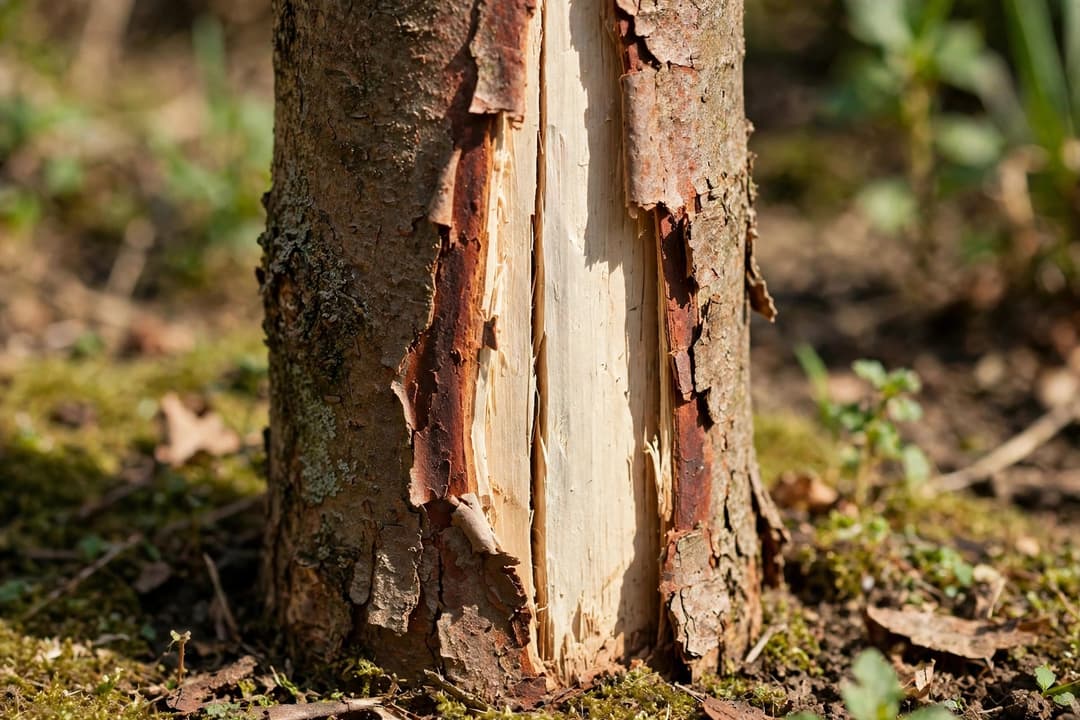
Damage often is not visible until late winter or spring, when growth begins and the bark loosens, per Kentucky. Left alone, it escalates. Advanced symptoms are sunken or split bark that peels back to expose the wood, per Arizona, and Arkansas describes the late stage as a classic vertical fissure down to the interior wood with exfoliating bark. The crack is an open door: University of Kentucky notes the wounds are slow to heal and provide a point of entry for insects and diseases, and limb breakage can result. Idaho warns that a tree killed by canker or rot may initially have been injured years earlier by sunscald — intact bark normally keeps fungi and bacteria out, and a sunscald wound lets them in. Arizona is blunt about the endpoint: over time, sunscald damage can lead to chronic disease and tree death, and Arkansas adds that a very large wound is a likely spot for the trunk to fail and break.
How to whitewash a trunk
Pick your trees first. Young, thin-barked trees — especially fruit trees — are the priority, and Idaho advises keeping orchard and home-garden fruit trees painted white throughout their lives. Ornamental trees need protection from the time they are transplanted until at least two years after, longer if they sit next to pale pavement or still have thin bark.
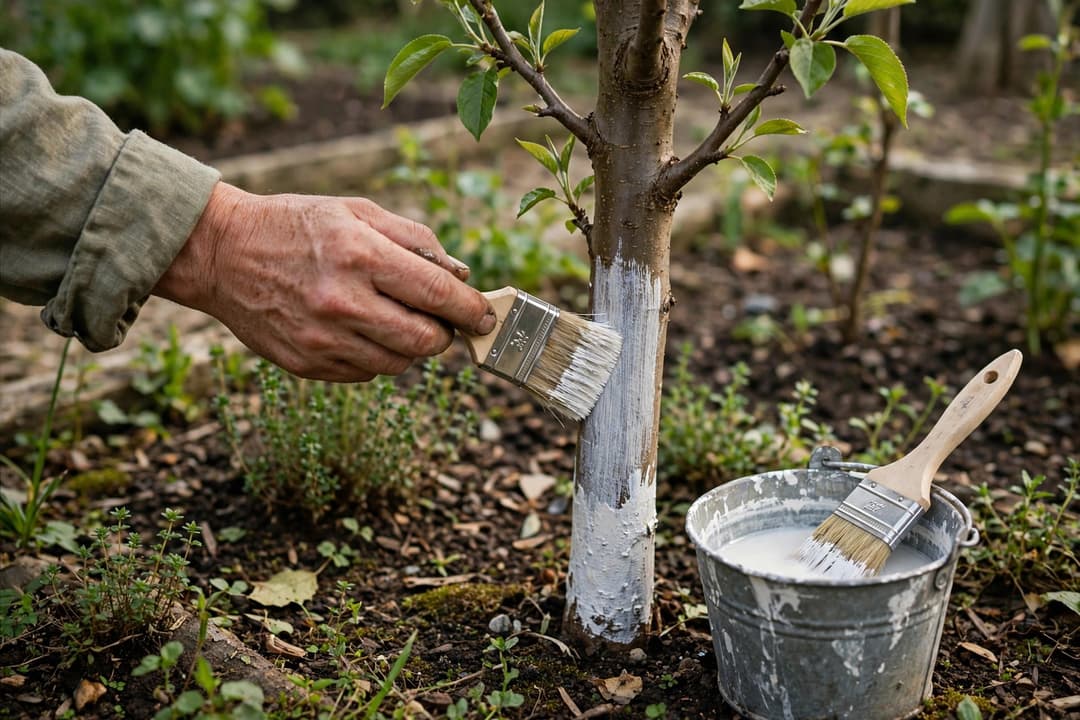
1. Mix the paint. Use white interior latex paint, diluted roughly half-and-half with water — the 50-50 ratio shown in Washington State University's photo of a painted young cherry trunk. Idaho itself specifies the paint type, not a ratio: interior white latex only, and no enamel or exterior paints, which may contain chemicals that can injure plants. Kentucky's peach guide allows white exterior latex paint as well — but Idaho's caution still stands, so interior latex is the safer default and exterior latex is a second choice, not an equal one.
2. Time it for late fall. Kentucky says to protect young trunks late in autumn; Idaho says to paint in fall or spring, when leaves are absent. Read practically, that means November to early December for most gardeners in mild climates — wherever you are, the rule is after leaf drop, before the first hard freeze, on a dry day so the paint dries before nightfall. Spring is Idaho's fallback if fall slips by. One fall coat is the usual routine, covering the late-winter sun that warms bark just as growth begins — check it in late winter and touch up any thin or bare spots.
3. Paint the right places. Brush from the ground up to the first branches, covering the trunk and the major scaffold limbs that face south or west — Idaho's instruction — and paint the tops of horizontal, exposed scaffold limbs with indoor latex paint, per Kentucky. Do not paint small branches.
4. Keep it up. Refresh the coat each fall — Idaho's advice is to keep orchard trunks painted for the life of the tree. One side benefit Idaho notes: the white coating may retard budbreak slightly by slowing how fast the tree warms in spring, and delaying budbreak by several days can help dodge spring frost losses.
What not to do
Do not use oil-based paint or enamel. Idaho warns that enamel and exterior paints may contain chemicals that can injure plants, and Arkansas says to make sure any paint used is not toxic to plant tissue. As the author's own caution, not a sourced claim: oil-based paint is best avoided on living bark.
Do not paint a wound to “seal” it. If the bark is already split, Arkansas says loose pieces of bark can be removed, but avoid cutting or tearing into healthy tissue, and pruning paints should not be applied to the wound area. Whitewash is prevention, not a bandage.
Do not wrap the trunk tightly. Wraps are the alternative (below), but Idaho warns that tight wrappings press on growing bark and can girdle the trunk. Snug, not strangling.
Do not use black or dark wraps. Arkansas is explicit: dark-colored tree wrap intensifies the temperature problem instead of fixing it.
Do not shade the leaves to shade the trunk. Idaho's warning: when blocking sunlight to protect a trunk, be sure not to shade the leaves — they produce all the plant's energy, and a shaded tree is a weakened tree.
Do not send the tree into winter thirsty. Idaho advises providing ample moisture to reduce sunscald and not letting plants go into or through the winter in a water-stressed condition. Arkansas notes the water-stress link itself has never been confirmed by research — watering is still recommended to reduce overall tree stress.
Wraps and guards if you would rather not paint
Paint is not the only light-colored shield. Arkansas lists rigid corrugated plastic tree guards, kraft paper tree wrap, and breathable white fabric wrap as the most common options, and Idaho adds paper tree-wrapping tape, burlap strips, and split PVC pipe tied around the trunk. Washington State University recommends wrapping the trunks of recently transplanted trees with a white or light-colored bark wrap in the fall, especially younger trees or ones with dark bark.
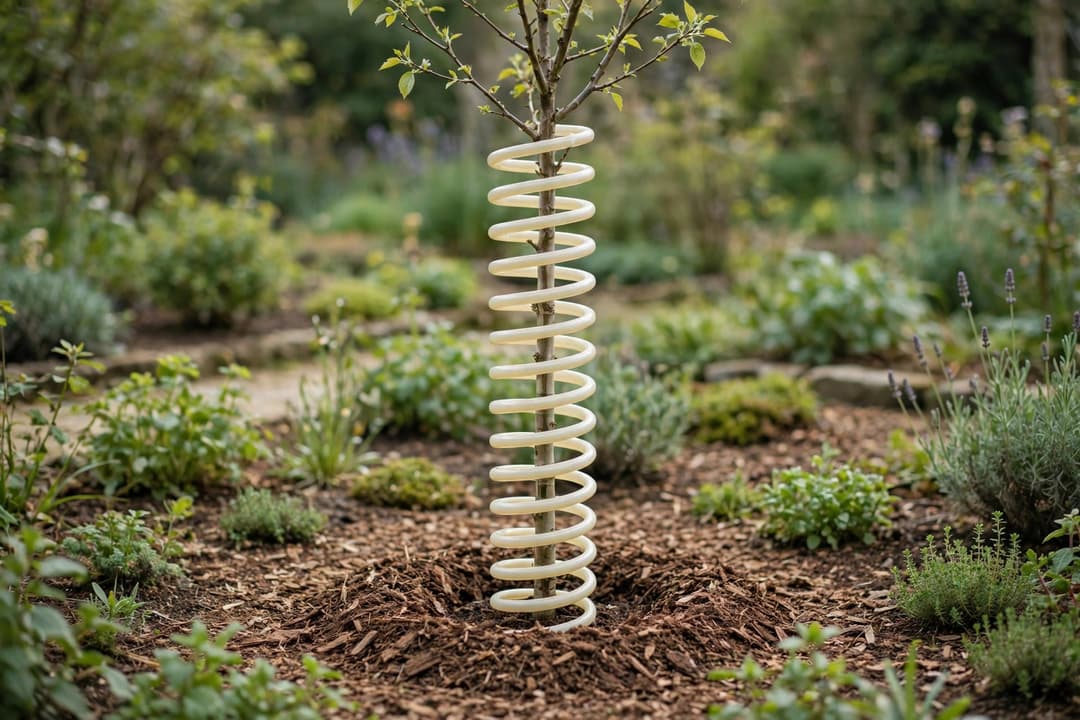
Wraps stay on longer than paint. Arkansas says trunk-shading materials need to stay in place for several years, until the trunk grows thick, textured bark or the canopy widens enough to shade the trunk itself — and to check the fit as the trunk expands so the material does not girdle it. Idaho adds a maintenance habit: remove tree wraps after one year, inspect the trunk for borer damage, and reapply if needed, since wraps can hide insects. Arizona flags the same hiding-place risk. Arkansas offers some reassurance here: while wraps may raise moisture or shelter insects, research has not shown those issues to cause increased problems for the tree.
One honest note on the pest claim: whitewash is sometimes credited with deterring borers and rodents, but none of the extension sources linked here makes that claim — paint the trunk for the sun and treat any pest benefit as unproven.
Quick answers
When exactly should I paint my tree trunks white?
Late fall — in practice, November to early December for most gardeners in mild climates — after the leaves have dropped and before the first hard freeze, on a dry day. Kentucky says late in autumn; Idaho says fall or spring, when leaves are absent, so spring is the fallback if fall slips by. One fall coat is the usual routine, covering the late-winter sun that strikes just as growth begins.
Will the paint hurt my tree?
Not if it is the right paint: white interior latex, diluted roughly half-and-half with water — the ratio shown in Washington State University's photo of a painted cherry trunk; Idaho specifies interior latex only. Use interior white latex only: Idaho warns enamel and exterior paints may contain chemicals that can injure plants. As the author's own caution, not a sourced claim: oil-based paint is best avoided on living bark. The white coat may slightly delay budbreak in spring — Idaho notes delaying budbreak by several days may help reduce spring frost losses in some plantings.
My trunk already has a split — can whitewash fix it?
No. Whitewash prevents sunscald; it does not heal it. Arkansas says you can remove loose pieces of bark, but do not cut into healthy tissue and do not apply pruning paint to the wound. Protect the tree from further sun with paint or a light-colored guard, and watch the wound — small ones may callus over, per Arizona, while very large ones can lead to decline or trunk failure.
Does this matter in mild California winters?
It still matters. The injury needs a sunny day plus a freezing night, so where winters rarely freeze hard the risk is lower — Arkansas notes winter sunscald is less common there than summer sunscald. But young thin-barked fruit trees are still at risk, especially next to pale walls or pavement that reflect extra heat, and the summer version strikes whenever heavy pruning suddenly exposes bark to direct sun. If you grow peach or apple and your winters bring even occasional frost, the November coat is cheap insurance.
How long do I keep doing this?
For fruit trees, for life — Idaho's advice is to keep orchard trunks painted white throughout their lives. For ornamental trees, until the bark thickens and toughens, which takes at least a couple of years after planting; wraps stay on for several years on the same logic, per Arkansas. Refresh the paint each fall.