
Every year, for about a week around the autumn equinox, Japan turns red. Along rice paddies, riversides, and temple paths, crimson blooms burst from bare, leafless stalks — flowers with no leaves anywhere in sight. This is higanbana, the red spider lily (Lycoris radiata), and it does everything backwards.
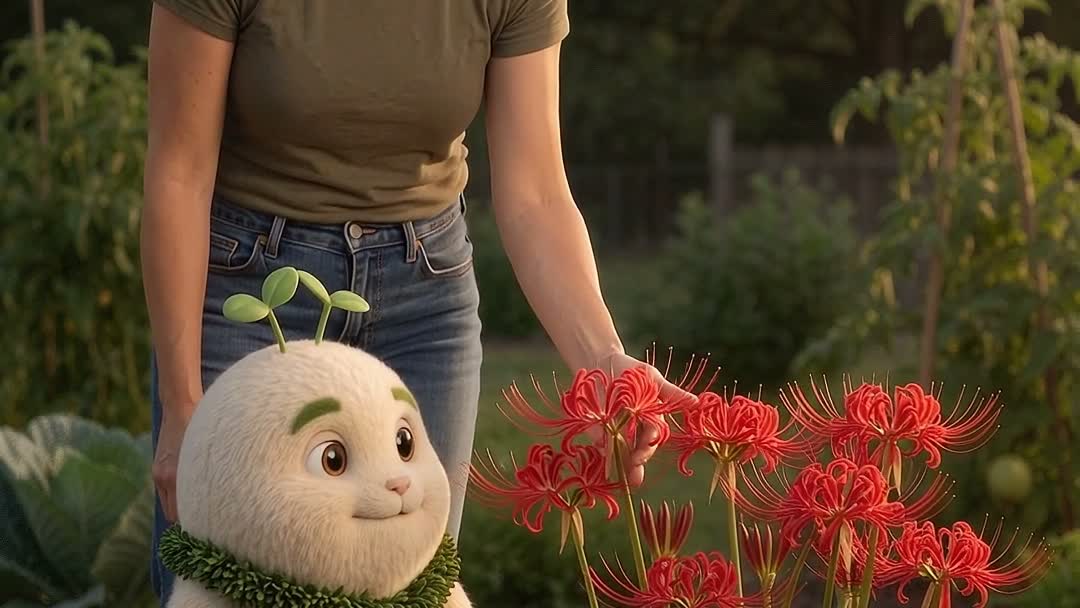
In Sophie's garden this week, a cluster of red spider lilies opened right on cue. As Sophie gently parted the spidery blooms at dusk, the conversation went like this:
Sophie: (Gently parting the red blooms with one hand) "These only bloom for the equinox — flowers first, leaves later. They never meet."
Sprouty: (Reaching a paw toward one bloom as if to pick it, then pausing and laying his paw back down) "So we never pick them as a bouquet."
Sophie: (Smiling softly) "Six hundred names for one flower."
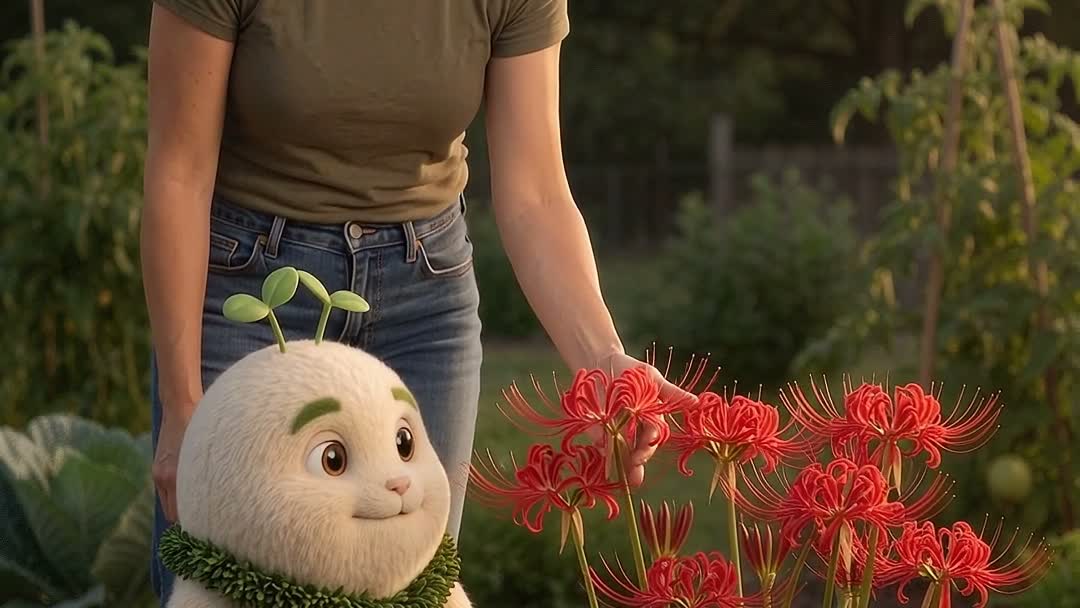
Backwards by Design: Flowers First, Leaves Later
Most bulbs grow leaves, then flowers. The red spider lily reverses the script. In late summer the bulb sends up a bare, leafless stalk, and the spidery crimson flower opens at its tip. Only after the blooms wilt and vanish do the strap-like leaves emerge — they photosynthesize through winter, store energy back into the bulb, and wither away in spring.
There is a Japanese saying for this: "hamizu hanamizu" — the leaves never see the flowers, and the flowers never see the leaves. It is also the root of the legend that two spirits, Manju (who tended the flowers) and Saka (who tended the leaves), were forbidden to meet — yet met anyway.
The Equinox Connection
The name higanbana (彼岸花) literally means "flower of higan" — the Buddhist observance around the autumnal equinox (September 22 or 23), a week when families honor their ancestors. The lilies bloom uncannily close to this period, which is why the flower is entwined with remembrance and farewell. In Buddhist thought it marks the crossing between this life and the next — "the other shore."
Poison with a Purpose
The bulbs contain lycorine, a toxic alkaloid — every part of the plant is poisonous. But that poison had a job: for centuries, Japanese farmers deliberately planted red spider lilies along the narrow ridges of rice paddies and around graveyards, because the toxic bulbs kept mice, moles, and other burrowing animals away from crops and graves.
In times of famine, people reportedly washed the bulbs repeatedly in water to leach out the poison and ate them as emergency food — desperation cooking, not a recipe to try.
Six Hundred Names for One Flower
The red spider lily may hold the record for the most aliases of any flower. Sources credit it with 600 names (some say 900, some say over a thousand regional variants). A few of the famous ones:
- Manjushage (曼珠沙華) — from the Lotus Sutra's mythical red flower
- Shibitobana (死人花) — "flower of the dead"
- Jigokubana (地獄花) — "hell flower"
- Yuureibana (ゆうれいばな) — "ghost flower"
- Soshikibana (そうしきばな) — "funeral flower"
Most of the names are ominous — which is why, in Japan, this is not a flower you hand to someone you love. It is beautiful, beloved, and best admired where it blooms.
Watch Sprouty & Sophie Among the Spider Lilies
The 10-second companion to this story — mystery and wonder at dusk, never morbid.
Frequently Asked Questions About Higanbana
When do red spider lilies bloom?
For roughly a week around the autumn equinox (September 22 or 23). The Japanese name higanbana literally means "flower of higan," the Buddhist equinox observance — the bloom timing is built into the name.
Why do red spider lilies have no leaves when they flower?
They grow backwards: the bulb sends up a bare stalk and flowers first. Only after the blooms fade do the leaves emerge, photosynthesizing through winter before withering in spring. The Japanese saying is "hamizu hanamizu" — the leaves never see the flowers, and the flowers never see the leaves.
Are red spider lilies poisonous?
Yes — the bulbs contain lycorine, a toxic alkaloid, and all parts of the plant are poisonous. That toxicity is exactly why farmers planted them along rice paddies and graveyards: to deter mice, moles, and other burrowing animals.
Why is the red spider lily called the flower of the dead?
Its bloom coincides with the equinox week when Japanese families honor ancestors, and it was traditionally planted around graveyards (partly to keep animals away from graves). It carries ominous folk names — hell flower, ghost flower, funeral flower — and in Japan it is not a flower you give to someone you love.
Explore More Seasonal Plant Stories
For more fall-season garden stories, browse our SproutySpeaks Fall Gardening Guide & Seasonal Cleanup Playbook, see why you should never pile mulch against tree trunks, and check our Interactive Garden Calendar for what to do in the garden right now.